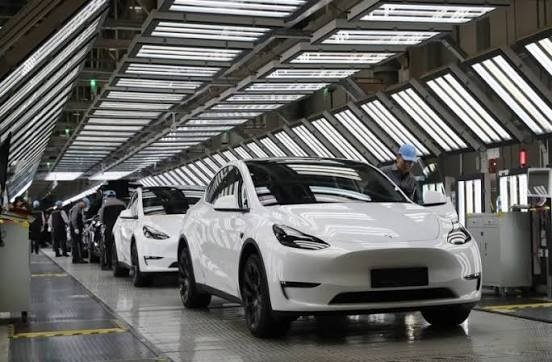
Nearly three million Teslas recalled in China over hidden door handles as flush design safety concerns escalate
Tesla is facing its largest safety action in China to date, with the automaker filing a recall covering nearly three million vehicles after regulators determined that the emergency door release mechanism inside its cars is too easy to miss in a crash. The filing, submitted to China’s State Administration for Market Regulation, applies to 2,975,910 vehicles spanning Tesla’s entire lineup sold in the country, including the Model 3, Model Y, Model S and Model X. It is the single biggest recall Tesla has ever issued in China, and it lands at a moment when the company’s signature flush door handle design, once celebrated as a hallmark of minimalist EV engineering, is drawing sustained scrutiny from regulators worldwide.
The problem, according to SAMR’s recall notice, has nothing to do with the sleek exterior handles that pop out when a driver approaches, the feature most people associate with Tesla’s styling. Instead, the concern centers on the manual backup release located inside the cabin, the mechanical lever drivers and passengers are supposed to use if the car’s electrical system fails after a severe impact. Regulators found that this interior release is colored so closely to the surrounding trim that occupants, and first responders arriving at a crash scene, may struggle to locate it quickly enough. In a worst case scenario, a collision severe enough to knock out the low voltage electrical system could leave both the automatic door buttons and the hidden manual backup effectively useless at the exact moment speed matters most.
Tesla’s fix does not involve tearing apart the door mechanism itself. Rather than a hardware overhaul, the company is rolling out a combination of physical warning labels marking the location of the manual release and an over the air software update that changes how the car behaves immediately after a crash is detected. Under the new logic, the vehicle will automatically lower all four windows the moment its sensors register a serious collision, giving occupants and rescuers an alternative way in or out even if the doors themselves remain stubbornly latched. The recall is scheduled to take effect on September 25, 2026, and Tesla has signaled that most affected owners won’t need to bring their car in for a manual repair, since the substantial portion of the fix arrives remotely.
What makes this moment notable isn’t just Tesla’s number, though 2.98 million vehicles is a staggering figure on its own. It’s the fact that Tesla wasn’t alone. Eight other automakers, including Xiaomi, Leapmotor, Xpeng, Geely, Chery, Dongfeng and BAIC BluePark, filed nearly identical recalls with SAMR on the same day for the same underlying issue, pushing the combined total past 4.3 million vehicles. That makes it the largest coordinated automotive safety action China’s regulator has ever undertaken, and it signals that Beijing is treating concealed and electronically operated door handles as a systemic industry problem rather than a Tesla specific defect. Xiaomi’s roughly 390,000 vehicle recall and Xpeng’s 264,000 vehicle action each represent the largest recalls those companies have ever issued, underscoring just how widely the flush handle aesthetic that Tesla popularized had spread across the Chinese EV market before regulators stepped in.
The timing is not coincidental. China has already announced that it will ban fully concealed, electronically operated door handles starting in 2027, becoming the first country to formally phase out a design choice that has defined a generation of electric vehicles. Under the new rules, every car sold in the country will be required to have door mechanisms that can be opened manually and intuitively from both the inside and outside, without relying on power or software to function. Regulators have been explicit about their reasoning: batteries and electrical systems can fail in a crash, and when they do, occupants need an escape route that doesn’t depend on electronics working correctly under duress.
This isn’t a concern that has stayed confined to China. In the United States, the National Highway Traffic Safety Administration has separately opened an investigation into reports that exterior door handles on 2021 Tesla Model Y vehicles failed to open, and the agency is said to be evaluating a related petition concerning whether Model 3 interior door releases pose similar risks during a crash or battery failure. NHTSA has also looked into electronic door handle issues involving other manufacturers, including past recalls tied to Ford and Fisker vehicles, suggesting the underlying engineering tradeoff, trading a simple mechanical latch for a sleeker, tech forward design, is facing a broader reckoning across the industry rather than being isolated to one brand or one country.
Bloomberg has reported that door handle failures have been linked to entrapment incidents and, in some cases, fatalities, though regulators in China have not detailed an exact death toll tied specifically to this recall. That ambiguity is likely to keep pressure on Tesla and its Chinese regulator alike, especially since the company’s chief designer told Bloomberg last year that Tesla was already working on reengineering its door handles even before this recall was filed, an acknowledgment that the flush handle concept, however visually distinctive, had accumulated enough real world safety questions to warrant a rethink.
For Tesla, the recall arrives at a delicate moment. China remains one of the company’s most important markets, home to its Shanghai Gigafactory and a growing base of price sensitive, tech literate buyers who have made Tesla one of the top selling EV brands in the country. A recall of this scale, even one resolved primarily through software, is the kind of headline that invites comparisons to legacy automakers grappling with entrenched hardware problems, a narrative Tesla has generally tried to avoid given its self image as a software first car company capable of fixing defects remotely and instantly. The fact that the remedy here leans almost entirely on an over the air update does reinforce that self image to some degree, but the underlying design flaw, one baked into the physical architecture of millions of vehicles already on the road, is not something a software patch alone fully resolves. Warning labels and auto lowering windows address the immediate safety gap, but they don’t change the fact that the mechanical backup remains, by regulators’ own description, difficult to identify and operate under exactly the conditions when it matters most.
In February, Chinese authorities announced a ban on hidden door handles.
Under new rules due to take effect on 1 January 2027, cars will only be allowed to be sold in China if they have a mechanical release on both the inside and outside of their doors.
Tesla’s door handles were also involved in a probe by US safety regulators after reports that they suddenly stopped working, leaving children trapped in the cars.
In July, the US National Highway Traffic Safety Administration suggested creating a new formal safety standard for all carmakers.
The agency told the BBC that it is reviewing whether it will require emergency door-exit systems in vehicles.
With China’s 2027 ban on concealed handles now locked in and other regulators watching closely, Tesla and the rest of the industry are likely heading toward a broader design shift, one where the minimalist door handle, long treated as a defining feature of modern EV styling, gives way to something closer to the tactile, unmistakable hardware that older cars relied on for decades.