|
Getting your Trinity Audio player ready...
|
DeepSeek’s Revenue Reaches $70 Million as of July, Tenfold Jump from 2025
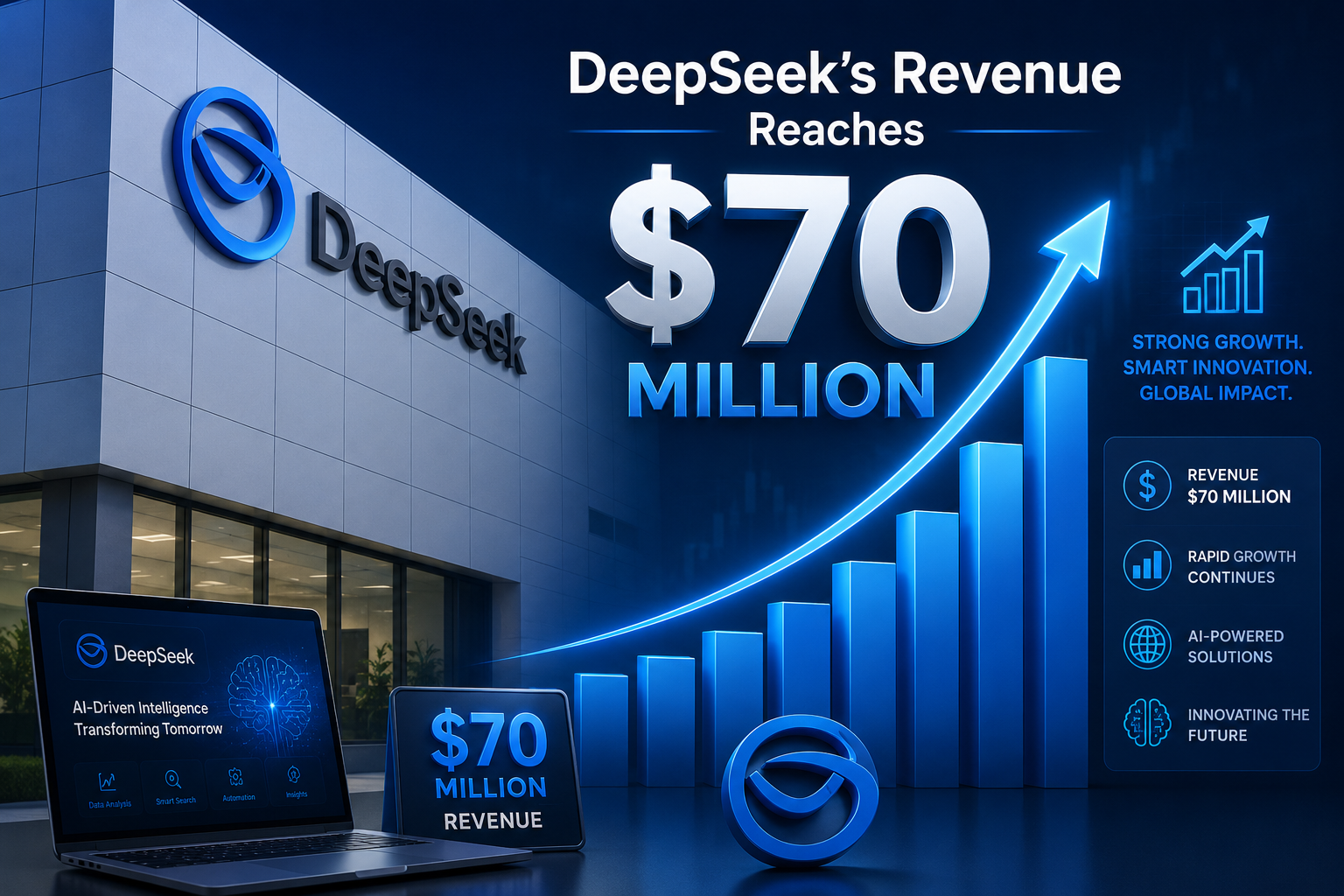
DeepSeek generated roughly 475 million yuan, or about $70.7 million, in revenue during the first seven months of 2026, a figure that already stands at close to ten times the Chinese AI lab’s entire revenue total for all of 2025. The numbers, first reported by The Information citing people familiar with the company’s financial data, land at a pivotal moment for DeepSeek as it pushes forward with a second funding round and lays groundwork for a potential public listing.
The growth trajectory is genuinely striking even by the standards of an industry where triple-digit percentage increases have become almost routine. DeepSeek’s full-year 2025 revenue was a fraction of what it pulled in during just the first seven months of this year, and the company achieved that scale-up while simultaneously narrowing its losses rather than widening them, a combination that’s harder to pull off than pure revenue growth alone. DeepSeek recorded a net loss of approximately 715 million yuan between January and July, compared with a full-year loss of 935 million yuan in 2025. In other words, the company lost less money over seven months this year than it lost across the entirety of last year, even while generating nearly ten times the revenue.
What’s driving that improved efficiency appears to come down largely to infrastructure optimization rather than simply charging customers more. DeepSeek posted an overall gross margin of 44.6 percent across the first seven months of the year, but the segment covering its API model invocation services, essentially developers and businesses paying to access DeepSeek’s models programmatically, reached a considerably stronger 82.9 percent gross margin. According to reporting on the underlying data, the company managed to reduce the number of chips required to run its models through infrastructure improvements, which kept inference costs low even as usage scaled up. That’s a meaningfully different cost profile than what’s typically associated with running large language models at scale, where GPU costs tend to eat heavily into margins as demand grows.
Context matters here, and DeepSeek’s numbers still look modest next to the biggest names in the AI industry. OpenAI reported first-quarter revenue of $5.7 billion with a 39 percent gross margin, while Anthropic posted second-quarter revenue of $11.5 billion and has said it expects its gross margin to climb from 40 percent in 2025 to 63 percent in 2026. Against those figures, DeepSeek’s seven-month total of roughly $70 million looks almost negligible in absolute terms. But the comparison that matters more for evaluating DeepSeek’s trajectory isn’t the current revenue gap, it’s the growth rate and the underlying unit economics, and on both fronts DeepSeek appears to be doing something unusual. The company’s API gross margin outpacing both OpenAI’s and matching or exceeding what Anthropic is targeting suggests DeepSeek has found a way to serve inference traffic profitably at price points well below what its larger, better-funded competitors typically charge.
That pricing gap has been part of DeepSeek’s core competitive identity since it first drew global attention. The company did raise prices this month on its flagship V4-Pro model, moving peak-hour pricing from $0.87 to $3.96 per million output tokens, a roughly 4.6-fold increase that reflects growing confidence in what the market will bear for its models. Even after that adjustment, though, DeepSeek’s pricing remains dramatically below premium competitors, sitting well under Kimi K3’s $15 per million tokens and Claude Opus 5’s $25 per million tokens. That combination, materially cheaper pricing alongside a genuinely high gross margin on API revenue, is precisely the kind of positioning that makes DeepSeek’s growth numbers meaningful rather than simply a function of underpricing everyone else and burning cash to do it.
Some analysts following the report have pushed back gently on how the seven-month figure gets framed. One widely circulated analysis noted that averaging $70.7 million across seven months works out to roughly $10 million a month, but an earlier report had already pegged DeepSeek’s annualized revenue run rate somewhere between $400 million and $500 million, implying monthly revenue closer to $33 million to $42 million by the time that estimate was made. If that’s accurate, it suggests DeepSeek’s growth accelerated meaningfully as the period progressed, meaning the true pace of expansion heading into the back half of 2026 is likely faster than the flat seven-month average would suggest on its own. It’s also worth noting that DeepSeek’s infrastructure spending has reportedly run at roughly 23 times its revenue over the period, though that figure includes both rented server capacity and purchased chips and equipment rather than reflecting pure operating costs, making it a less alarming number than it might initially appear for a company still in an aggressive investment phase.
The revenue and margin improvements arrive as DeepSeek works to close a second funding round, targeting 50 billion yuan, or roughly $7.4 billion, at a valuation of around 500 billion yuan, close to $74.4 billion. That follows an initial funding round of the same size that closed in June, with the second round launching almost immediately afterward according to reporting on the matter. The company has reportedly already selected investment banks to prepare for a Shanghai listing next year, positioning this fundraising push and the accompanying revenue disclosure as groundwork for what would be one of the more closely watched Chinese tech listings in recent memory, particularly given how much international attention DeepSeek’s models have drawn since the company first burst into global prominence.
For a company that built its early reputation largely on releasing capable open-weight models at a fraction of the cost typically associated with frontier AI development, translating that technical reputation into sustainable commercial revenue has always been the harder test. These latest figures suggest DeepSeek is making real progress on that front, even if the absolute scale still trails far behind the American labs it’s most often compared against. Whether that momentum holds through the rest of 2026, and whether investors are willing to underwrite a valuation approaching $75 billion based on revenue that remains a small fraction of what OpenAI or Anthropic generate in a single quarter, will likely become clearer as the second funding round moves toward completion and the IPO preparation process advances. For continued coverage of major developments across the global AI industry, readers can follow ongoing reporting on Techchora.
Further detail on DeepSeek’s model lineup and API pricing is available through the company’s official platform, and broader context on competing AI model economics can be found through OpenAI’s published research and pricing pages.