|
Getting your Trinity Audio player ready...
|
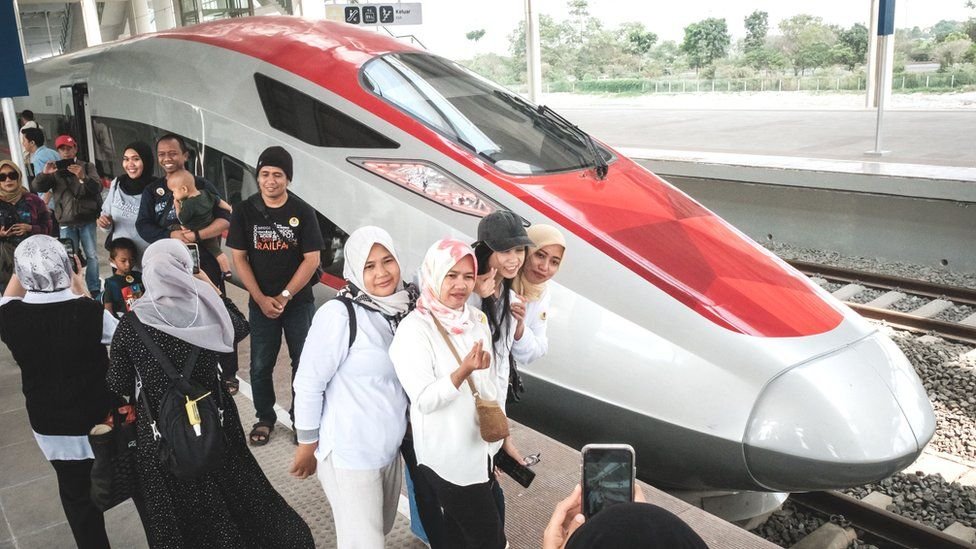
Indonesia’s government is set to complete a major restructuring of ownership over the country’s troubled Jakarta-Bandung high-speed rail project by mid-September, transferring the controlling 60 percent stake away from the state-owned enterprise consortium that has held it since construction and placing it directly under the Finance Ministry instead. The move, confirmed this week by Finance Minister Purbaya Yudhi Sadewa, represents the government’s most concrete step yet toward addressing years of financial strain tied to the $7.3 billion project commercially branded as Whoosh, Southeast Asia’s first high-speed railway and one of the highest-profile pieces of Chinese Belt and Road infrastructure built anywhere in the region.
Speaking at the Presidential Palace this week, Purbaya confirmed the government has sufficient internal resources to meet the project’s debt repayment obligations once the ownership transfer completes, and stated plainly that Indonesia will not seek external investors to help service that debt. “No, the money is already there,” Purbaya said, indicating the necessary capital will instead be drawn from state-owned enterprises already operating under the ministry’s oversight rather than requiring fresh outside financing or drawing directly from the national budget.
The mechanics of the transfer center on PT Pilar Sinergi BUMN Indonesia, known as PSBI, the Indonesian consortium that currently holds the 60 percent controlling stake in PT Kereta Cepat Indonesia-China, the joint venture company known as KCIC that actually operates the Whoosh railway. PSBI itself is made up of four state-owned entities, railway operator PT Kereta Api Indonesia, construction firm PT Wijaya Karya, toll-road operator PT Jasa Marga, and state plantation group PTPN III. Under the restructuring plan, the Finance Ministry, or more specifically a special mission vehicle appointed by the ministry, will take over PSBI’s entire holding, effectively shifting control of Indonesia’s side of the KCIC joint venture from a group of Indonesian state companies with no core mandate to operate high-speed rail into a dedicated financial vehicle built specifically to manage the project’s debt obligations going forward. The remaining 40 percent stake, held by Chinese consortium Beijing Yawan HSR Co. Ltd., remains entirely unaffected by the restructuring.
It’s worth being precise about what this transaction actually represents, since some coverage has conflated it with a full nationalization. This is a transfer of Indonesia’s existing majority interest from one set of state-linked entities to another, not an outright government takeover of the entire KCIC joint venture, and it doesn’t change the underlying 60-40 ownership split between the Indonesian and Chinese consortiums that has defined the project since construction began. Purbaya has described the process largely in administrative terms, telling reporters back in July that the government had already developed a solution for handling the project’s debt and was simply waiting for the relevant KCIC-related assets to formally transfer from Danantara, Indonesia’s sovereign wealth fund that currently controls all state-owned enterprises, including those making up the PSBI consortium.
The financial pressure driving this restructuring has been building for some time. PSBI reported losses of Rp 5.1 trillion, roughly $285 million, during just the first half of 2026 alone, a burden that threatened the solvency of state railway operator Kereta Api Indonesia, one of PSBI’s core member companies. Whoosh has been losing money consistently since it began commercial operations in October 2023, and the project’s total construction cost has ballooned to $7.2 billion, well above original estimates, driven by a combination of land procurement delays, pandemic-related disruptions, and cost overruns that pushed the railway’s opening years behind its originally planned 2019 target. By moving the controlling stake and its associated debt burden into a dedicated special mission vehicle structure under the Finance Ministry, officials say the arrangement is specifically designed so the project’s ongoing financial obligations won’t directly count against Indonesia’s formal state budget, even though the government will technically be managing the railway going forward.
The timeline for completing this transfer has shifted somewhat since the plan first became public. Danantara’s chief operating officer, Dony Oskaria, first floated a Finance Ministry takeover as one option under consideration back in April, and by early August, Purbaya had confirmed at a joint press conference with Danantara that the transaction would be completed at the latest by mid-September. That target has held steady through subsequent public updates, with Purbaya noting in a TikTok post later in August simply that “in September, the management of high-speed rail Whoosh will be under the Finance Ministry,” without providing a more specific date at the time.
Beyond the immediate debt restructuring, this ownership shift carries implications for the railway’s future expansion plans as well. Indonesian officials have said they hope the change won’t disrupt the country’s broader high-speed rail cooperation with China, particularly ongoing studies into potentially extending the current Jakarta-Bandung line further east to Surabaya, and potentially as far as Banyuwangi at the eastern tip of Java island, a project currently being examined by Indonesia’s Ministry for Infrastructure and Regional Development. The Transport Ministry has framed this restructuring as establishing a useful benchmark the government can reference when deciding whether to proceed with that eastern expansion, effectively treating the Finance Ministry’s handling of Whoosh’s existing debt as a test case for how any future extension of the line might be financed and structured.
For a project that began under President Joko Widodo as a flagship symbol of Indonesia-China infrastructure cooperation, and one that Chinese Premier Li Qiang personally rode during a test run before its official 2023 launch, this restructuring marks a notably different chapter, one focused less on symbolic diplomatic significance and more on the practical, unglamorous work of managing a genuinely large debt burden that fell short of commercial expectations. Whether shifting control to a dedicated Finance Ministry vehicle actually resolves Whoosh’s underlying financial challenges, or simply relocates the same debt problem to a different part of the Indonesian government’s balance sheet, will likely become clearer once the transfer completes and the special mission vehicle structure begins operating the railway directly in the weeks ahead.
Further detail on the restructuring is available through Indonesia’s Ministry of Finance official channels. For more coverage of Belt and Road infrastructure and Southeast Asian economic policy, visit Business Tech.