|
Getting your Trinity Audio player ready...
|
South Korea’s Power Demand Set to Soar 25-30 Gigawatts on AI Data Center Boom, Nuclear Expansion
South Korea is bracing for an electricity demand surge that officials say could require the equivalent of roughly 20 new nuclear reactors, and the scale of that number is forcing the government to confront a question it has spent years avoiding: how far it is willing to go in rebuilding a nuclear program it once planned to phase out.
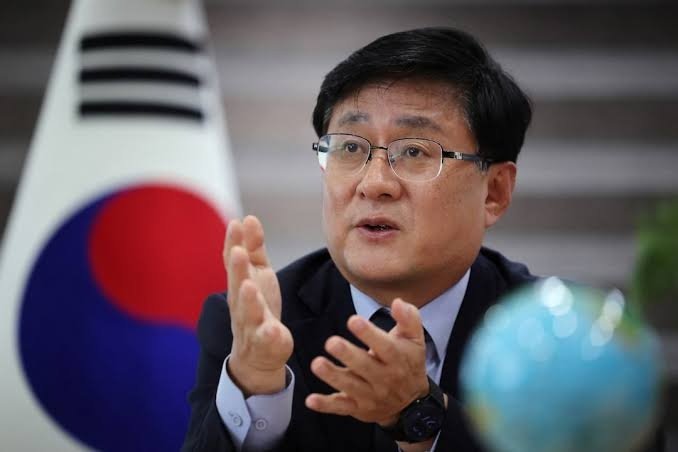
The figures come directly from Kim Sung-hwan, South Korea’s Minister of Climate, Energy and Environment, who told Reuters that the country’s power demand is set to rise by 25 to 30 gigawatts in the coming years, driven almost entirely by artificial intelligence infrastructure. That growth is tied to two forces moving in tandem. Samsung Electronics and SK Hynix, the country’s two dominant chipmakers, are expanding semiconductor production to meet global AI chip demand, while separately, new AI data centers are being built across the country to support the same boom. Kim also noted that South Korea will need to absorb additional electricity demand from the broader shift toward electric vehicles and electric heating, meaning the AI-driven numbers represent just one part of a larger structural change in how the country consumes power.
A more detailed breakdown of that demand paints a clearer picture of where the pressure is concentrated. Semiconductor manufacturing alone accounts for an estimated 24.3 to 24.6 gigawatts of the coming increase, a dramatic jump from the 3.7 to 4 gigawatts projected earlier this year, reflecting the addition of the Yongin chip cluster, four new fabrication plants in the Honam region, and expansions underway at existing Pyeongtaek and Cheongju facilities. AI data centers separately account for another 11.9 gigawatts, nearly triple what planners had estimated only months earlier. Even that figure has been deliberately conservative. Companies submitted requests for data center capacity totaling 20.8 gigawatts, but energy planners chose to count only the 10.8 gigawatts tied to firmly defined first-phase projects, setting the remainder aside as too speculative to build national energy planning around.
That filtering approach has not satisfied everyone. Han Ga-hee of the climate advocacy group Solutions for Our Climate has warned that basing national power infrastructure decisions on unverified corporate demand submissions risks locking in overinvestment in generating capacity, a concern that carries particular weight given that South Korea’s state grid operator is already managing significant debt. Building large-scale power plants, nuclear or otherwise, based on projected industrial demand that may not fully materialize is a genuine financial risk, and Han’s warning reflects a broader tension in energy planning worldwide as governments try to size infrastructure investment around AI demand forecasts that remain inherently uncertain.
On the other side of that debate is a more physics-driven argument. Park Woo-young of the Korea Energy Economics Institute has argued that among carbon-free power sources capable of running continuously, nuclear is effectively the only option that can reliably meet demand of this scale, since solar and wind remain intermittent and cannot be scaled up fast enough to match the timeline AI infrastructure investment is moving on. That argument aligns with comments from South Korea’s presidential policy chief, Kim Yong-beom, who has separately called for a major expansion of nuclear power, framing the country’s growing AI and semiconductor sectors as requiring a fundamental rethink of national electricity policy rather than incremental adjustments.
The political backdrop here matters. South Korea’s nuclear industry effectively stalled between 2017 and 2022 under a national phaseout policy pursued during the Moon Jae-in administration, a period that saw new reactor projects shelved and the broader nuclear supply chain contract. That policy reversed under subsequent leadership, and nuclear power’s share of South Korea’s total electricity generation has climbed from 25.9 percent in 2019 to 31.7 percent in 2024, according to data from state utility Korea Electric Power Corporation, largely displacing coal, which fell from 40.4 percent to 28.1 percent over the same period. Nuclear generation output rose 8.7 percent year-on-year in the first half of 2025, roughly three times the government’s original 2.9 percent growth target, aided by fewer maintenance outages and the addition of the 1.4-gigawatt Shin Hanul No. 2 plant.
That momentum has already translated into concrete new projects. Korea Hydro & Nuclear Power, the state-run nuclear operator, has selected Yeongdeok in North Gyeongsang province as the site for two new large-scale reactors and Gijang in Busan for a small modular reactor project. The two large reactors are scheduled for completion in 2037 or 2038, while the small modular reactor is targeted for 2035, timelines that underscore just how long nuclear construction cycles run even when political will is firmly behind them. That lag is central to the current dilemma facing Kim Sung-hwan’s ministry. AI-driven power demand is arriving on a timeline measured in single-digit years, while new nuclear capacity takes over a decade to bring online, leaving a gap that will likely need to be bridged by natural gas, renewables, and efficiency measures in the interim regardless of how aggressively South Korea commits to new reactors.
Kim has stopped short of specifying exactly how many new reactors the country needs, but he described nuclear as an essential element to consider within the broader power generation mix, language that suggests the government is leaning toward expansion without yet committing to a specific number. That clarity is expected to arrive soon. The government plans to unveil an updated long-term energy roadmap next month, extending national planning out to 2040, and the document is expected to lay out exactly how much new generating capacity, nuclear and otherwise, South Korea intends to build to meet the AI-driven demand its own semiconductor industry has helped create.
For a country that is simultaneously one of the world’s largest chip exporters and a major nuclear reactor exporter in its own right, the stakes extend beyond domestic electricity bills. How South Korea resolves this tension between rapid AI-driven industrial growth and the slower physical reality of building power infrastructure will likely serve as a reference case for other advanced economies facing similar demand surges as AI data center construction accelerates worldwide.