|
Getting your Trinity Audio player ready...
|
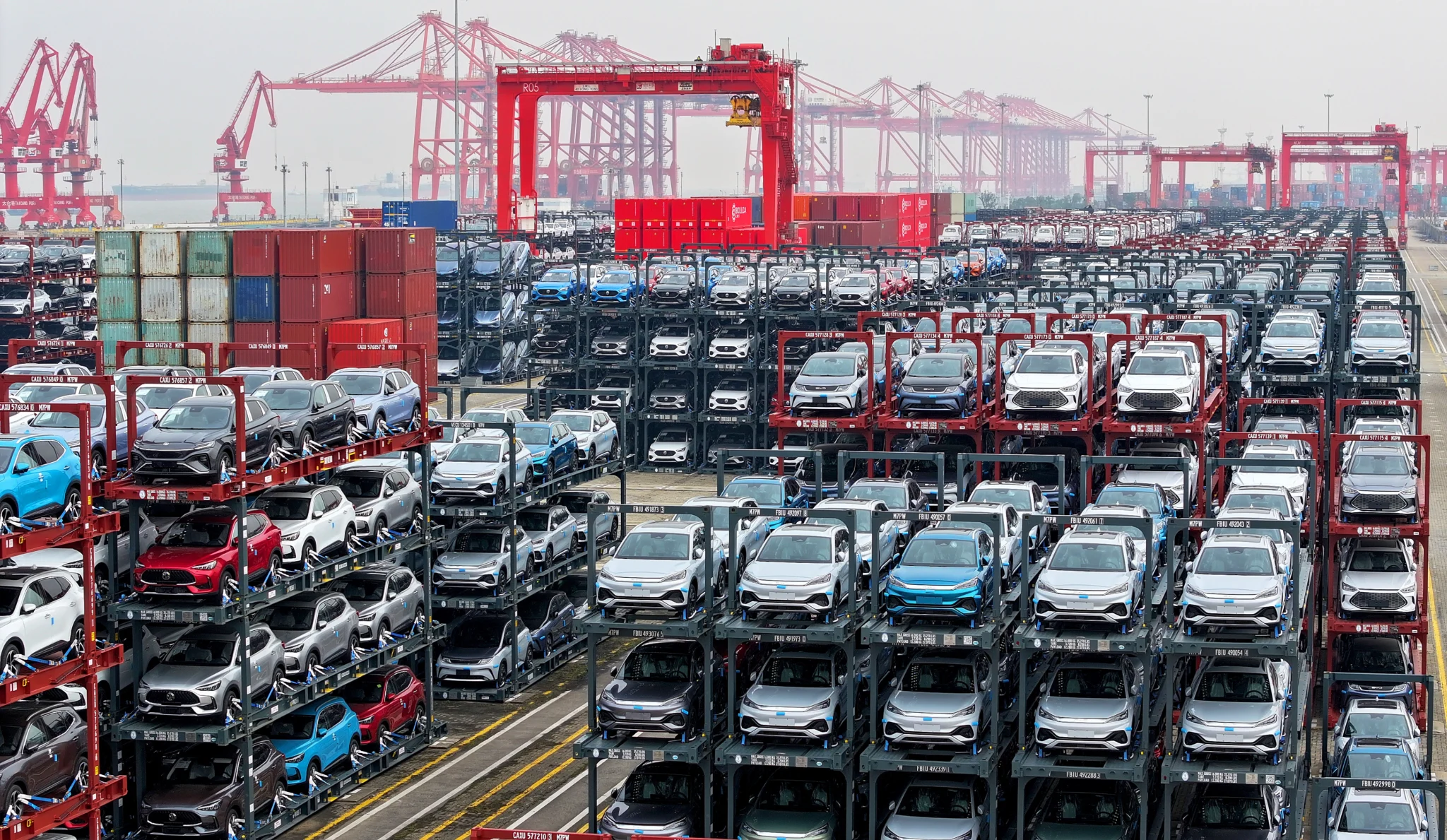
China’s automakers shipped a record number of vehicles overseas in August, even as the country’s domestic car market extended its losing streak to an eleventh consecutive month, according to data released Tuesday by the China Passenger Car Association. The widening gap between booming exports and a sinking home market has become one of the defining storylines of China’s auto industry this year, and August’s figures show that divide isn’t narrowing, it’s deepening.
Passenger car exports climbed 77.5 percent year on year in August to 894,000 vehicles, a genuinely robust figure even though the growth rate actually slowed somewhat compared to July’s 88.2 percent surge. Meanwhile, domestic sales sank 23.7 percent to 1.55 million units, an acceleration of the decline compared to July’s 21.1 percent drop, and a pattern that’s now stretched across nearly a full year of consistent monthly weakness. Cui Dongshu, secretary-general of the China Passenger Car Association, had described the downturn as more severe than expected back in July, having anticipated a noticeable improvement that simply never materialized, and August’s numbers suggest that weakness has, if anything, gotten worse rather than better since then.
Electric vehicles and plug-in hybrids reveal an even sharper version of the same divergence. Domestic sales of these new-energy vehicles fell 10.1 percent year on year in August, a meaningful worsening compared to July’s more modest 3.9 percent decline, even though this category still accounted for nearly 65 percent of all domestic vehicle sales during the month. Export growth for the same vehicle types told the opposite story entirely, accelerating to 154.7 percent year on year, up from 147.8 percent growth in July. That combination, domestic EV demand softening while overseas EV demand keeps climbing at triple-digit growth rates, illustrates precisely why Chinese manufacturers have been racing to build export infrastructure and overseas manufacturing capacity throughout 2026 rather than continuing to chase an increasingly saturated home market.
BYD and Geely both set new individual export records during August, according to reporting on the CPCA data, reinforcing a pattern that’s become increasingly visible across brokerage research this year. Earlier this week, Deutsche Bank and Citi disclosed that BYD management is now targeting more than 2.5 million vehicle exports in 2027, nearly double the company’s own upgraded 2026 guidance of 1.9 million to 2 million units, a target management attributes to continued market share gains overseas, an expanding fleet of dedicated car carrier vessels, and a growing local manufacturing footprint across markets including Hungary, Brazil, and Indonesia. That kind of aggressive expansion strategy isn’t isolated to BYD specifically, with the ten largest Chinese automakers collectively announcing combined overseas sales targets exceeding 7 million vehicles for 2026 alone, according to the International Energy Agency’s Global EV Outlook, almost double what those same companies had targeted for 2025 and approaching the scale of China’s entire national export total from just the prior year.
The structural shift behind this export boom has been building for years, but the pace has clearly accelerated. In 2021, less than two in five Chinese-made electric cars sold overseas came from Chinese-headquartered manufacturers, with the remainder coming from foreign brands like Tesla, Dacia, and BMW that also happened to manufacture in China. By 2025, that ratio flipped dramatically, with four in five Chinese electric car exports now coming directly from Chinese manufacturers, while exports from foreign automakers operating Chinese factories remained roughly flat in absolute terms, causing their combined share of China’s total export volume to shrink by nearly 40 percentage points over the same period. That shift reflects Chinese brands increasingly building their own dedicated international distribution and manufacturing infrastructure rather than relying on foreign joint venture partners to move products abroad.
The reasons behind the domestic slump are fairly well understood at this point, even if reversing the trend has proven difficult. Elevated fuel prices have weighed heavily on gasoline-powered vehicle sales specifically, while broader consumer confidence has remained subdued amid what HSBC analysts described in a July note as replacement demand moderating after earlier subsidy-driven purchases pulled buyers forward artificially, leaving consumers now more selective given frequent new product launches and an intensely competitive domestic market. For the first seven months of 2026 combined, domestic passenger vehicle sales fell 20.5 percent, equivalent to roughly 2.65 million fewer vehicles sold compared to the same period the previous year, a genuinely substantial contraction for the world’s largest auto market.
Beijing has begun taking notice of the pressures this dynamic is creating, both domestically and in how Chinese automakers behave abroad. Chinese regulators issued new recommendations to automakers last week specifically warning companies against frequent or substantial price cuts and other practices in overseas markets that could damage consumer trust or brand reputation, a signal that authorities are increasingly concerned about how the export-driven growth strategy might backfire if pursued too aggressively through pure price competition rather than genuine product differentiation. Domestically, the government has also moved to formally prohibit automakers from selling vehicles below production cost, an attempt to rein in the punishing price war that’s been eroding profit margins across the entire domestic industry throughout 2026.
Not every Chinese manufacturer is benefiting equally from the export boom either. Seres, which co-develops the Aito vehicle lineup alongside Huawei, recorded a 44 percent drop in total sales during August, a reminder that the broader export success story masks considerable variation between individual manufacturers depending on their specific product lineups, market positioning, and international expansion timing. Meanwhile, Xiaomi has been laying groundwork for its own European market entry, having signed agreements with German car dealers ahead of a planned launch next year, suggesting the current wave of Chinese automotive expansion into international markets is still gathering additional participants rather than having already reached its peak roster of competitors.
For China’s broader economy, this widening gap between export strength and domestic weakness carries implications beyond the auto sector specifically, reflecting a pattern where sluggish household spending has left exports accounting for an increasingly outsized share of overall economic growth. Whether domestic consumer confidence eventually recovers enough to narrow that gap, or whether Chinese automakers continue leaning ever more heavily on overseas markets to sustain their growth trajectories, will likely remain one of the more closely watched indicators of both the auto industry’s health and China’s broader economic trajectory heading into 2027.
Further detail on China’s automotive trade data is available through the China Passenger Car Association’s official reports. For more coverage of global automotive markets and China’s economic trends, visit Business Tech.