|
Getting your Trinity Audio player ready...
|
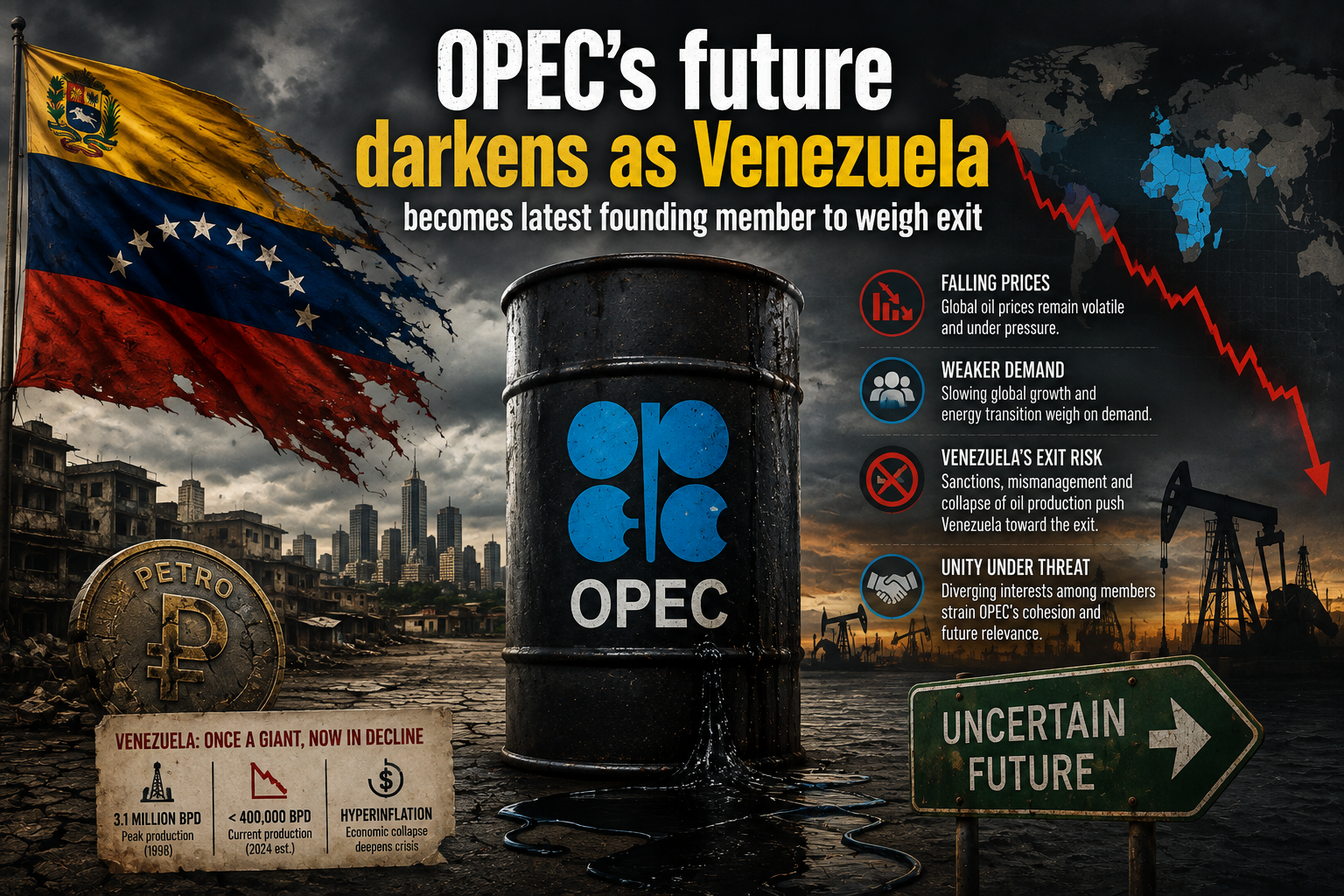
Venezuela is closely examining plans to leave OPEC, according to people familiar with the matter, a move that would deliver a fresh blow to the oil cartel it helped found more than six decades ago and deepen mounting doubts about whether the organization can hold together at all in its current form.
The idea of an exit has surfaced in conversations between Caracas and US officials, though multiple people familiar with the discussions caution that no final decision has been made. A White House spokesperson declined to comment, and Venezuela’s Information Ministry did not respond to requests for comment when the story first broke. But the fact that the option is even on the table marks a striking turn for a country that stood among the five founding members when the Organization of the Petroleum Exporting Countries was established in Baghdad in 1960, alongside Saudi Arabia, Iran, Iraq and Kuwait.
The historical weight of a potential Venezuelan departure goes beyond symbolism. It was Venezuelan oil minister Juan Pablo Pérez Alfonzo, working alongside Saudi counterpart Abdullah Tariki, who drove the founding logic of OPEC after foreign oil companies unilaterally cut posted crude prices without consulting the producing nations. Pérez Alfonzo’s core argument, that producer states should set their own terms rather than accept prices dictated from outside, became the organizing principle behind the cartel’s entire existence. A Venezuelan exit would therefore mean the country that supplied OPEC’s founding idea walking away from the institution it helped conceive, a departure carrying far more historical resonance than the barrels of oil actually involved.
Those barrels, notably, aren’t what they once were. Venezuela’s crude output stood at roughly 1.16 million barrels per day as of July 2026, according to figures cited in reporting on the situation, a fraction of the roughly 3.5 million barrels per day the country pumped at its late-1990s peak. Years of US sanctions, chronic underinvestment, and the steady deterioration of state oil company PDVSA have combined to turn what should remain one of the world’s great oil-producing nations, sitting atop the planet’s largest proven reserves, into a far more modest player on the global stage. Because Venezuela’s declining output already sits well outside the production limits OPEC and its OPEC+ partners impose on active members, a formal withdrawal wouldn’t meaningfully shift global oil supply in the short term.
What makes this moment significant instead is the broader political realignment happening inside Venezuela and its rapidly evolving relationship with Washington. The potential OPEC exit comes against the backdrop of sweeping change in Caracas following the ousting of longtime Venezuelan leader Nicolás Maduro by the Trump administration, which subsequently took control over how the nation’s oil sales are conducted. That shift in political control has opened the door to a far closer US-Venezuela energy relationship than would have been conceivable under the previous government, with Washington reportedly negotiating long-term leasing arrangements for Venezuelan oil fields as part of a broader push to expand American access to the country’s vast reserves.
Some US officials have reportedly floated an even more ambitious vision underlying these discussions: building what one characterization described as an “oil power” partnership between Washington and Caracas explicitly designed to weaken OPEC’s overall market influence. Exempting Venezuela from any future OPEC production quotas, the thinking goes, could allow the country to substantially ramp up output over time using American investment and technical expertise, applying sustained downward pressure on global crude prices at a moment when markets are already bracing for ample supply growth from other sources. That vision represents a notable evolution from President Trump’s own earlier position; back in January 2026, Trump had suggested it would be better for Venezuela to remain within OPEC, though he acknowledged at the time that the topic hadn’t been fully discussed with Venezuelan officials.
Venezuela wouldn’t be the first country to walk away from OPEC in recent memory, and that recent precedent is part of what makes this potential departure feel less like an isolated event and more like a pattern threatening the cartel’s long-term cohesion. The United Arab Emirates formally exited OPEC and the broader OPEC+ alliance effective May 1, 2026, a departure that already tested the group’s unity and raised uncomfortable questions about whether Saudi Arabia, as the cartel’s de facto leader, retains sufficient leverage to keep an increasingly fractious membership aligned on production policy and pricing strategy. If Venezuela follows the UAE out the door, it would mark the second high-profile departure within a matter of months, this time involving a nation whose founding role in the organization gives its exit considerably more symbolic weight than the UAE’s more recent, commercially-driven membership.
The stakes extend well beyond Venezuela and the UAE individually. Analysts tracking the situation have pointed out that public frustration with the obligations of OPEC membership has been expressed by other members as well, including Iraq, suggesting the discontent driving these departures reflects broader structural tensions within the cartel rather than country-specific grievances that might resolve on their own. A further breakdown in OPEC’s cohesion carries the real risk of plunging remaining members into a renewed contest for market share, potentially reprising the brief but brutal price war that erupted in 2020, when disagreements over production cuts sent oil prices into freefall and inflicted serious financial damage across the global energy sector.
For the United States specifically, the geopolitical calculus behind courting a Venezuelan exit and a deeper bilateral energy partnership seems fairly transparent: weakening OPEC’s collective pricing power serves American interests both by potentially lowering global oil prices and by reducing the influence Saudi Arabia and its allies hold over international energy markets. Whether that strategy actually produces the outcome Washington envisions depends heavily on whether Venezuela can realistically rebuild its battered oil production infrastructure quickly enough, and with sufficient foreign investment, to become the kind of major independent supplier capable of meaningfully undercutting OPEC’s market position rather than remaining a modest producer whose formal exit matters more symbolically than materially.
For now, the situation remains fluid, with Caracas reportedly still weighing its options rather than having committed to a final course of action. But the mere fact that a founding OPEC member is seriously entertaining withdrawal, layered on top of the UAE’s departure earlier this year and simmering frustration among other members, paints an increasingly uncertain picture for an organization that has shaped global energy markets for more than six decades. Whether OPEC can adapt its structure and incentives to hold its remaining membership together, or whether this marks the beginning of a more significant unraveling, will likely become clearer as Venezuela’s internal deliberations and its evolving relationship with Washington continue to play out over the coming months.