|
Getting your Trinity Audio player ready...
|
Another African Country Wants In on Dangote’s $16 Billion Refinery
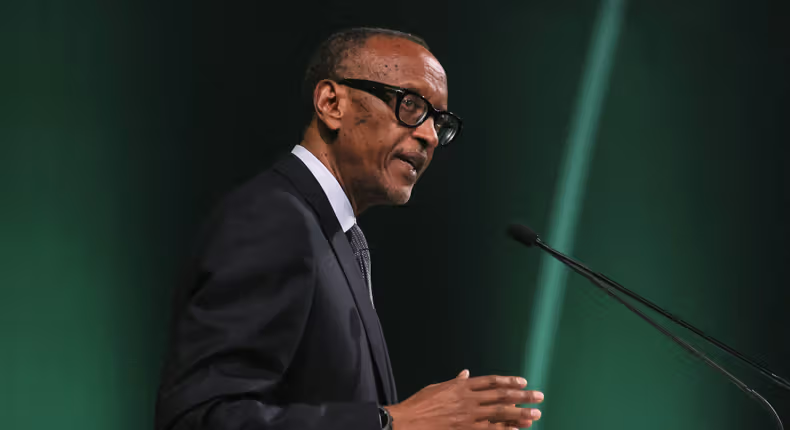
African countries Dangote refinery,Rwanda has become the latest country to signal interest in Aliko Dangote’s planned $16 billion oil refinery in Kenya, with President Paul Kagame confirming his government is in early discussions about acquiring an equity stake in the East African facility. Kagame told reporters his country would be “very happy” to participate, adding Rwanda to a growing list of regional governments angling for a piece of what would become one of the largest industrial projects in East Africa’s history.
The refinery itself is planned for Lamu, a coastal town in southeastern Kenya, and would process up to 700,000 barrels of crude oil per day, matching the capacity of Dangote’s existing flagship refinery in Lagos, Nigeria. That scale would make it a genuinely transformative piece of infrastructure for a region that currently imports the overwhelming majority of its refined petroleum products despite sitting on the doorstep of significant crude reserves elsewhere on the continent. The project is designed to supply refined fuel not just to Kenya but across Uganda, South Sudan, Rwanda, Ethiopia, and other neighboring markets that have long depended on imports routed through global supply chains vulnerable to disruption.
Kagame’s comments follow disclosures made earlier in the week by David Ndii, chief economic adviser to Kenyan President William Ruto, who confirmed at the Mwango Capital Markets Forum in Nairobi that Dangote had formally offered East African countries a combined 30 percent equity stake in the project. Under that arrangement, Kenya would take a 10 percent share worth approximately $500 million, while Ethiopia and Rwanda would be invited to divide the remaining 20 percent, bringing the total regional investment package to around $1.5 billion. Ndii said he didn’t anticipate difficulty structuring the deal even if some participating countries struggled to commit fully, noting that Dangote had indicated willingness to backstop any shortfall in crude off-take commitments from smaller partners.
The location itself has shifted over the course of the project’s development. East African leaders, led by Kenya’s Ruto, had initially floated the idea of a joint regional refinery at Tanzania’s Tanga port, framing the project as a way to reduce dependence on fuel routed through geopolitically sensitive chokepoints like the Strait of Hormuz. Ruto made that case explicitly at a Nairobi business event earlier this year, arguing that African nations should use their own resources to industrialize rather than remaining exposed to conflicts and supply disruptions originating elsewhere. Dangote, however, indicated in an interview with the Financial Times that he preferred building the facility in Kenya rather than Tanzania, citing commercial and technical considerations, and the project has since moved forward under that revised plan targeting the Lamu site.
Total project costs, including the refinery itself along with associated port infrastructure and petrochemical facilities, are estimated at around $20 billion, with the core refining operation accounting for roughly $16 billion of that figure. Construction is targeted to begin between September and October, pending regulatory approvals, an aggressive timeline that reflects both the urgency regional governments are placing on reducing fuel import dependence and Dangote’s own track record of moving large industrial projects from announcement to groundbreaking relatively quickly.
This East African push comes at a moment when Dangote’s broader refining empire is also undergoing significant financial restructuring back home in Nigeria. The Lagos refinery, which transformed Nigeria from a net importer of refined petroleum products into an exporter reaching markets as far as Western Europe, is reportedly seeking to raise around $5 billion through an initial public offering expected to conclude in October, in what would be the largest share sale in African capital markets history. Dangote Petroleum Refinery and Petrochemicals has filed its application with Nigeria’s Securities and Exchange Commission, with approval expected within weeks and a prospectus likely to follow in September. Reports suggest Dangote has spoken of a $50 billion valuation for the refinery, a figure that would need to hold up against investor scrutiny once the listing process moves forward on the Nigerian Exchange.
Alongside that domestic listing, Dangote has also structured a private placement through the Pan-African Refinery Investment SPV, distributing participation among African and Caribbean sovereign wealth funds, governments, and institutional investors. That structure reflects a deliberate strategy to broaden ownership of the refinery among African institutions rather than relying primarily on international banks, a framing Dangote himself has described as important for both the refinery and for African capital markets more broadly. Several stock exchanges across the continent, including those in South Africa, Egypt, Ghana, and Rwanda, have reportedly expressed interest in offering depositary receipts or similar instruments that would let local investors gain exposure to the Nigerian shares without a formal multi-jurisdiction listing.
The interest from Rwanda and other East African governments in the Kenyan refinery mirrors a pattern that’s played out repeatedly around Dangote’s Lagos operation, where multiple African governments, including South Africa, have separately sought long-term supply arrangements for refined petroleum products, particularly amid periods of global fuel market disruption. Ghana and Kenya have both expressed interest in diversifying their fuel supply sources away from traditional import channels, and the Lamu refinery would give several of these countries direct equity exposure to production rather than simply purchasing finished product on the open market.
For Dangote, the strategy playing out across both the Nigerian IPO and the East African expansion follows a consistent logic that has defined his approach to industrial expansion for years: build large, capital-intensive infrastructure that addresses a genuine structural gap in African energy independence, then bring in a mix of private and sovereign capital to spread both the financial burden and the long-term stakeholder base across the continent rather than concentrating ownership narrowly. Whether Rwanda, Ethiopia, and Kenya can actually finalize their respective equity commitments in time for the targeted construction start remains to be seen, and the history of large African infrastructure financing suggests these kinds of multilateral arrangements often take longer to close than initial announcements suggest. But with Kagame now publicly confirming Rwanda’s interest, the political momentum behind the Lamu refinery appears to be building steadily, even as the harder work of actually structuring and financing a $20 billion regional energy project across four or more sovereign partners still lies ahead. For continued coverage of major African infrastructure and energy investment developments, readers can follow ongoing reporting on Techchora.
Further background on Dangote Group’s refining operations and expansion plans is available through the company’s official website, and updates on the Nigerian IPO process can be tracked through filings with Nigeria’s Securities and Exchange Commission.