|
Getting your Trinity Audio player ready...
|
Chinese Car Brands Target South Africa’s EV Buyers and Pickup Truck Market at Kyalami Auto Show
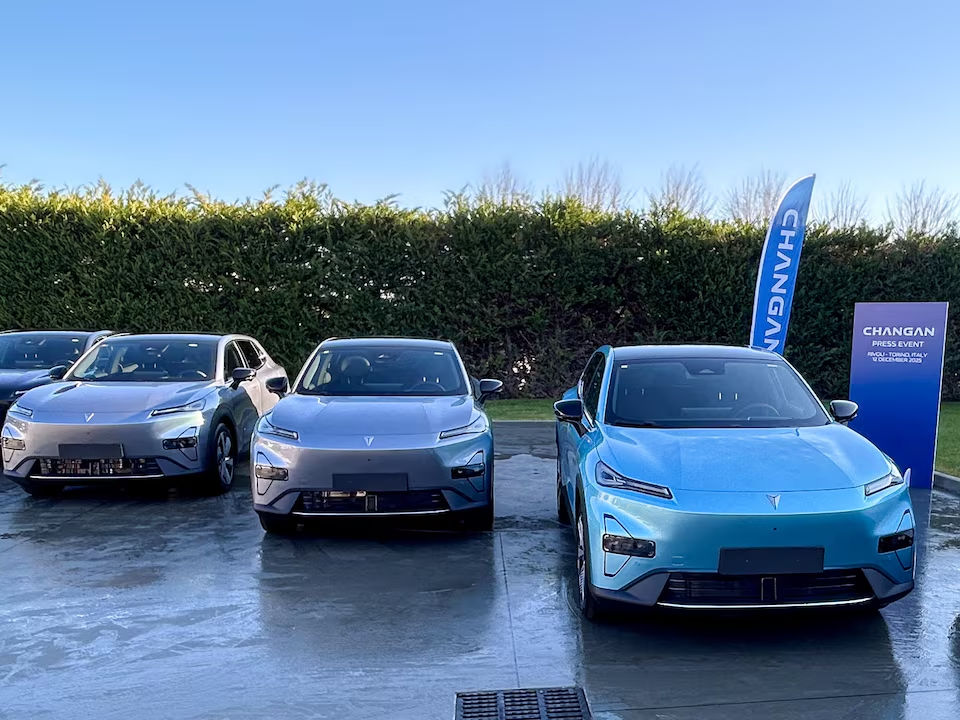
South Africa’s car buyers are getting a very clear signal this week about where the local motor industry is heading, and it isn’t from Detroit, Stuttgart or Tokyo. At the Festival of Motoring at Kyalami Grand Prix Circuit outside Johannesburg, running from 28 to 30 August, Chinese manufacturers make up nearly half the exhibitor lineup, a scale of presence that would have seemed unthinkable a decade ago. Chery, Jaecoo, Omoda, Geely, GAC, Changan, Dong Feng, LDV, iCaur and Lepas are all on the show floor alongside long-established names like Volkswagen, Toyota, BMW and Suzuki, and the mix says a lot about how quickly the balance of power in South African motoring has shifted.
This isn’t a one-off appearance. It’s the latest and most visible chapter in a run of momentum that Chinese automakers have been building in South Africa for the past two years, and it lands just months after a Chinese-badged vehicle did something no Chinese car had ever done in this market before.
In May, the Jetour T2 was named South Africa’s 2026 Car of the Year, beating out 17 other finalists in a competition that has run for four decades and, until now, had only ever crowned German and Japanese vehicles. Seven of the eighteen finalists that year came from Chinese brands, and the Omoda C7 picked up a category win of its own, edging out the Chery Tiggo 7 PHEV, the Opel Grandland and the Volkswagen Tayron in the family segment. For an industry that has long treated Chinese vehicles as a budget alternative rather than genuine competition, that result forced a rethink of what these brands are now capable of.
Pricing is still doing a lot of the work. South African households have spent the past few years squeezed by a weak rand and stubborn inflation, and that has made the price-to-feature ratio of a new car matter more than ever. Chinese manufacturers have leaned hard into that pressure point, offering vehicles loaded with the kind of tech, safety features and interior finishes that used to be reserved for premium badges, at price points that undercut established rivals by a significant margin. But the strategy on display at Kyalami this week goes beyond simply being cheaper. It’s about product range, and two segments in particular stand out: electric and hybrid vehicles, and bakkies, the pickup trucks that South African buyers treat almost as a national institution.
BYD has arguably done more than any other Chinese brand to prove that Chinese EVs and hybrids can work on South African roads. Its Shark 6 plug-in hybrid bakkie, which pairs a full battery with a 60-litre fuel tank for a combined range that stretches past 800 kilometres, has become one of the company’s strongest local sellers, addressing the range anxiety that has held back battery-only vehicles in a country where long highway drives and inconsistent charging infrastructure are simply part of daily life. BYD’s Managing Director for South Africa, Steve Chang, said in December that the company was on track to hit around 35 dealerships by early 2026 and was targeting 60 to 70 outlets by the end of the year, a rollout pace that reflects genuine confidence in local demand rather than a cautious toe in the water. BYD has also committed to installing between 200 and 300 fast-charging stations across the country by the end of 2026, a move aimed squarely at closing the infrastructure gap that has slowed EV adoption elsewhere on the continent. More details on the brand’s local lineup and charging plans are available on BYD’s official website.
The pickup segment is where the competitive stakes are arguably highest. Bakkies aren’t a niche category in South Africa the way pickups are in much of Europe. They’re used for farm work, small business, family transport and weekend recreation all at once, and the segment has traditionally been the exclusive turf of Toyota, Ford and Isuzu. Chery’s move to acquire Nissan’s former Rosslyn plant in Pretoria for local production, expected to be operational by mid-2026, signals an intention to compete in this space on a manufacturing footing rather than just as an importer. Local assembly also positions Chinese brands to benefit from South African government incentives, including a 150 percent tax deduction on EV-related investment, while sidestepping some of the import costs and currency exposure that have made fully imported vehicles more expensive.
Denza, BYD’s upmarket sub-brand, is entering the market this year with the B5 and B8, both plug-in hybrid SUVs built on body-on-frame platforms that share engineering with the Shark. The B5 is expected to compete with rugged 4x4s like the Ford Everest, Land Rover Defender and Toyota Prado, putting Chinese engineering directly up against vehicles that have defined that segment for years. Alongside Denza, at least five more Chinese marques, including Zeekr, Farizon, Riddara, Lepas and iCaur, are set to establish a presence in South Africa before the end of 2026, following a 2025 wave that already brought Changan, Deepal, Dongfeng, Geely, Leapmotor and MG back or newly into the market.
Industry figures suggest this expansion has passed the point of being a passing trend. By the end of 2025, 18 Chinese marques were already active in South Africa, and Chery and GWM have become fixtures in the monthly sales figures tracked by the National Association of Automobile Manufacturers of South Africa, whose data continues to show Chinese brands steadily climbing the rankings. Detailed monthly sales breakdowns are published on Naamsa’s website.
What’s happening at Kyalami this weekend is really a snapshot of a broader repositioning. Chinese automakers are no longer trying to win South African buyers on price alone. They’re building dealership networks, investing in charging infrastructure, localising production and chasing the exact vehicle categories, hybrids, EVs and bakkies, that matter most to South African drivers. Whether that translates into lasting market share against entrenched Japanese and German loyalty will play out over the next few car-buying cycles, but the direction of travel at this year’s show is hard to miss.