|
Getting your Trinity Audio player ready...
|
Japan’s Remote-Controlled Robot Workers: How an 8-Kilometer Convenience Store Experiment Became a National Labor Strategy
A striking video clip has been circulating showing a Japanese convenience store robot restocking drink coolers while the person actually controlling it sits in an office 8 kilometers away wearing a VR headset. It’s a genuinely eye-catching demonstration of remote robotics, but it’s worth being clear about what it actually shows: this is footage from a trial that Japanese convenience store chain FamilyMart ran with robotics firm Telexistence starting back in 2020, not a brand-new experiment. What makes it worth revisiting now is how directly it foreshadowed a labor strategy Japan has continued building on in the years since, as the country’s chronic worker shortage has pushed robotics adoption from a novelty into something closer to necessity.
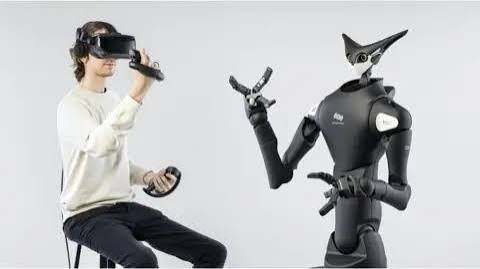
The original setup was built around Telexistence’s Model-T robot, a human-sized machine with a distinctive angular head and three-pronged hands designed for gripping items on store shelves. Rather than running autonomously, Model-T was piloted in real time by a human operator using what Telexistence called its Augmented Workforce Platform, a VR headset and hand controller system that let the operator see through the robot’s cameras and control its arms as if they were an extension of their own body. In the demonstration that’s resurfaced online, an operator working from Telexistence’s office in Tokyo’s Minato Ward controlled a Model-T unit stocking shelves inside a FamilyMart store roughly 8 kilometers away in Toshima Ward, restocking a drinks cooler, a task that would normally require a staff member physically present in the store.
The economic logic behind the trial was straightforward. A task like restocking drinks typically ties up at least one employee, and often two, since someone else needs to be free to handle the register and customers while restocking happens. With a remotely piloted robot handling the physical restocking work, a single trained operator could potentially manage that task across several different store locations throughout a shift without ever leaving their desk, while in-store staff stayed focused entirely on customers. FamilyMart said at the time it hoped to have the robots running in at least 20 locations by 2022, ahead of a broader rollout across its full store network.
The timing of that original trial wasn’t incidental either. It aligned with a Japanese government-backed Moonshot research initiative aimed at developing avatar robot technology capable of letting people of varying ages and physical abilities remotely perform physical labor, with a long-term target of converting a large share of Japan’s workforce toward this kind of robot-assisted model by 2050. That goal reflects Japan’s specific demographic pressure: a shrinking, rapidly aging population that has left many industries, retail and convenience stores prominently among them, struggling to fill shifts even when wages are raised.
What’s changed since that original demonstration is the scale and sophistication of Japan’s broader robotics push in retail and logistics. Japan’s largest convenience store chain, 7-Eleven, began its own robot trials more recently, testing autonomous machines in a Tokyo store capable of tasks like shelf stacking and window cleaning, alongside a separate pilot of four-wheeled delivery robots navigating Tokyo sidewalks that ran through February 2026. That delivery trial was deliberately run in an area with hilly terrain and an older population, specifically chosen to surface the kinds of real-world problems the technology would need to solve before any wider rollout, according to a company spokesperson. Japan has also revised its traffic laws to formally allow self-driving delivery robots to operate on public streets nationwide, a regulatory shift that other robotics firms, including Tokyo-based ZMP working alongside Japan Post Holdings, have already built delivery pilots around.
The distance side of the equation has advanced considerably too. Where the original FamilyMart trial demonstrated remote operation across roughly 8 kilometers, more recent research led by Japanese telecom company NTT has pushed real-time robotic teleoperation dramatically further using advanced photonics-based networking. In one notable case, doctors used NTT’s photonics technology to remotely and successfully control a hinotori surgical robot at Hirosaki University from 30 kilometers away, maintaining the kind of real-time responsiveness and high-resolution visual feedback that precision tasks like surgery demand, where even small delays or visual lag can be genuinely dangerous. NTT researchers involved in that work have pointed to the broader potential for these networks to eventually support robot operation from vastly greater distances, potentially thousands of kilometers, without requiring the kind of expensive local infrastructure that’s traditionally been needed to keep latency low enough for delicate manual control.
Put together, the original 8-kilometer convenience store demonstration looks less like an isolated experiment and more like an early, relatively modest proof of concept for a much larger bet Japan has continued placing over the past several years: that remote-controlled and increasingly autonomous robots, backed by steadily improving low-latency networking, can meaningfully offset a labor shortage that shows no sign of easing on its own. Whether that bet pays off at the scale Japan’s government has envisioned by 2050 remains an open question, but the throughline from a single VR-piloted robot stocking drinks in 2020 to nationwide delivery robot legislation and 30-kilometer surgical teleoperation trials today suggests the country isn’t treating this as a passing gimmick.