|
Getting your Trinity Audio player ready...
|
China’s Local Governments Are Racing to Turn AI Filmmaking Into the Next Big Industry
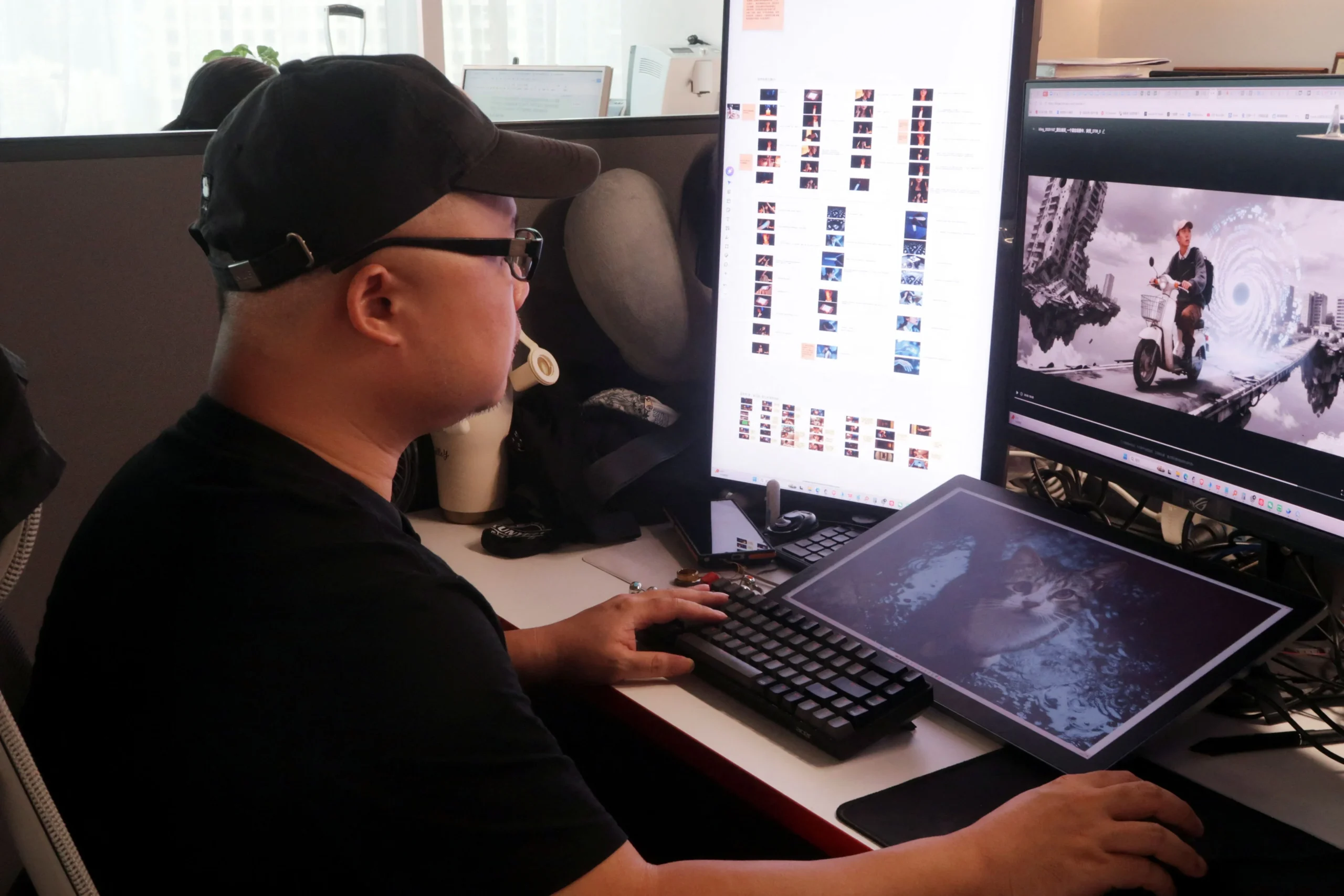
Two years ago, when Chinese AI director Zhu Zhili went looking for a place to set up his artificial intelligence film studio, the choice was obvious: Shenzhen, with its dense concentration of tech talent and infrastructure. These days, Zhu doesn’t have to go looking for anywhere. Cities and industrial parks across the country are coming to him instead.
Zhu, who now heads the AI-generated content department at China Wit Media, a film and television production company based in Shenzhen’s Guangdong province, told Reuters he now fields calls from officials representing everywhere from major metropolitan areas to smaller localities, all pitching the same basic offer: relocate his technology or his company to their city. That kind of courtship reflects a much bigger ambition taking shape across China right now, one aimed at weaving artificial intelligence into virtually every part of the economy, right down to the movies playing in local cinemas.
The response from local governments has followed a script that will look familiar to anyone who’s watched China build out its electric vehicle, solar panel or robotics industries over the past decade. City and regional authorities are dangling tech cluster development plans and direct subsidies at AI filmmakers and startups, treating AI-generated video content as the next sector worth nurturing into global competitiveness through the same kind of coordinated industrial policy that’s worked, at least by scale, in those earlier tech pushes. The result is a rapidly growing ecosystem of AI filmmakers, production studios and streaming platforms all racing to establish an early lead in both the technical craft of AI video production and the distribution networks needed to actually get that content in front of audiences.
Zhu described China as having built what he called the best environment anywhere for AI filmmakers, pointing specifically to cheap rent, living allowances, and subsidized access to the computing power AI video generation demands. That description lines up with the concrete support already flowing through the system. Beijing has set up a 260 million yuan fund dedicated to backing audiovisual technology, and the capital’s Huairou district, long considered a hub for China’s traditional film industry, is now handing out vouchers specifically to producers of short AI dramas, aimed at lowering the computing costs behind each production. Shenzhen has taken a similar approach, offering technical support covering video production, visual effects and content generation, alongside subsidized rent for filmmakers willing to base their operations there.
Streaming platforms are leaning in just as aggressively. Gong Yu, chief executive of major Chinese streaming service iQIYI, said in August that the company is going all-in on AI, and iQIYI has begun offering creators direct subsidies for AI-generated content that streams on its platform, a clear signal that the push isn’t confined to government policy alone but is being matched by commercial investment from the platforms that actually distribute this content to viewers.
The economics behind the rush help explain why filmmakers are so eager to get in early. According to Chinese state broadcaster CCTV, the cost of producing AI-generated short dramas collapsed during the first half of 2026, falling from around 5,000 yuan, roughly $747, per minute of finished footage down to just a few hundred yuan for the same amount of content. That kind of cost compression, arriving within a single six-month stretch, is precisely the sort of shift that tends to pull an entire industry’s worth of new entrants in at once, since production budgets that once required substantial studio backing suddenly become achievable for far smaller, leaner teams.
That speed of expansion carries a familiar downside, though, one China has already run into with other state-supported industries. As production capacity ramps up faster than actual consumer demand can absorb it, prices tend to collapse further in what’s often described as a race to the bottom, a pattern that’s already played out in sectors like electric vehicles and solar panels, where Chinese manufacturers built out enormous production capacity that eventually outpaced what domestic and even global markets could reasonably consume.
There are early signs that AI video content in China may already be running into exactly that kind of overcapacity. According to data from analytics firm DataEye, 221,900 new AI-generated shows launched on Douyin, the Chinese version of TikTok, during the first half of 2026 alone. Of those, only 1,055 managed to cross 100 million views, the platform’s rough benchmark for what counts as a genuine hit. That’s a hit rate under half of one percent, a stark illustration of just how much content is being produced relative to how much of it actually finds a real audience, and a warning sign for anyone assuming that cheaper production costs alone guarantee commercial success.
The broader technology underpinning this boom has been advancing quickly too. ByteDance released its Seedance 2.5 video model in July, a notable leap for text-to-video generation capable of producing 30-second native clips built from up to 50 separate multimodal reference inputs, with a local editing feature that lets creators fix a single detail, like a character’s hair color, without having to regenerate an entire scene from scratch and risk losing a preferred take’s performance or lighting. Other Chinese AI labs have been pushing their own video tools forward in parallel, including Shanghai-based MiniMax, one of the companies commonly grouped among China’s so-called AI Tigers, which runs the video-generation service Hailuo AI, and Kuaishou’s Kling AI, both competing for a share of the same fast-growing production pipeline. Notably, China’s entertainment industry has generally embraced these tools with more enthusiasm than Hollywood has shown toward similar technology, with respected filmmakers like Jia Zhangke publicly experimenting with AI tools like ByteDance’s Doubao to remake scenes from his own earlier films.
Whether China’s AI filmmaking push ultimately becomes another genuine export success story, or ends up mirroring the overcapacity struggles that have hit its EV and solar industries, likely depends on how quickly production quality and audience demand can catch up to the sheer volume of content now flooding platforms like Douyin. For now, filmmakers like Zhu are riding a wave of government enthusiasm and falling costs that shows little sign of slowing down, even as the numbers suggest plenty of that new content is landing with barely anyone watching.