|
Getting your Trinity Audio player ready...
|
Few weeks on the economic calendar carry as much weight as this one. Investors get a fresh read on the labor market, a final look at second-quarter growth and the Federal Reserve’s favorite inflation gauge, all within days of each other and barely two weeks after the central bank raised interest rates for the first time in three years. With the policy rate now at 3.75 percent to 4 percent, every number will be read for clues about whether another hike is coming.
The headline event arrives Friday morning, when the Labor Department publishes the September jobs report. Economists surveyed by Trading Economics expect employers added about 100,000 jobs, down from 162,000 in August, with the unemployment rate ticking up to 4.2 percent from 4.1 percent. That would represent a cooling, but not a collapse. The August report matters as background here: it came in strong enough that the Fed moved to raise rates less than two weeks later, and policymakers have described the labor market as sitting near full employment. A weaker number could ease some pressure on the central bank, while a strong one would reinforce the case for tightening.
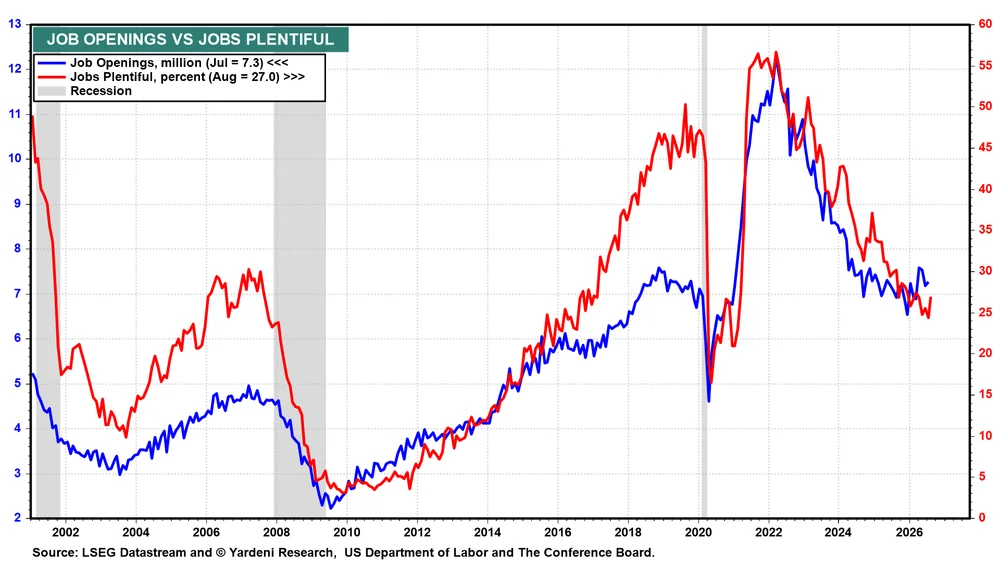
Earlier in the week, two smaller labor indicators will set the tone. The JOLTS report on job openings is due Tuesday, with forecasters expecting openings to slip to about 7.23 million in August from 7.27 million in July. The ADP private payrolls survey, which often gets treated as a preview of Friday’s report despite a patchy track record, is projected to show a gain of roughly 70,000 jobs. Tuesday also brings the Conference Board’s consumer confidence reading, a useful check on how households feel about work and prices as fuel costs stay high.
Growth data comes Wednesday, when the final estimate of second-quarter GDP is published. The economy expanded at an annualized rate of 1.5 percent in that quarter, a noticeably slower pace than the gains seen in 2025, and revisions to that figure could change how strong the underlying economy looks heading into autumn. GDP combines consumer spending, business investment, government outlays and net trade, so a revision in any one piece can shift the whole picture.
Thursday belongs to inflation. The Commerce Department releases August personal income and spending figures along with the PCE price index, the measure the Fed watches most closely. The consensus calls for the PCE index to rise 0.4 percent on the month, with the core reading, which strips out food and energy, climbing 0.3 percent, both faster than July’s 0.2 percent. Personal spending is expected to jump 0.8 percent after a 0.2 percent gain, while income growth holds at 0.4 percent. Consumer price data already showed inflation heating up again in August as energy costs rose alongside the conflict in the Middle East, so a hot PCE reading would surprise few, but it could harden expectations of another rate increase. The ISM manufacturing survey for September also lands Thursday and is expected to point to stronger factory activity.
Fed officials will supply plenty of commentary to go with the data. New York Fed President John Williams, Chicago’s Austan Goolsbee, who speaks twice, and Dallas Fed President Lorie Logan are all scheduled to appear, along with governors Michael Barr, Christopher Waller, Lisa Cook and Vice Chair Philip Jefferson. Markets will parse their remarks for any change in tone after the hike.
Corporate earnings offer a different lens. Micron, a central player in AI memory chips, reports this week and will test whether investor enthusiasm around artificial intelligence is backed by results. Nike, Carnival and Accenture also report, giving readings on consumer spending, travel demand and corporate technology budgets. Nike is a stock to watch for a different reason, as its shares are down sharply this year and investors want signs that sales are recovering.
Washington adds its own deadline. The federal fiscal year ends Wednesday, and lawmakers have funded the government under a stopgap law, so a shutdown is not expected when the new year begins Thursday.
Abroad, the calendar is just as busy. Eurozone inflation and unemployment figures arrive while markets price in several rate hikes from the European Central Bank. China publishes purchasing managers’ indexes in a holiday-shortened week. Japan releases industrial production, retail sales and the Bank of Japan’s quarterly Tankan business survey, and South Korea’s trade data could offer another read on demand for AI-related chips.
Running through everything is the standoff involving Iran and the oil market. With crude near $107 a barrel and bond yields at multi-decade highs, any breakthrough or escalation in the talks could overshadow the data. As always, this is a guide to what is scheduled, not a forecast or investment advice, and actual results can differ sharply from consensus expectations.