|
Getting your Trinity Audio player ready...
|
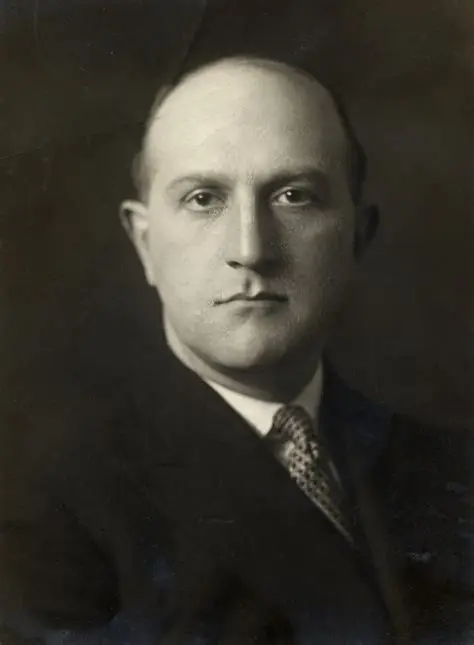
Irish writer Oliver Goldsmith, born in 1728, made his name as a novelist, playwright and poet, and is best known for The Vicar of Wakefield and the comedy She Stoops to Conquer. He also wrote a satirical work in letters called The Citizen of the World, narrated by an imagined Chinese philosopher living in London. In it appears the line: “Our greatest glory is not in never falling, but in rising every time we fall.” Millions of people have since seen it credited to Confucius, but the words come from Goldsmith.
The mix-up has an understandable cause. Goldsmith gave his fictional narrator a Confucian voice, and the letter containing the sentence borrows heavily from the ancient philosopher’s ideas. Over time, quote collections dropped the novelist and kept the sage. Careful research has traced the wording back to Goldsmith’s book, and Confucian scholars have searched the classical texts for the sentence without finding it. For a quotes section that values accuracy, the right credit is Goldsmith.
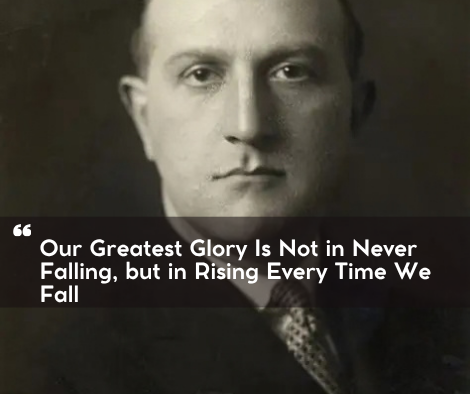
“Our Greatest Glory Is Not in Never Falling, but in Rising Every Time We Fall” – Oliver Goldsmith
The sentence is built around a redefinition of success. Most people measure themselves by their record of avoiding mistakes. Goldsmith moves the measure somewhere else. Glory, in his view, does not belong to the person who never stumbles, because that person probably never attempted anything difficult. It belongs to the one who keeps standing up after each setback.
Notice the phrase “every time.” Goldsmith is not praising a single dramatic recovery. He is describing a repeated habit. The achievement is not that someone rose after one failure, but that rising became their response to all of them. That is a more demanding standard than it first appears, because the second and third fall are harder to recover from than the first.
Picture two people who each launch a small business and each lose their first major customer in the same month. One treats the loss as proof that the venture was a mistake and quietly closes it. The other spends a week working out what went wrong, rewrites the sales approach and wins two smaller customers by the end of the quarter. Their circumstances were identical. What differed was the response, which is exactly the thing Goldsmith is describing.
Falling is a normal part of attempting anything
The quote starts from an honest assumption: everyone falls. It does not pretend that careful people can avoid failure entirely. In business, this is easy to forget. Founders, managers and employees are often judged on outcomes, which can make admitting a mistake feel dangerous. Goldsmith’s framing makes failure ordinary and shifts attention to what follows.
A practical consequence is that mistakes should be examined early and without drama. A team that can say “this did not work, here is what we learned” recovers faster than one that spends its energy hiding errors.
Rising does not mean repeating the same step
It would be unfair to read the quote as advice to simply try again in the same way. Rising after a fall includes looking at why it happened. A person who trips on the same obstacle every day has not risen in any useful sense. The strongest version of the idea combines persistence with adjustment. Get up, check what caused the fall, and step differently.
This matters in careers as well as companies. Someone rejected from several jobs does better to refine their application than to send the same one to fifty more employers. The habit Goldsmith praises is a cycle of falling, learning and rising, not stubbornness.
Glory in the quote is about character
The word “glory” is unusual for a self-improvement line. It suggests something worth admiring, not just something useful. Goldsmith is making a claim about what people respect. Admiration, he implies, goes to resilience more than to a spotless record. That holds up in ordinary life. People tend to trust the colleague who has recovered from a serious error and handled it honestly more than the one who has never been tested.
Why this advice still holds true today
Modern work moves quickly, and visible failure can feel permanent because it is easy to record and share. This sentence, written more than two and a half centuries ago, pushes back against that pressure. It reminds readers that a single stumble is not a verdict and that the people who build lasting careers are usually the ones who kept getting up. The quote remains useful because it asks for something achievable: not perfection, only the decision to rise one more time than you fall.