|
Getting your Trinity Audio player ready...
|
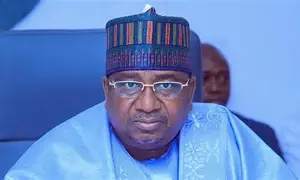
Former Kebbi State governor Saidu Usman Nasamu Dakingari has been handed a central role in Governor Nasir Idris’s bid for a second term. He now heads the state’s All Progressives Congress (APC) campaign council for the 2027 elections. The appointment, announced at a ceremony in Birnin Kebbi, brings a former governor and sitting ambassador into the front line of the party’s effort to hold the state and deliver votes for President Bola Tinubu.
Idris inaugurated the APC 2027 Campaign Council on Sunday at the Presidential Lodge in Birnin Kebbi, urging members to show commitment, dedication and determination. “I have the honour and privilege of inaugurating this campaign council,” he told the gathering, adding that it would be headed by Dakingari, a former governor and Nigeria’s Ambassador to Türkiye. The line-up shows how the governor wants to organise the campaign. He is taking the chairmanship himself, with Dakingari running the day-to-day operation.
Blueprint reported that Idris chairs the council, Dakingari serves as director-general, and the managing director of the Sokoto Rima River Basin Development Authority, Abubakar Gari Mallam, is deputy director-general. The expanded body has a mandate to mobilise votes for Tinubu and other APC candidates. That brief covers the presidency, the governorship and the legislative seats on the ballot, which means the council has to coordinate across several races at once.
Idris also set out his reading of the political terrain. He described Kebbi as an APC stronghold and asked party stakeholders to go back to their communities and mobilise support for candidates in every elective position. He said the APC remains the proper home for all Nigerians because of its record as a rancour-free party that laid the foundation for the country’s transformation. The APC state chairman, Alhaji Abubakar Kana-Zuru, praised the governor for his support and for making the inauguration possible, and urged members to work together.
Dakingari’s response was brief and focused on delivery. He thanked the governor for the confidence placed in him and other members of the council, and promised to work hard for the party’s success in the 2027 general elections. The full details of his remarks on the governor’s second-term bid were not available in the reports reviewed for this article, so readers should consult the original Punch coverage for his exact words.
His support for Idris is not new. When Idris cleared the APC’s national screening for the 2027 governorship ticket in Abuja, Dakingari was among the party leaders and officials who accompanied him to the venue. At that stage the governor said a second term would consolidate ongoing projects across critical sectors of the economy. The screening was conducted by a committee headed by the APC national chairman, Professor Nentawe Yilwatda, according to the governor’s office.
The backing from past governors has been building for some time. Last year, all former civilian governors of Kebbi, Muhammad Adamu Aliero, Dakingari and Atiku Bagudu, renewed their support for Tinubu and Idris to continue beyond 2027. That declaration came at a gathering of APC stakeholders at the Presidential Lodge in Birnin Kebbi. Putting Dakingari at the head of the campaign machinery is, in effect, a step from endorsement to organisation.
Dakingari’s own record gives the role some weight. He first won the governorship in 2007 on the platform of the Peoples Democratic Party and was re-elected in 2011, according to his biography. He held office from April 2012 to May 2015. His successor was Atiku Bagudu, who governed Kebbi from 2015 to 2023 before Idris took over. A former governor who has served two decades in public life, and who now holds a diplomatic post, brings name recognition and long-standing contacts across the state’s local governments.
There is a political message in the choice as well. Governors seeking a second term in Nigeria often try to show that the party is united behind them, particularly when rumours of defections or internal rifts circulate. Idris has faced such talk before. In 2025 the Kebbi APC held a stakeholders’ meeting to respond to reports about defections, with Dakingari among those present. Bringing a former governor to lead the campaign is one way to answer such talk with a visible show of unity.
The timetable leaves little room for delay. Under the revised schedule from the Independent National Electoral Commission, presidential and National Assembly elections hold on Saturday, January 16, 2027, with governorship and state assembly polls following on February 6. The commission’s website at INEC carries the official calendar. That means the council has barely three months before the first ballots are cast, and under three months before Kebbi chooses its governor. The sequence matters because the presidential vote comes first, and the party will want a strong showing for Tinubu to help lift the state-level campaign that follows.
The opposition is also organising. Vanguard’s list of the Nigeria Democratic Congress campaign structure, led by presidential candidate Peter Obi, includes a state campaign coordinator for Kebbi, Capt. Ladan Soja Bunza (rtd), along with a Kebbi state representative on the council. That suggests the APC cannot take the state for granted, whatever its own leaders say about its strength. Voters will decide how much weight to give to claims of a stronghold, and the party will have to earn each vote.
Several questions remain open. The reports reviewed do not set out the council’s budget, its zonal structure or how it will work with local government chairmen and ward leaders. They also do not describe how it plans to deal with disputes among party members, which tend to surface during campaigns. Those details usually shape results more than speeches at an inauguration, and they will be tested once campaign activity picks up.
For Idris, the sequence of events is clear enough. He has cleared screening, assembled a council with a former governor as director-general, and secured public declarations of support from the state’s past governors. For Dakingari, the job is to turn those declarations into votes. The official line from the party is confidence. The result in January and February will show whether that confidence is justified.