|
Getting your Trinity Audio player ready...
|
A palm-sized computer built for hobbyist robotics projects and university labs has turned up in some of the deadliest weapons on the modern battlefield. Ukrainian intelligence officials and independent researchers have repeatedly recovered Nvidia Jetson Orin modules from the wreckage of Russian drones and missiles, raising uncomfortable questions about how consumer-grade artificial intelligence hardware keeps finding its way into a war zone despite years of sanctions.
The most recent example involves the S-71 “Monochrome,” a cruise missile Ukraine’s Main Directorate of Intelligence, known as HUR, says is derived from the S-70 Kovyor platform and designed to be launched from Su-57 fighter jets or S-70 Okhotnik drones. Investigators who examined the wreckage identified a Jetson Orin module among roughly three dozen foreign-made electronic components inside the weapon. The missile also reportedly contained a Chinese-made Honpho TS130C-01 camera, the same imaging hardware previously found in Russia’s Geran-4 drones, suggesting the Jetson chip may be paired with that camera to give the missile some ability to recognize and track targets on its own during its terminal approach.
This is not an isolated case. Earlier reporting, including an investigation that traced a fatal strike in Zaporizhzhia to a small drone guided almost entirely by onboard software, found that the aircraft responsible carried the same type of Jetson hardware. Three people, including a 19-year-old university student, were killed when the drone struck near a gas station rather than a clearly defined military target, a detail that has fueled debate among military ethicists and drone specialists about how reliable machine vision systems actually are when deployed without a human operator in the loop.
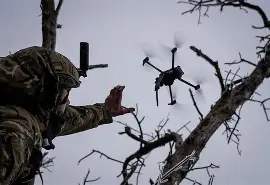
Separately, Ukrainian officials have pointed to a drone designated MS001, described by Ukrainian Major General Vladyslav Klochkov as capable of operating without external commands once launched. According to Klochkov, the platform uses a Jetson Orin module to process thermal imaging, object recognition and telemetry in real time, allowing it to fly in coordinated groups, share data with other drones, and adjust its path if other units in the swarm are shot down. He described the shift bluntly, telling colleagues that traditional air defense systems were not built to counter something that, in his words, does not simply carry coordinates but makes its own decisions mid-flight.
None of this is happening because Nvidia is selling directly to the Russian military. The company has been explicit that it does not sell Jetson products in Russia and has confirmed, when shown photographs from earlier drone recoveries, that the hardware pictured was indeed a Jetson Orin unit. In a public statement responding to those findings, Nvidia described the module as a consumer product marketed to students, developers and start-ups for legitimate applications ranging from robotics prototypes to industrial automation. The company’s own marketing for the Jetson line, visible on Nvidia’s developer site, touts the hardware as a low-power, high-performance option for exactly the kind of edge-AI tasks that make it attractive to drone builders anywhere in the world, which is precisely what makes it hard to keep out of the wrong hands.
The Jetson Orin NX, the specific module most frequently cited in these findings, has been shipping since 2023 and is sold in large volumes globally, reportedly reaching into the hundreds of thousands or millions of units annually. Most of what ends up on store shelves is not the bare processing module itself but development kits and small integrated systems built around it, though the standalone modules are also available through electronics retailers in Europe and Asia, typically priced in the hundreds of dollars. That combination of affordability, availability and genuine computational power, Nvidia has said its Jetson chips can process tens of trillions of operations per second in a footprint small enough to fit inside a loitering munition, is exactly why the hardware keeps resurfacing in intelligence reports despite export restrictions meant to keep advanced computing chips out of Russia.
Ukraine’s HUR has used each new discovery to renew calls for tighter enforcement of existing sanctions rather than simply adding new restrictions on paper. Officials there argue that the recurring appearance of the same Western components, sourced through third countries and resellers, shows that current controls are being routinely circumvented rather than genuinely blocking supply. Limited domestic production capacity, according to Ukrainian intelligence assessments, forces Russia to stockpile drones and missiles before launching large coordinated strikes, which analysts say indicates the flow of foreign components, while persistent, is not unlimited.
For the broader technology industry, the pattern illustrates a problem that extends well beyond one company or one conflict. Edge-AI hardware designed for benign uses, warehouse robots, agricultural drones, medical imaging devices, is functionally identical to the hardware needed to give a weapon basic autonomous targeting capability. A chip does not know or care what it is bolted into. That dual-use reality has become one of the defining tensions in the AI hardware market, and it is likely to intensify as more countries pursue autonomous weapons programs and as the underlying components needed to build them become cheaper and more widely distributed through ordinary commercial channels rather than specialized military supply chains.
Whether the presence of a Jetson module in a given weapon actually translates into meaningful autonomous targeting is not always clear cut. Analysts examining the S-71 Monochrome, for instance, have noted that confirming the chip’s exact function inside the missile, rather than assuming it based on its known capabilities elsewhere, requires more forensic work. But the recurring pattern across multiple weapons platforms, from small first-person-view drones to long-range cruise missiles, suggests Russia’s defense industry has settled on Jetson hardware as a reliable, off-the-shelf answer to a genuine technical need: giving weapons the ability to see and decide without needing a constant data link back to a human operator, a link that Ukrainian electronic warfare units have become increasingly effective at jamming.
For readers following the broader intersection of consumer technology and modern conflict, the Jetson story is a reminder that export controls built around large data-center chips do little to stop the spread of much smaller, much cheaper processors that were never designed with military use in mind but turn out to be good enough for it anyway.