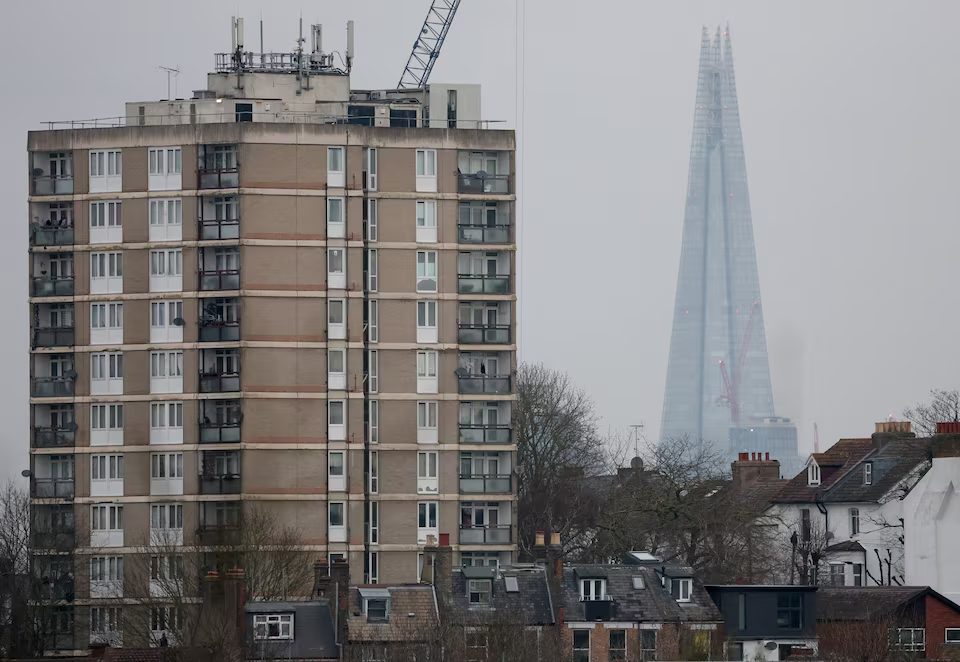
UK moves ahead with first £10 billion wave of low-cost housing plan targeting affordable housing crisis and social rent homes
Britain’s government has set out the details of nearly £10 billion in funding aimed at building lower-cost housing for renters, marking the first major rollout under a much larger ten-year commitment and giving the clearest signal yet of how new Prime Minister Andy Burnham intends to reshape the country’s approach to the housing crisis. The announcement, made Monday, channels more than £7 billion toward London alone, the city widely regarded as ground zero for Britain’s shortage of affordable homes, while committing over £16 billion of the broader programme to areas outside the capital over time.
The funding represents the first tranche of a previously announced £39 billion package spread across a decade, part of the Social and Affordable Homes Programme that was originally launched under former Prime Minister Keir Starmer’s government. Burnham, who moved into Downing Street in July, inherited the programme’s basic architecture but has pushed to reshape its priorities since taking office, most notably around how much control local councils get over where and how the money gets spent.
Under the plan, around 60 percent of homes delivered through the funding will be designated for social rent, a subsidized housing model that offers tenants a discount of roughly 50 percent compared with market rates and can be delivered either by local councils directly or through housing associations. That 60 percent target lines up with the proportion originally set when the programme launched in 2025, but it falls short of Burnham’s campaign pledge to have all housing under the initiative delivered exclusively through local councils rather than a mix of councils and housing associations. The gap between what Burnham promised and what the government has actually committed to in this first phase suggests some of his more ambitious devolution goals are still being negotiated within Whitehall rather than fully realized in policy.
Burnham has been vocal about why he believes empowering councils, rather than relying primarily on private landlords or housing associations, is the better long-term strategy. He has pointed to Britain’s post-World War Two housebuilding era as a model, arguing that giving local authorities the resources and authority to build social housing directly could meaningfully reduce the portion of the welfare budget currently spent subsidizing rents in the private market, while also cutting homelessness and offering more housing security to lower income households. “Councils built this country out of a housing crisis once before,” Burnham has said, framing the current funding wave as an attempt to revive that same model of state-led construction at scale.
The scale of what the government is attempting is significant. Officials say the first wave of financing will support construction of more than 70,000 new homes across England, distributed among 33 organizations the government is calling strategic partners. Notably, councils located outside London have been designated as strategic partners for the first time under this programme, a shift that gives local authorities in cities like Manchester, Birmingham, and Leeds direct access to central funding rather than having to route requests through intermediary housing bodies. According to figures released alongside the announcement, Greater Manchester is expected to receive £529 million to deliver 4,400 homes, the West Midlands will get £409 million for 3,200 homes, the North East has been allocated £445 million to support 3,400 homes, and West Yorkshire will receive £441 million toward 4,000 homes.
London’s specific allocation within the first wave has not yet been broken down by individual council, since the capital’s share of over £7 billion still needs to be divided among boroughs and housing associations. Local authorities in London are expected to deliver more than half of the new homes built under this initial phase, reflecting both the severity of the capital’s housing shortage and the political weight London carries in any national housing strategy. Separately, government estimates suggest around 20,000 new homes in northern English cities are likely to be financed specifically through this first wave, giving an early indication of how heavily the programme intends to invest outside the London-centric housing policies that have often dominated past government initiatives.
The human stakes behind the funding numbers are stark. Government figures cited alongside the announcement noted that almost 180,000 children in England are currently growing up without a permanent home, a statistic officials pointed to directly when justifying the decision to place councils, rather than private developers, at the center of the building push. The reasoning is that council-led housebuilding, when properly funded, can move families out of costly and often unstable temporary accommodation more reliably than waiting for private sector supply to catch up with demand, particularly in a market where private developers have limited financial incentive to prioritize the cheapest end of the rental spectrum.
Beyond the immediate housing numbers, the programme is also designed to advance a second, more structural priority for Burnham: devolution. By giving mayoral authorities greater power to set strategic direction for housing investment in their regions, the government is effectively testing whether shifting decision-making away from Westminster and toward regional leaders produces better outcomes than the more centralized approach used in earlier housing initiatives. Homes England, the public body responsible for distributing much of the funding outside London, has said it plans to work with a broad mix of both established partners and organizations it hasn’t previously funded, a signal that the government wants to widen the pool of who gets access to this money rather than concentrating it among the same handful of large housing associations that have historically dominated affordable housing delivery.
- Summary
- First funding wave supports construction of more than 70,000 new homes
- More than £7 billion of first tranche is earmarked for London
- About 60% of homes delivered through funding would be for social rent
LONDON, Aug 24 (Reuters) – Britain set out plans to spend £10 billion ($13.6 billion) on lower-cost housing for renters with a focus on London, although its target for offering social rent was lower than a pledge made by new Prime Minister Andy Burnham.
The government said around 60% of homes delivered through the funding would be for social rent — a subsidised cheaper form of rent that can be built by local councils or housing associations.
Whether this first £10 billion wave translates into homes being occupied on the timeline the government is promising remains to be seen, and housing policy in Britain has a long history of ambitious funding announcements running into planning delays, construction cost inflation, and local political resistance to new development. But the scale of this rollout, paired with Burnham’s explicit framing around council-led building and devolved authority, marks a meaningful departure in tone from previous approaches, betting that local government, given real money and real autonomy, can move faster on Britain’s housing crisis than a decade of market-driven policy has managed on its own.