
|
Getting your Trinity Audio player ready...
|
Zscaler shares soared Thursday after the cloud security company delivered fiscal fourth-quarter results that beat Wall Street’s expectations across the board, with executives pointing to rising artificial intelligence-related risk as a major driver of urgent demand for the company’s zero trust security tools. Shares jumped roughly 51.5 percent in extended trading following the release, a dramatic reversal for a stock that had fallen about 6.4 percent over the two weeks leading into the report before stabilizing in the days just before earnings.
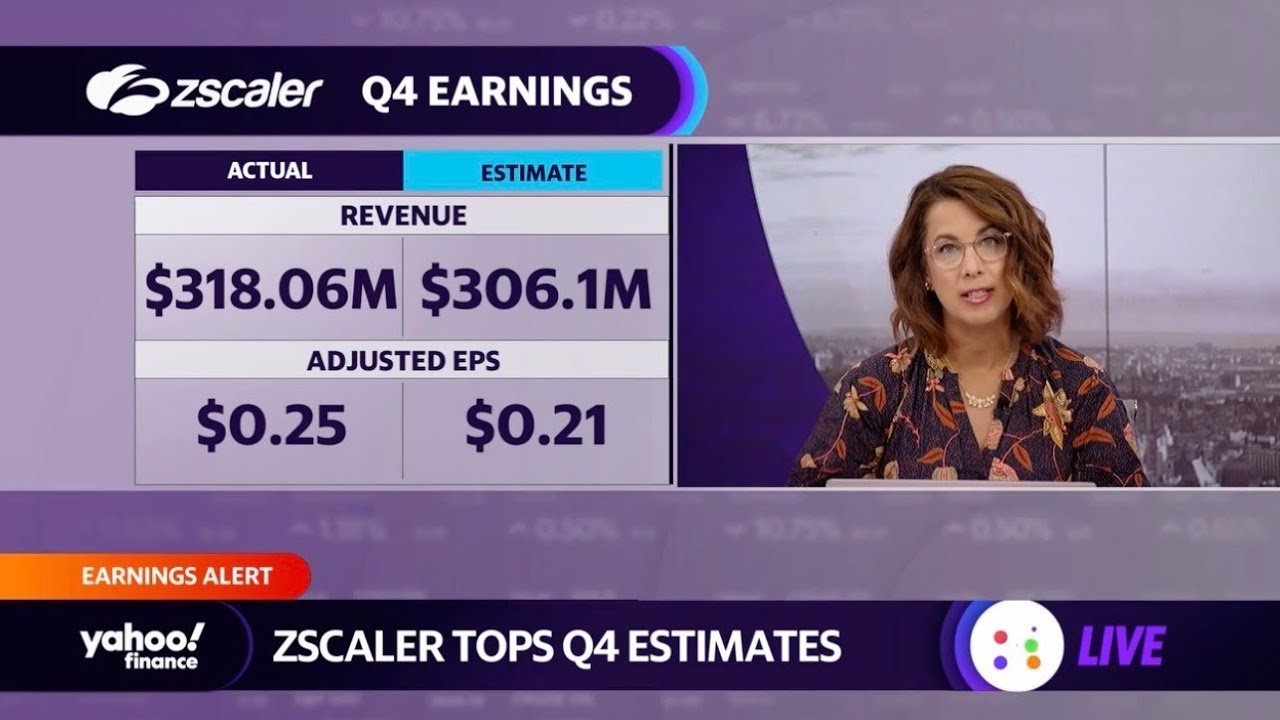
The numbers themselves painted a clearly strong picture. Zscaler reported adjusted earnings per share of $1.19 against analyst expectations of $1.09, while revenue came in at $898 million, comfortably ahead of the $877 million analysts had projected. That revenue figure represented 25 percent growth compared to roughly $719 million in the same quarter a year earlier, a pace consistent with the company’s broader multi-year growth trajectory. Zscaler’s adjusted operating income reached $218.4 million, beating expectations by more than 5 percent and translating to a 24.3 percent margin, alongside a record 24 percent non-GAAP operating margin for the quarter. On a GAAP basis, the company reported a net loss of $3.4 million, or 2 cents per share, a meaningful improvement from the $17.6 million loss, or 11 cents per share, it posted in the same period last year.
Annual recurring revenue, a metric investors watch particularly closely for subscription-based cybersecurity businesses like Zscaler, climbed 25 percent year over year to $3.77 billion, edging past the $3.75 billion estimate from StreetAccount. That kind of consistent double-digit growth in recurring revenue matters significantly for how the market values a company like Zscaler, since it signals durable, contracted customer spending rather than one-time sales that could prove harder to repeat.
What really seems to have driven the scale of Thursday’s rally, though, was Zscaler’s forward guidance rather than the quarterly beat alone. The company forecast first-quarter fiscal 2027 revenue between $935 million and $939 million, comfortably ahead of the roughly $928 million analysts had penciled in, alongside adjusted earnings per share guidance of $1.15 to $1.16. For the full fiscal year, Zscaler guided toward revenue between $3.908 billion and $3.938 billion, with annual recurring revenue expected to land between $4.396 billion and $4.426 billion, and adjusted earnings per share guidance of $4.88 at the midpoint, beating analyst estimates by roughly 6 percent. Given how much of Zscaler’s valuation rests on continued rapid growth, guidance that comfortably clears already-elevated expectations tends to matter more to investors than the historical quarter alone, and that appears to be exactly what happened here.
CEO Jay Chaudhry pointed directly to the company’s Zero Trust cloud security architecture as the central force behind the quarter’s strength, telling CNBC he’s very bullish on a recently launched Zero Trust iteration specifically built for AI agents, describing early momentum around that product as strong and expecting it to accelerate significantly heading into fiscal years 2028 and 2029. That framing fits into a broader theme reshaping the cybersecurity industry throughout 2026, as increasingly sophisticated AI-driven attack methods and the rise of autonomous, agent-led threats push businesses to adopt new categories of security tooling designed specifically for risks that didn’t meaningfully exist just a couple of years ago. Coverage of a recent Microsoft Exchange vulnerability has also highlighted Zscaler’s zero-trust platform as a tool organizations are turning to for reducing exposure to exactly these kinds of emerging threats.
The broader context around this earnings reaction is worth understanding, since it reflects a stock that’s had a genuinely rocky year despite operating in one of technology’s hottest sectors. While competing cybersecurity companies have notched new highs throughout 2026 amid the broader industry rally, Zscaler shares had actually fallen roughly 20 percent heading into this report. Much of that underperformance traces back to the company’s previous quarter, when Zscaler’s stock recorded its worst single-day decline ever after management adopted what it described as a prudent approach to guidance at the time, a cautious posture that clearly didn’t sit well with a market pricing in aggressive growth expectations. Thursday’s much stronger guidance appears to represent a direct reversal of that cautious stance, and investors rewarded it accordingly.
Zscaler’s five-year track record adds useful context for why the market remains willing to assign the company a premium valuation despite recent volatility. According to analysis of the company’s historical performance, Zscaler’s sales grew at a compounded annual growth rate of roughly 37.9 percent over the past five years, a pace that comfortably exceeds the average software company and reflects genuinely sustained demand for its platform rather than a short-term spike. That kind of durable growth track record is precisely what allows a company still posting GAAP net losses to command investor confidence, provided the growth trajectory keeps holding up quarter after quarter.
Looking ahead, Zscaler’s continued premium valuation means the stock remains sensitive to any future signs of growth deceleration, and a few specific factors are worth watching closely in coming quarters. Competition from established cybersecurity vendors continues intensifying as more companies race to capture the same AI-driven security spending wave, and the pace at which Zscaler’s newer agentic AI security products actually convert into meaningful recurring revenue will likely determine whether Chaudhry’s bullish commentary about accelerating growth into fiscal 2028 and 2029 proves accurate or overly optimistic. For now, though, Thursday’s results and guidance gave Zscaler shareholders their strongest single-day validation in recent memory, following a stretch that had tested investor patience considerably more than the company’s underlying growth numbers would typically suggest was warranted.
Further detail on the earnings results is available through Zscaler’s official investor relations page. For more coverage of cybersecurity industry earnings and market trends, visit Business Tech.