
|
Getting your Trinity Audio player ready...
|
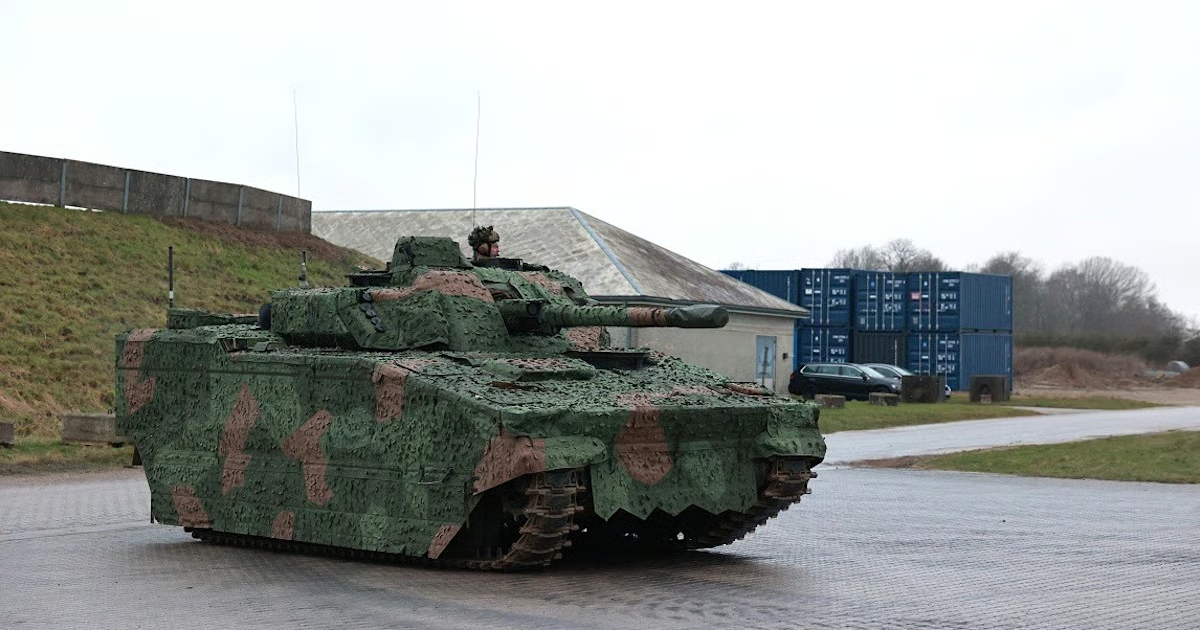
Sweden’s Saab has secured a significant new defence contract with the Netherlands, signing a long-term agreement with the Dutch Ministry of Defence to supply its Barracuda Mobile Camouflage System for the Royal Netherlands Army’s vehicle fleet. The deal, announced by Saab on August 27, adds the Netherlands to a growing list of European militaries turning to multispectral camouflage technology as detection capabilities on the modern battlefield become increasingly sophisticated and harder to evade using traditional concealment methods.
Under the terms of the agreement, the Netherlands gains the ability to place ongoing orders for the Barracuda system across multiple years, rather than committing to a single fixed procurement. Saab has already received its first order within the framework, with deliveries scheduled to begin in the coming years. The initial rollout will focus on outfitting the Royal Netherlands Army’s existing Fennek reconnaissance vehicles and Panzerhaubitze self-propelled artillery systems, though the agreement also leaves room to extend coverage to additional vehicle types down the line as Dutch procurement needs evolve. Industry reporting on the deal has pointed to a contract duration stretching up to a decade, positioning this as one of the more substantial long-term equipment commitments the Netherlands has made in the camouflage and signature management space.
Henning Robach, who heads Saab’s Barracuda business unit, framed the agreement as a meaningful step in supporting the Royal Netherlands Army’s efforts to protect its vehicles from an expanding range of enemy sensor technology, an area where Saab has spent years building out its multispectral concealment expertise. The emphasis on multispectral protection reflects how much the underlying threat has shifted in recent years. Camouflage today has to contend not just with the human eye or standard optical sensors, but with infrared, thermal and increasingly hyperspectral imaging systems that can pick out a vehicle’s heat signature or material composition even when its visual profile blends into the surrounding terrain. Saab’s Barracuda system is designed to address that broader spectrum of detection risk simultaneously, offering woodland, urban and arctic pattern configurations depending on the operational environment a given vehicle is deployed in.
This agreement did not emerge in isolation. Saab’s Barracuda division has spent the past several years steadily expanding its footprint across European defence markets, a trend that reflects both rising continental defence spending and a broader recognition among NATO member states that vehicle survivability increasingly depends on more than armor plating alone. France’s defence procurement agency, the Direction générale de l’armement, previously signed an eight-year framework contract with Saab for Barracuda systems, while Sweden’s own Defence Materiel Administration struck a separate agreement enabling the Swedish Armed Forces to order object-specific camouflage tailored to individual combat vehicles rather than relying solely on general-purpose camouflage netting. Denmark and Norway have likewise maintained long-running relationships with Saab’s Barracuda unit covering both mobile and static camouflage configurations. The Netherlands deal extends that pattern into another major European military, reinforcing Barracuda’s position as one of the more established suppliers in a niche but strategically important corner of the defence industry.
The broader defence and security backdrop helps explain why contracts like this one are landing with growing frequency. European governments have been steadily increasing military spending since 2022, driven by heightened concerns over regional security following Russia’s invasion of Ukraine, and that spending has flowed not only into headline categories like fighter jets, air defence systems and munitions, but into less visible but operationally critical capabilities such as signature management and battlefield concealment. Modern reconnaissance and strike capabilities, including drones equipped with thermal and hyperspectral sensors, have made traditional camouflage far less effective on its own, pushing militaries toward integrated multispectral solutions that address several detection methods at once rather than relying on visual concealment as the primary layer of protection.
For Saab, the Netherlands agreement fits into a period of broader commercial momentum across the company’s defence portfolio. The Barracuda deal follows closely on the heels of several other announcements from the company this year, including an expanded partnership with Embraer to scale up Gripen fighter jet production capacity, the acquisition of UK-based autonomous systems specialist BlueBear, and the unveiling of a concept uncrewed combat aircraft designed to complement Gripen and future crewed platforms in high-risk mission profiles such as electronic warfare and suppression of enemy air defences. Taken together, these moves point to a company actively positioning itself across multiple layers of modern military capability, from crewed and uncrewed aircraft down to the comparatively unglamorous but operationally essential business of keeping ground vehicles hidden from an increasingly sensor-saturated battlefield.
The Netherlands, for its part, has been steadily modernizing its armed forces in recent years amid broader NATO commitments to increase defence readiness and spending across the alliance. Equipping existing platforms like the Fennek and Panzerhaubitze with updated camouflage technology represents a relatively cost-effective way to extend the operational relevance of vehicles already in service, rather than requiring wholesale platform replacement to keep pace with evolving detection threats. That approach, upgrading survivability features on existing fleets rather than only investing in entirely new hardware, has become an increasingly common strategy among European militaries working within constrained budgets even as overall defence spending trends upward.
Saab’s press release did not disclose the specific financial terms of the agreement, and the company has not indicated exactly how many vehicles will ultimately be covered once the full scope of the multi-year contract is realized. What is clear is that the deal reinforces Saab’s standing as a preferred supplier for camouflage and signature management technology among European militaries actively reassessing how they protect their ground vehicle fleets in an era where being seen, in any part of the sensor spectrum, can carry serious operational consequences. As deliveries begin over the coming years, the practical impact of this agreement will likely be measured less by headline contract value and more by how effectively it helps the Royal Netherlands Army keep its vehicles operationally relevant against threats that traditional camouflage was never designed to counter.
Further details on the Barracuda Mobile Camouflage System and Saab’s broader defence portfolio are available through Saab’s official newsroom. For more coverage of global defence industry developments, visit Techora.
Meta Description: Saab signs a long-term deal with the Netherlands Ministry of Defence to supply its Barracuda Mobile Camouflage System for army vehicles.
Focus Keyword: Saab Barracuda Mobile Camouflage System
Related 6 Keywords: Netherlands Ministry of Defence contract, Royal Netherlands Army vehicles, multispectral camouflage technology, Saab defence contract 2026, Fennek Panzerhaubitze camouflage, European defence spending 2026