|
Getting your Trinity Audio player ready...
|
Dacia is bringing its best-selling electric city car back to European soil, unveiling a completely redesigned second-generation Spring that shifts production from a plant in China to Renault’s facility in Novo Mesto, Slovenia. The move, announced this week, addresses a problem that has quietly held back one of the Renault-owned budget brand’s most important products, France’s own electric vehicle subsidy program has excluded the current China-built Spring, leaving Dacia largely locked out of exactly the kind of government-backed EV incentives that have driven record electric vehicle adoption across its home market this year.
The scale of what Dacia has missed out on is genuinely significant. According to Frank Marotte, Dacia’s vice president for sales and operations, the company has watched EV demand grow substantially across nearly every vehicle segment since April, a trend he attributed directly to buyers increasingly favoring electric options once subsidies make them price-competitive with combustion alternatives. Yet Dacia found itself unable to fully capitalize on that shift, Marotte told Reuters, “which is holding us back as we only have one electric model,” and that one model happened to be built in a country whose vehicles don’t qualify for France’s low-income EV purchase incentives. The consequences show up clearly in the sales data. Dacia’s sales fell in France during both July and August even as EVs reached record shares of new car registrations, 35 percent in July and 38 percent in August, a surge partly driven by higher fuel prices tied to the ongoing US-Iran conflict pushing more buyers toward electric alternatives. Through August, the current Spring ranked just 55th among France’s best-selling vehicles overall, trailing considerably behind competitors including Tesla’s Model Y and Renault’s own 5 and Twingo models.
The new Spring addresses that subsidy gap directly by relocating production entirely within the European Union’s customs union. Built at Renault’s Novo Mesto plant in Slovenia, a facility that has assembled small Renault Group models for decades, the new Spring shares its underlying platform with the revived Renault Twingo E-Tech and a related Nissan sister model. That shared architecture matters enormously for keeping costs down, since developing an entirely new platform from scratch for a budget-focused city car would have been considerably more expensive and time-consuming than adapting technology Renault had already engineered for the Twingo. Dacia says the entire development process for the new Spring took less than two years, a notably fast cycle the company credits partly to substantial support from Renault Group’s dedicated EV research and development center in Shanghai, known as ACDC, which contributed the vehicle’s entire powertrain engineering despite the finished car now being assembled in Europe rather than China.
Beyond simply qualifying for subsidies, European assembly also shields the new Spring from tariffs the EU has imposed on Chinese-made electric vehicles in recent years, a second meaningful cost advantage layered on top of subsidy eligibility. Slovenia’s comparatively lower labor costs relative to France or Germany play a role too, helping Dacia keep the new Spring’s starting price at €17,900, or roughly $20,821, despite the added expense and complexity of shifting production westward. Once French EV purchase credits are applied for eligible buyers, that starting price could drop as low as €12,200, according to reporting on the launch, a figure that puts genuine pressure on competing budget EVs now that the pricing playing field between Chinese and European-built cars has shifted meaningfully in Dacia’s favor.
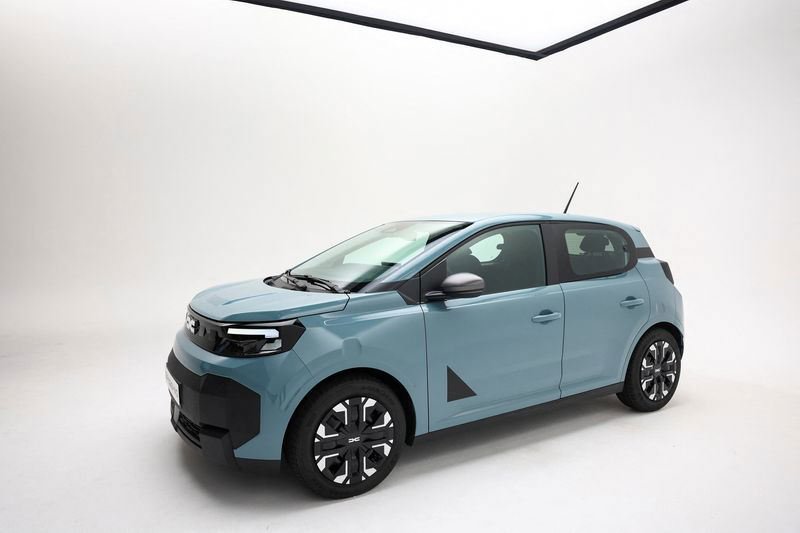
Physically, the new Spring represents a substantial departure from its predecessor rather than a simple manufacturing relocation. The redesigned model is 18 centimeters longer and 18 centimeters wider than the outgoing version, pushing it toward the upper end of Europe’s A-segment vehicle class and delivering meaningfully more interior space, with boot capacity climbing to 337 liters, or 1,283 liters with the rear seats folded down, plus an optional 18-liter front trunk. Dacia has given the car a more rugged, muscular styling direction as well, a deliberate attempt to broaden its appeal beyond the current Spring’s narrower positioning. Under the hood, a 27.5 kWh LFP battery delivers up to 155 miles of WLTP range, translating to roughly 133 miles under stricter EPA testing standards, numbers that keep the car firmly positioned for city and suburban driving rather than long-distance travel. Dacia’s own usage data on existing Spring owners supports that positioning directly, showing average daily driving distances of just 34 kilometers, with roughly 75 percent of charging happening at home rather than at public stations.
Charging specifications reflect the car’s budget-focused engineering throughout. The standard 6.6 kW onboard AC charger takes 2 hours and 55 minutes to charge from 15 to 80 percent using a 7 kW home wallbox, stretching to a full nine hours on a standard domestic socket. Buyers wanting faster charging can opt for an available Charge Pack that adds an 11 kW AC charger and a 50 kW DC fast charger, cutting the DC charging window down to just 28 minutes while also enabling vehicle-to-load functionality, letting the car power external devices like a coffee machine or an e-bike, a genuinely practical feature for a vehicle marketed heavily around everyday, budget-conscious ownership.
The competitive backdrop driving this entire strategic shift centers on Chinese automakers’ rapidly expanding presence across the European EV market. Geely’s EX5, priced around $15,000, has become something of a benchmark for what European buyers now expect from an affordable electric city car, and Dacia’s answer is a vehicle that undercuts its own predecessor on price while sitting safely inside the EU’s tariff wall and remaining eligible for exactly the subsidy programs that wall was designed to protect domestic manufacturing against foreign competition. Dacia has sold roughly 210,000 Spring EVs since the model first launched in 2021, giving the nameplate genuine commercial momentum heading into this relaunch, and the company has confirmed the new Spring represents the first of four fully electric Dacia models planned by 2030, with deliveries of the redesigned car expected to begin in 2027.
For a brand that built its entire identity around no-frills, budget-conscious motoring, primarily through combustion-engine vehicles until fairly recently, this relaunch signals a genuine strategic pivot toward EVs backed by real manufacturing investment rather than a token single electric offering. Whether European assembly and subsidy eligibility prove sufficient to meaningfully close the gap against increasingly aggressive Chinese competitors will likely become clearer once the new Spring actually reaches dealerships and French buyers get their first real chance to weigh it against rivals now competing on price at a scale European manufacturers have historically struggled to match.
Further detail on the new Spring is available through Dacia’s official press site. For more coverage of the global EV market and automotive manufacturing trends, visit Business Tech.