|
Getting your Trinity Audio player ready...
|
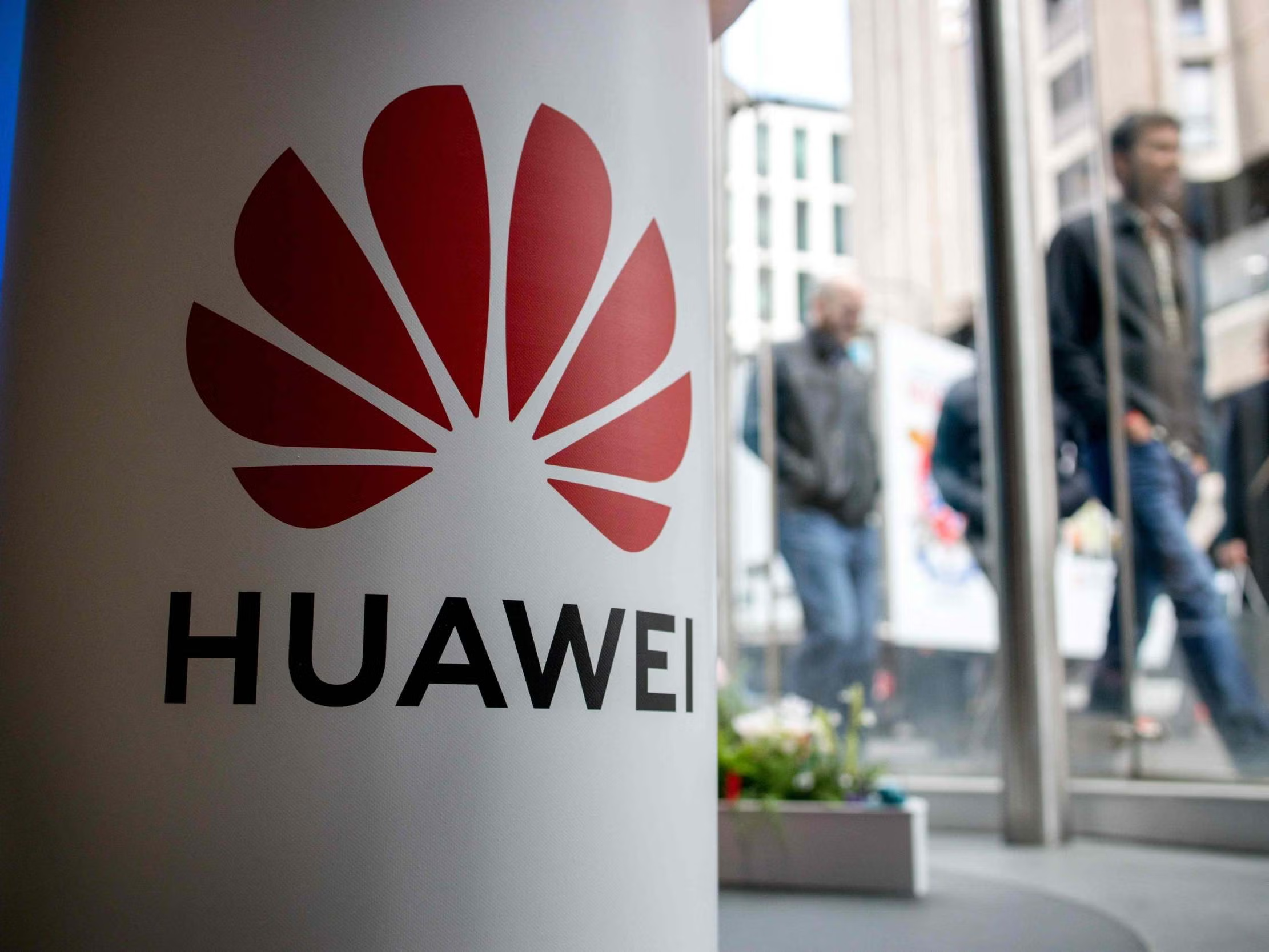
Eight years after American prosecutors quietly filed charges against Huawei Technologies, the Chinese telecom giant is finally walking into a Brooklyn courtroom to face them. Jury selection began this week in federal court in New York before US District Judge Ann Donnelly, marking the start of a trial expected to run for roughly three months. It is one of the longest-running legal battles the US government has waged against a Chinese technology company, and its outcome could carry weight far beyond the courtroom.
The case traces back to 2018, when Huawei’s chief financial officer, Meng Wanzhou, was arrested at Vancouver’s airport on a US extradition request. Her detention triggered a diplomatic standoff involving Washington, Beijing and Ottawa that lasted nearly three years. Meng was eventually released in September 2021 as part of a prisoner swap that also freed two Canadians held in China. The US dropped its extradition request and agreed to drop the fraud charges against her once she admitted to making false statements about Huawei’s dealings with Iran. That admission, however, did not end the case. It simply shifted the spotlight onto the company itself, and that is the case now going to trial.
Prosecutors accuse Huawei of using a Hong Kong-based front company called Skycom to sell embargoed American technology to Iran and move money out of the country through the international banking system, in breach of US sanctions. The indictment alleges that one bank, widely reported to be HSBC, cleared more than $100 million in US-dollar transactions tied to Skycom after Huawei executives, including Meng, misrepresented the true ownership and control of the firm to bank officials. Much of the original reporting that fed into the government’s case traces back to Reuters investigations published in 2012 and 2013, which first exposed the close ties between Huawei and Skycom.
Beyond the Iran sanctions allegations, Huawei also faces charges of conspiring to steal trade secrets from five American technology companies, along with counts of racketeering, wire fraud, money laundering and obstruction. Prosecutors further allege the company misled investigators about business activities in North Korea and supplied surveillance equipment that helped Iranian authorities track protesters during the 2009 anti-government demonstrations in Tehran. The conduct described in the indictment spans roughly two decades, from 1999 to 2020, giving prosecutors a wide window to build their case in front of jurors.
Huawei has pleaded not guilty to every charge and has consistently denied wrongdoing. The company has described the trade secret allegations as a rehash of commercial disputes that were already settled years ago, and it has argued in court filings that the broader criminal case should be thrown out. A Huawei spokesperson pushed back firmly on the government’s framing over the weekend, calling the prosecution’s account of events demonstrably false. Beijing has echoed that defiance, characterising the trial as part of a wider American campaign to slow China’s technological rise rather than a genuine pursuit of justice.
The timing of the trial is hard to ignore. It is set to unfold just as tensions between Washington and Beijing over technology dominance reach into new territory, from semiconductors to artificial intelligence. The proceedings are expected to overlap with a planned meeting later this month between Chinese President Xi Jinping and President Donald Trump, adding a layer of geopolitical weight to what is, on paper, a white-collar criminal case. Jury selection alone has reflected the sensitivity of the matter, with potential jurors filling out lengthy questionnaires probing their views on the Chinese and Iranian governments before being considered for the panel.
A conviction on the Iran-related charges would strengthen the US government’s justification for placing Huawei on its trade blacklist back in 2019, a move that cut the company off from key American suppliers and reshaped its global business almost overnight. That blacklisting, paired with years of sanctions restricting Huawei’s access to advanced chips, forced the company to rebuild large parts of its supply chain from scratch. Rather than retreating, Huawei has pushed further into new territory, positioning itself as a central player in China’s push to develop homegrown artificial intelligence chips, alongside its long-standing dominance in telecom network equipment.
If the company is convicted, prosecutors have said they will pursue forfeiture of property or proceeds connected to the alleged illegal activity, a step that could add financial consequences on top of the reputational damage the case has already inflicted. The original charges were filed during President Trump’s first term in office, a period that also saw the administration lobby allied nations to strip Huawei equipment from their telecommunications networks over espionage concerns, arguing that Chinese law could compel the company to hand over data to its government. Huawei has always rejected that characterisation of its operations.
For a company that has weathered blacklisting, chip shortages and years of restricted access to Western markets, this trial represents something different: a direct legal reckoning rather than a policy restriction. Whatever the jury decides, the case is likely to be read as a signal of how far the US is willing to go in pursuing Chinese tech firms through the courts, not just through trade policy. Readers following the broader intersection of technology, regulation and global business can find more coverage like this on Business Tech, which regularly tracks how international policy shifts ripple through the tech industry.
Huawei, for its part, has continued to expand its footprint well beyond the smartphones and network gear that first built its global reputation. Details on the company’s current business lines and public statements are available on its official website, huawei.com, where it has posted responses to the ongoing litigation as the trial gets underway. With jury selection now behind it, the coming months will determine whether one of China’s most recognisable technology companies faces a formal conviction on US soil, nearly a decade after the case first began.