
|
Getting your Trinity Audio player ready...
|
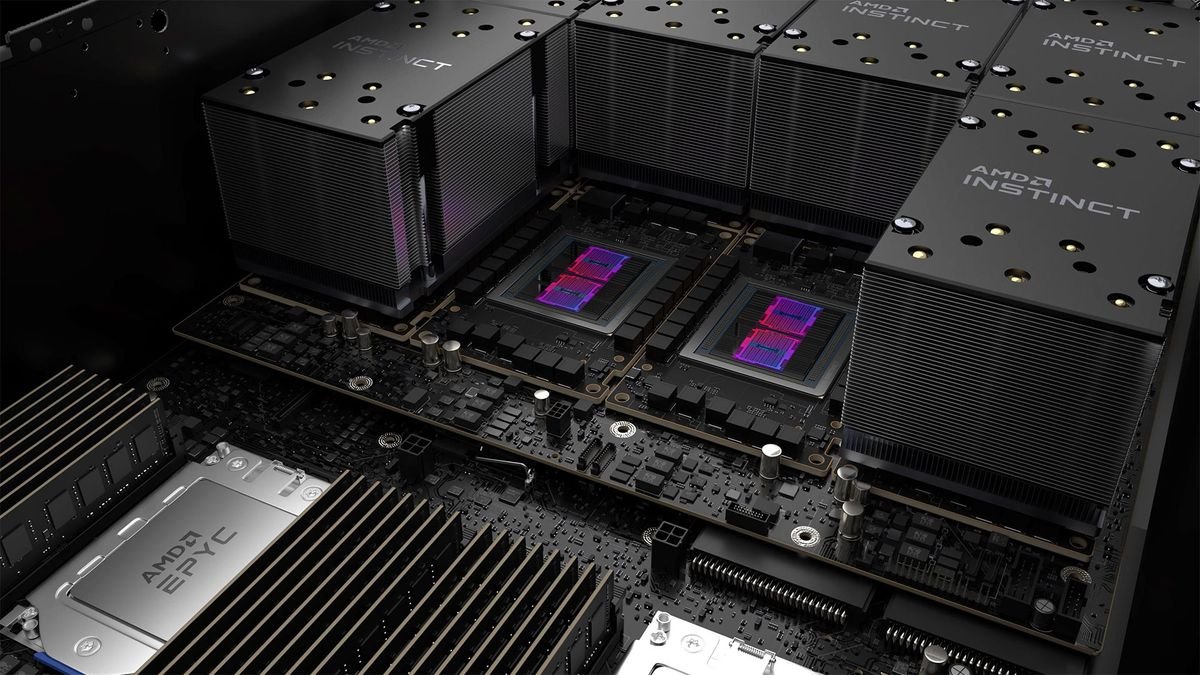
Europe’s ambitions to build genuinely sovereign artificial intelligence infrastructure took a significant step forward this week, with the announcement that AMD’s next-generation Instinct MI430X GPUs and sixth-generation EPYC 256-core processors will power LUMI-AI, a new supercomputer set to become one of the continent’s most capable AI and high-performance computing systems. The €387.8 million project, awarded to French technology company Bull, will be deployed at the CSC data center in Kajaani, Finland, home to the original LUMI supercomputer, and is being developed under the EuroHPC Joint Undertaking in partnership with the LUMI AI Factory consortium.
The scale of the ambition behind LUMI-AI becomes clearer when measured against its predecessor. According to the project announcement, the new system will deliver roughly a tenfold increase in artificial intelligence processing capacity compared to the current LUMI supercomputer, while also nearly doubling that system’s existing high-performance computing capability. LUMI itself has served as a cornerstone of European AI and scientific research since becoming operational in 2022, ranking among the world’s fastest and most efficient supercomputers and currently sitting at number 11 on the global Top500 list. Building a successor system that dramatically expands AI capacity while maintaining strong general-purpose HPC performance reflects the increasingly dual-purpose demands being placed on Europe’s largest computing infrastructure investments, systems that need to simultaneously serve traditional scientific simulation work and the rapidly growing computational appetite of modern AI research.
Bull, a subsidiary of the French technology group operating under nearly a century of engineering history in high-performance computing, artificial intelligence and quantum technologies, will build LUMI-AI using its BullSequana XH3500 architecture, a platform the company has purpose-built for demanding AI workloads. The system will rely on Bull’s patented water-cooling technology alongside its proprietary high-performance interconnect, known as BXI, to manage the substantial thermal and data-throughput demands that come with packing next-generation AMD Instinct GPUs and high-core-count EPYC processors into a single liquid-cooled deployment. With approximately 720 million euros in annual revenue and roughly 3,000 professionals operating across 32 countries, Bull brings considerable institutional depth to a project of this scale and complexity.
AMD’s role in the announcement extends a partnership with European supercomputing infrastructure that stretches back several years. The original LUMI system, when it was first commissioned, similarly relied on AMD EPYC CPUs paired with AMD Instinct GPUs to reach its targeted 552 petaflops of theoretical peak performance, a configuration that made LUMI one of the most powerful AMD-based systems in the world at the time of its construction. That earlier deployment was built around 10,240 AMD Radeon Instinct MI250X GPUs alongside 362,496 CPU cores, delivering roughly 379 petaFLOPS of sustained performance at a total project cost of around 144.5 million euros. LUMI-AI’s considerably larger budget and its use of AMD’s newer MI430X GPU architecture alongside sixth-generation EPYC processors signals a substantial generational leap in both raw computing capacity and the underlying silicon driving it.
The strategic framing behind this announcement leans heavily on the concept of European technological sovereignty, a theme that has become increasingly central to how the continent approaches large-scale AI infrastructure investment. AMD’s own statement on the partnership described LUMI-AI as an important step in strengthening Europe’s sovereign AI capacity, emphasizing that the system would give researchers, startups and industry the computational scale and flexibility needed to shape Europe’s AI future on its own terms rather than depending entirely on infrastructure built and controlled outside the continent. That sovereignty angle has taken on growing urgency across European policy circles in recent years, as concerns have mounted over the continent’s heavy reliance on American and Asian technology providers for the underlying compute infrastructure that increasingly determines competitiveness in AI research, healthcare modeling, climate science and industrial simulation.
Bull’s leadership echoed that framing in its own commentary on the project, describing the mission behind systems like LUMI-AI as providing the technologies that enable innovation, competitiveness and scientific excellence while strengthening Europe’s broader technological autonomy. That language reflects a consistent pattern across recent EuroHPC-backed announcements, where large supercomputing contracts are increasingly positioned not merely as scientific infrastructure investments but as strategically significant assets in a broader geopolitical competition over who controls the computational backbone of next-generation AI development.
Once operational, LUMI-AI will be shared across the broader LUMI consortium, a group of European countries that has historically included Belgium, the Czech Republic, Denmark, Estonia, Finland, Iceland, Norway, Poland, Sweden and Switzerland, giving researchers and organizations across a wide swath of the continent access to genuinely frontier-class AI computing resources rather than concentrating that capacity within a single national research institution. That shared-access model has been a defining feature of the EuroHPC Joint Undertaking’s broader strategy since its inception, aiming to pool resources across member states to build computing infrastructure that no individual European country could easily justify funding entirely on its own.
The announcement also fits within AMD’s broader momentum across European supercomputing more generally. According to figures the company shared earlier this year, AMD-powered systems currently account for four of the world’s ten fastest supercomputers and four of the ten most energy-efficient systems on the Green500 list, with a total of 191 AMD-powered systems appearing across the global Top500 rankings, an eleven percent increase year over year. Other recent European deployments include Eni’s HPC7 system in Italy, currently ranked sixth globally, and newly announced systems at the University of Cambridge built around AMD’s MI355X GPUs, suggesting LUMI-AI represents one node within a considerably broader pattern of AMD hardware anchoring Europe’s expanding high-performance computing and AI infrastructure ambitions.
For European researchers and industry, the practical payoff from LUMI-AI will likely take shape gradually as the system moves through construction, installation and eventual commissioning at the Kajaani facility. Given how quickly AI computational demands have escalated across scientific research, industrial modeling and commercial AI development in recent years, a system offering roughly ten times the AI capacity of one of Europe’s flagship existing supercomputers arrives at a moment when that additional capacity is likely to be absorbed by demand almost as soon as it comes online.
Further technical detail on the project is available through AMD’s official newsroom. For more coverage of supercomputing and AI infrastructure developments, visit Business Tech.