|
Getting your Trinity Audio player ready...
|
Macron Urges EU to Enact Social Media Ban for Under-15s, Citing Child Safety in Letter to Von der Leyen
French President Emmanuel Macron has formally asked the European Commission to push through EU-wide legislation banning children under 15 from social media, turning to Brussels after his own attempt to pass a national ban collapsed at home. The request came in a letter to Commission President Ursula von der Leyen dated August 29, and its timing, arriving weeks before her flagship State of the Union address to the European Parliament, suggests Macron is trying to force the issue onto the EU’s agenda before national efforts elsewhere in Europe lose momentum.
The letter followed a setback in France. A French proposal banning under-15s from social media was struck down in August by France’s Constitutional Council, derailing legislation that had been expected to take effect before the start of the school year. Rather than abandoning the effort, Macron shifted his focus to the EU level, arguing that a purely national law was no longer sufficient. In the letter, Macron said it had become urgent to introduce a bloc-wide ban through new EU legislation after France’s Constitutional Council struck down the national bill this summer before it was due to take effect in September. He framed the ask directly, stating that it had become essential to go further and, through a new European legislative text, harmonize a ban on access to social media platforms for children under the age of 15, in order to protect all children across the Union.
Macron’s reasoning centers on three specific concerns. He pointed to addictive platform design, weak account safety protections for minors, and exposure to pornography as justification for swift EU-level action. Those arguments echo concerns that have circulated across European policy circles for several years, but Macron’s push carries additional weight because it comes from the leader of one of the EU’s founding member states, at a moment when several other European governments are weighing their own restrictions.
Von der Leyen has already signaled that Brussels is moving in this direction, though her approach so far has been notably more cautious than what Macron is requesting. She said in July that the European Union would move to limit young children’s access to social media across the 27-member bloc, citing proposals from two experts recommending a tiered system. Under that approach, children under 13 would only be allowed limited, supervised access, with restrictions eased gradually as they get older. That structure is closer to graduated parental controls than an outright ban, and it stands in contrast to what Macron is now formally requesting. Macron is seeking a tougher approach, pushing for a blanket ban on social media access until the age of 15.
The backdrop to this push stretches back further than the August court ruling. Macron has linked the issue to youth violence and online harm for over a year, and the urgency escalated after a specific incident earlier in 2026. Macron said in June that France would ban access to social media for children under the age of 15 within a few months if it was not done at a European level, following a school staff member being stabbed by a 14-year-old student in Nogent. That event pushed the issue from a policy debate into a more immediate political priority, and it explains why Macron has continued pressing the issue at the EU level even after his domestic legislation failed.
France already has some restrictions on the books, though enforcement has been inconsistent. The country passed a law in 2023 requiring platforms to obtain parental consent before under-15s could create social media accounts, but implementation ran into practical obstacles almost immediately, since platforms have limited reliable ways to verify a user’s age without more invasive identity checks. Mobile phones have also been banned in French primary and middle schools since 2018, a restriction that predates the current fight over social media access entirely and reflects a longer-running effort in France to limit how much screen time young students have during school hours.
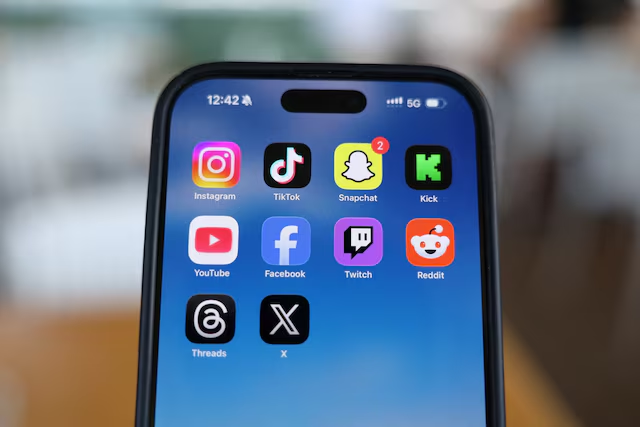
Macron’s EU appeal also draws heavily on Australia’s example. Australia introduced a nationwide ban restricting anyone under 16 from using major platforms including Facebook, Instagram, Snapchat, TikTok, and YouTube, a policy that took effect in December and has been closely watched by governments across Europe as one of the first large-scale tests of an outright age-based social media ban rather than a consent or verification-based system. In Australia, teenagers under the age of 16 cannot use social media platforms like Snapchat, TikTok, Facebook, Instagram, and X. Whether the EU adopts something closer to that model, or sticks with von der Leyen’s tiered, supervised-access framework, will likely shape how effective any resulting policy actually is in practice, since a hard age cutoff and a graduated access system carry very different enforcement burdens for platforms operating across 27 member states with different legal systems.
The European Parliament has already weighed in on the broader question, even if it has stopped short of endorsing a specific age threshold. Lawmakers have previously urged the EU to establish minimum ages for children to access social media in response to rising concerns about adolescent mental health tied to excessive platform use, though enforcement of any such minimums currently rests with individual member states rather than Brussels. That patchwork is precisely what Macron is now asking the European Commission to change, arguing that a single, harmonized EU law would be more effective than 27 separate national approaches that platforms can navigate unevenly.
For social media companies with major EU user bases, including Meta, TikTok’s parent company ByteDance, and Snap, the outcome of this debate carries real regulatory weight. An EU-wide age restriction, if it moves from proposal to binding law, would require significant changes to age verification systems across the bloc’s roughly 450 million residents, a scale of enforcement that dwarfs Australia’s rollout. Whether von der Leyen responds to Macron’s letter with legislation matching his blanket-ban approach, or holds to the more gradual tiered system her office outlined in July, should become clearer once she delivers her State of the Union address to the European Parliament later this month.