
|
Getting your Trinity Audio player ready...
|
SpaceX Marks 700th Falcon Rocket Flight With Final Satellites for SES O3b mPOWER Constellation
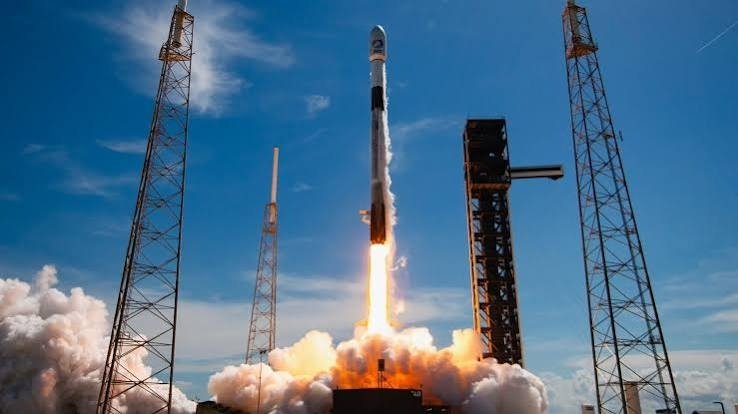
SpaceX notched a significant milestone this weekend, flying its 700th mission across the Falcon rocket family since the program’s earliest days two decades ago. A Falcon 9 lifted off from Space Launch Complex 40 at Cape Canaveral Space Force Station on September 13, 2026, at 2:49pm Eastern time, carrying the final three satellites needed to complete SES’s O3b mPOWER broadband constellation for the Luxembourg-based operator.
The number itself tells a story about how far SpaceX has come as a launch provider. Of the 700 total Falcon family flights, 687 have been carried out by the workhorse Falcon 9, while the remaining 13 belong to the heavy-lift Falcon Heavy, which remains the company’s only other active member of the Falcon lineage. The family’s roots trace back to March 2006, when the much smaller Falcon 1 made its debut launching the FalconSAT-2 mission from SpaceX’s launch site on Omelek Island in the Marshall Islands. That first rocket flew just five times total, reaching orbit successfully on only two of those attempts. Its first successful flight came on September 28, 2008, its fourth try, after three consecutive failures that Elon Musk has said repeatedly would have bankrupted the company had that fourth launch also failed. Falcon 1 gave way to the Falcon 9 in 2010, and the rest of the program’s growth has unfolded from there.
The scale of that growth becomes clearer when you look at recent years alongside the earliest ones. SpaceX flew just a single Falcon 1 mission in all of 2006. By comparison, the company logged 138 total Falcon missions in 2024 and 170 in 2025. This year alone, SpaceX crossed the 100-launch mark on August 19, and the O3b mPOWER mission represented its 107th orbital flight of 2026 to date, with the majority of that volume coming from Starlink satellite deployments supporting the company’s own broadband megaconstellation, which now numbers close to 11,000 operational satellites in orbit.
The milestone flight itself used a Falcon 9 first-stage booster with an extensive flight history behind it, reportedly flying for roughly the 29th time. That kind of reuse cadence has become almost routine for SpaceX at this point, but it’s worth remembering how radical the concept of routinely reflying orbital-class rocket boosters looked when the company first started attempting propulsive landings a decade ago. This particular booster had previously supported four International Space Station cargo missions, the European Space Agency’s Euclid space telescope, SES’s Astra 1P satellite, and more than twenty separate batches of Starlink satellites over its operational lifetime. Following stage separation, the booster returned to Earth and landed on one of SpaceX’s droneships stationed in the Atlantic Ocean roughly nine minutes after liftoff, adding another entry to the company’s long-running tally of successful booster recoveries.
The mission also closed out a meaningful chapter for its customer. SES’s O3b mPOWER constellation now sits complete with its full network of medium Earth orbit satellites, giving the company a broadband infrastructure layer that operates in a different orbital regime and serves a different market segment than SpaceX’s own Starlink system, which sits primarily in low Earth orbit. Boeing built the satellites delivered on this particular flight, continuing a partnership between the aerospace manufacturer and SES that has spanned the constellation’s full rollout.
Weather conditions leading up to launch were far from ideal. The Space Force’s weather squadron had forecast only a 60 percent chance of favorable conditions at the opening of the launch window, with that probability dropping to around 40 percent by the window’s close due to sea breeze activity and localized storm risk in the area. Despite the marginal conditions, the Falcon 9 cleared the tower without issue and proceeded through a clean ascent.
The 700th flight lands at a particularly active moment for SpaceX more broadly. The company has been shifting Falcon 9 flights carrying its own Starlink satellites over to its West Coast launch facilities at Vandenberg Space Force Base, freeing up capacity on Florida’s Space Coast as it prepares for Starship-Super Heavy’s next major test flight from the same region. Ground testing on the Starship vehicle and its booster has reportedly wrapped up, with regulatory filings pointing toward a target launch window opening as early as September 15. That timing puts a major Starship milestone landing just days after the Falcon program’s own 700-flight mark, giving SpaceX two significant program milestones within the same short stretch.
For a company whose rocket family very nearly didn’t survive its first year of operation, reaching 700 total flights represents a fairly remarkable trajectory. What started with a single small rocket attempting to reach orbit from a remote Pacific atoll has grown into arguably the most prolific launch operation in the history of spaceflight, one now averaging more missions in a single year than most national space programs have flown across their entire histories. The Falcon family isn’t done accumulating milestones either, with SpaceX’s launch cadence showing no real signs of slowing as Starlink deployment continues alongside a steady stream of commercial, government and national security payloads still on the manifest.