Every day since a wall of mud, rock, and glacial meltwater tore through a border crossing high in the Himalayas last month, Ajay Gupta has called and messaged his daughter, hoping this will be the day she finally answers. It has been nearly three weeks since Arushi Gupta, a 33-year-old Indian national, sent her last message from the Gyirong Port immigration post while crossing from Nepal into Tibet on a pilgrimage to Mount Kailash, one of Hinduism’s most sacred sites. Her parents have not heard from her since.
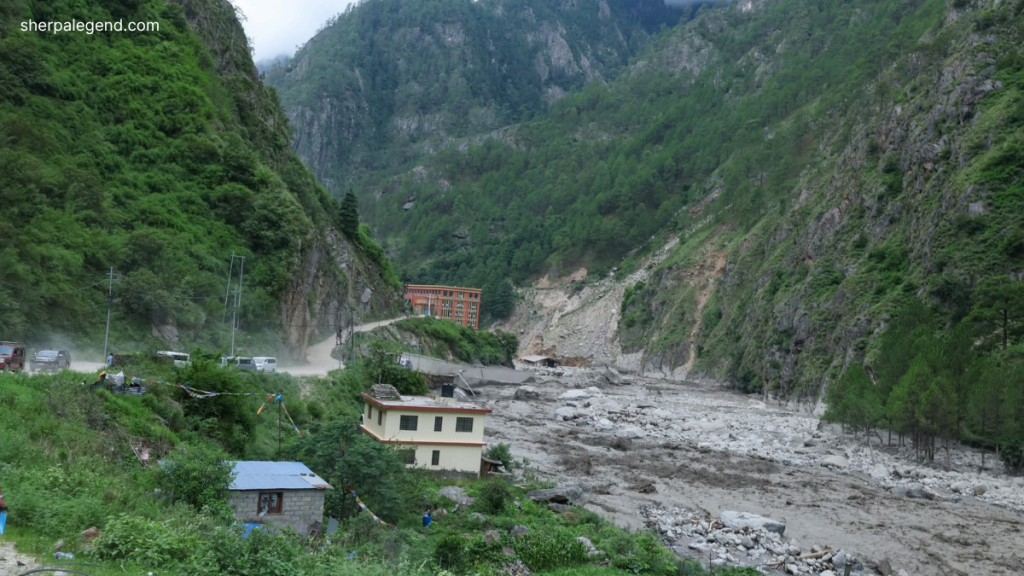
The disaster that swallowed the border crossing struck on the morning of August 26, when a massive chunk of glacier sheared off high on a mountain near the Nepal-China border and plunged roughly 7,000 feet down to the valley below. The collapse triggered tremors strong enough to register on seismometers around the world, initially misread by the US Geological Survey as a magnitude 4.4 earthquake before scientists pieced together what had actually happened using before-and-after satellite imagery. What followed was a torrent of water, mud, and debris that tore through the steep mountain valleys, hitting villages along a 72-kilometer stretch of the Trishuli River with what one witness described as the force of liquid cement.
The scale of loss has been staggering. On the Nepal side of the border, at least 1,386 people have been confirmed dead, with 5,130 still listed as missing. Across the border in China’s Gyirong county, at least 43 people were killed and 519 remain unaccounted for, among them a significant number of foreign nationals who were passing through the region at the time, many on the same pilgrimage route Arushi had set out on that morning.
For Ajay Gupta and his wife, Anshu, the last confirmed sign of their daughter came through a WhatsApp message she sent her father that morning, telling him she was just a fifteen-minute walk from the border. Up until then, her updates had come steadily throughout the trip, small details of the journey, a cup of milky tea at a hotel in Nepal, travel tablets taken before the climb. Then the messages stopped. Speaking to Reuters in New Delhi, the 63-year-old father said he remains convinced his daughter made it across into Tibet before the flood hit, and that she is safe somewhere at higher elevation, simply cut off from communication. “I am convinced, her husband is convinced, my wife is convinced,” he said.
That kind of conviction, held onto by families with no confirmed information either way, has become a recurring thread among those still waiting for news nearly a month on. Vladyslava Horlova, a 22-year-old Ukrainian film student living in Bergen, Norway, whose mother is among those still missing, described the same fragile hope in similar terms, pointing out that as painful as the uncertainty is, her mother has not been confirmed dead either, and that absence of confirmation is, for now, the only thing keeping hope alive.
Search and rescue operations have produced a handful of remarkable finds since the disaster struck, including survivors pulled from tunnels inside Nepal’s hydropower plants days after the initial flooding. But the steady flow of updates that families relied on in the disaster’s immediate aftermath has slowed considerably in recent weeks, leaving relatives like the Guptas increasingly dependent on their own calls and messages rather than official search updates. China’s Gyirong county has not been fully cleared for further search operations either, with state media warning of continued landslide and flash flood risk from unstable ground and newly formed barrier lakes created by the original collapse, complications that have made recovery efforts in the harder-hit Chinese side of the border especially slow and dangerous.
The disaster has since been formally documented as the 2026 Nepal-Tibet floods, also referred to regionally as the Bhotekoshi or Rasuwa floods, and stands as one of the deadliest natural disasters to strike the Nepal-China border region in recent memory. The flood’s force was strong enough to carry the bodies of some victims as far as 240 kilometers downstream, complicating identification efforts for families still searching for confirmation, one way or another, about loved ones who vanished that morning.
For now, Ajay Gupta continues his daily routine of calling a number that doesn’t answer, sending messages that go unread, holding onto the same conviction that has carried him through nearly three weeks without word. It is a routine shared by thousands of families across two countries, waiting for information that search teams, stretched thin across a disaster zone still too unstable in places to fully search, have not yet been able to provide.