|
Getting your Trinity Audio player ready...
|
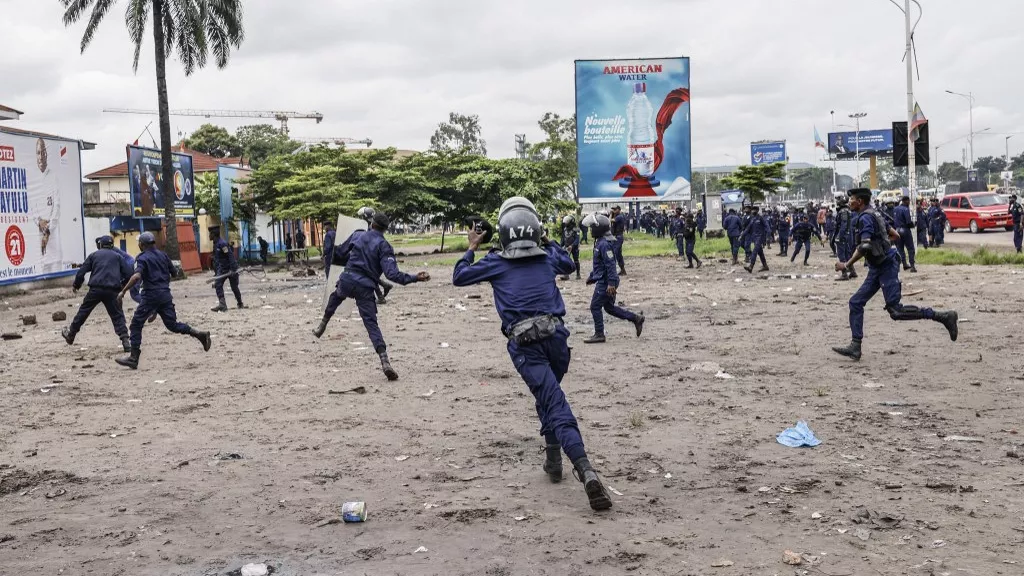
Police in the Democratic Republic of Congo dispersed opposition protests in several cities on Tuesday, firing tear gas and warning shots in the capital Kinshasa as hundreds of demonstrators marched against proposed constitutional changes that critics say could pave the way for President Felix Tshisekedi to seek a third term in office. The protests, coordinated across multiple cities on the same day parliament opened its September session, marked the latest and most visible flashpoint yet in a mounting standoff between Tshisekedi’s government and a united opposition coalition determined to block any attempt to extend presidential term limits.
The demonstrations were organized by the C64 coalition, a bloc uniting opposition parties led by former presidential candidates Martin Fayulu, Moise Katumbi, and Jean-Marc Kabund, among others. In Kinshasa, organizers and provincial authorities had agreed in advance on a modified march route that avoided the Palais du Peuple, the seat of Congo’s parliament. A procession estimated at roughly 5,000 people set off from Échangeur de Limete shortly after noon, moving along Boulevard Lumumba toward Boulevard Triomphal near the headquarters of Fayulu’s ECiDé party, with police escorting the march and traffic disrupted along parts of the route for much of the afternoon.
The demonstration began peacefully but grew tense as it passed through Limete, near the headquarters of the ruling UDPS party. Youth affiliated with UDPS, including members of a group called Force du Progrès, set up barriers in the area, and clashes broke out between protesters and pro-government supporters. Police responded by firing tear gas and warning shots to break up the confrontation, according to two Reuters witnesses on the ground. Speaking after the clashes, Fayulu accused the government of coordinating with party-aligned militia groups, telling reporters he considered himself fortunate to have made it out safely.
Outside the capital, authorities took a considerably harder line from the outset. Police used tear gas and made arrests to prevent or quickly disperse planned demonstrations in Kananga, Lubumbashi, Uvira, Mbandaka, Bandundu, Kikwit, and Kisangani, according to reporting on the nationwide protest effort. Local officials in several of those cities cited security and public-order concerns in justifying the restrictions, while C64 organizers have characterized the bans as unconstitutional, arguing they were imposed specifically to suppress opposition to the proposed changes rather than for genuine safety reasons.
Tuesday’s demonstrations were not the first time this specific dispute has turned violent. A previous C64-organized rally in Kinshasa back in June was also violently dispersed by security forces, with several people injured, including Fayulu himself. That earlier crackdown did little to deter Tuesday’s turnout, suggesting opposition supporters remain willing to keep testing the government’s tolerance for public dissent on this issue even after having already faced injury doing so once before.
At the center of the dispute is a bill currently under consideration in Congo’s National Assembly, the lower chamber of parliament. The Congolese Constitution explicitly bars any revision of presidential term limits, a provision put in place specifically to prevent exactly the kind of indefinite rule that has plagued other countries in the region. The bill under debate would allow the president to amend those provisions in the event of what’s described as a “major dysfunction” paralyzing state institutions, language critics argue is vague enough to be invoked opportunistically whenever convenient. Tshisekedi, 62, has been in office since 2019 and is constitutionally due to complete his second and final five-year term in 2028. He has publicly stated he would be willing to seek a third term if voters approved the change through a referendum, a position that has done little to reassure opponents who view any referendum process as a mechanism for legitimizing a predetermined outcome rather than a genuine democratic check.
Tshisekedi’s camp and the UDPS have pushed back against the third-term characterization directly, framing a newly launched national dialogue process as a path toward peace and national cohesion rather than a vehicle for extending presidential power. That messaging has done little to satisfy the C64 coalition, which accuses the government of using both the dialogue process and referendum proposals as cover for systematically weakening the constitutional protections currently standing between Tshisekedi and a third term.
The political standoff is unfolding against an already difficult backdrop for the country. Congo is simultaneously managing a fast-spreading Ebola outbreak, which prompted authorities to impose restrictions on mass gatherings even before Tuesday’s demonstrations, restrictions the C64 coalition proceeded past regardless in organizing this week’s protests. The country is also grappling with an escalating conflict in its eastern provinces involving the Rwanda-backed M23 rebel group, one of more than 100 armed groups competing for territorial control across that volatile region. That combination of a public health emergency, an active armed conflict, and now a deepening constitutional crisis over presidential term limits leaves Congo’s government managing multiple simultaneous, high-stakes challenges with no clear indication that any of them is close to resolution.
Whether Tuesday’s crackdown succeeds in discouraging further demonstrations, or instead hardens opposition resolve the way the June rally’s violent dispersal appeared to do, will likely become clearer in the weeks ahead as parliament continues debating the proposed constitutional changes. Given the pattern established over the past several months, further clashes between security forces and opposition supporters appear considerably more likely than a quiet resolution to a dispute that touches directly on the fundamental question of how long any single leader can remain in power in a country with a long and difficult history on exactly that issue.