|
Getting your Trinity Audio player ready...
|
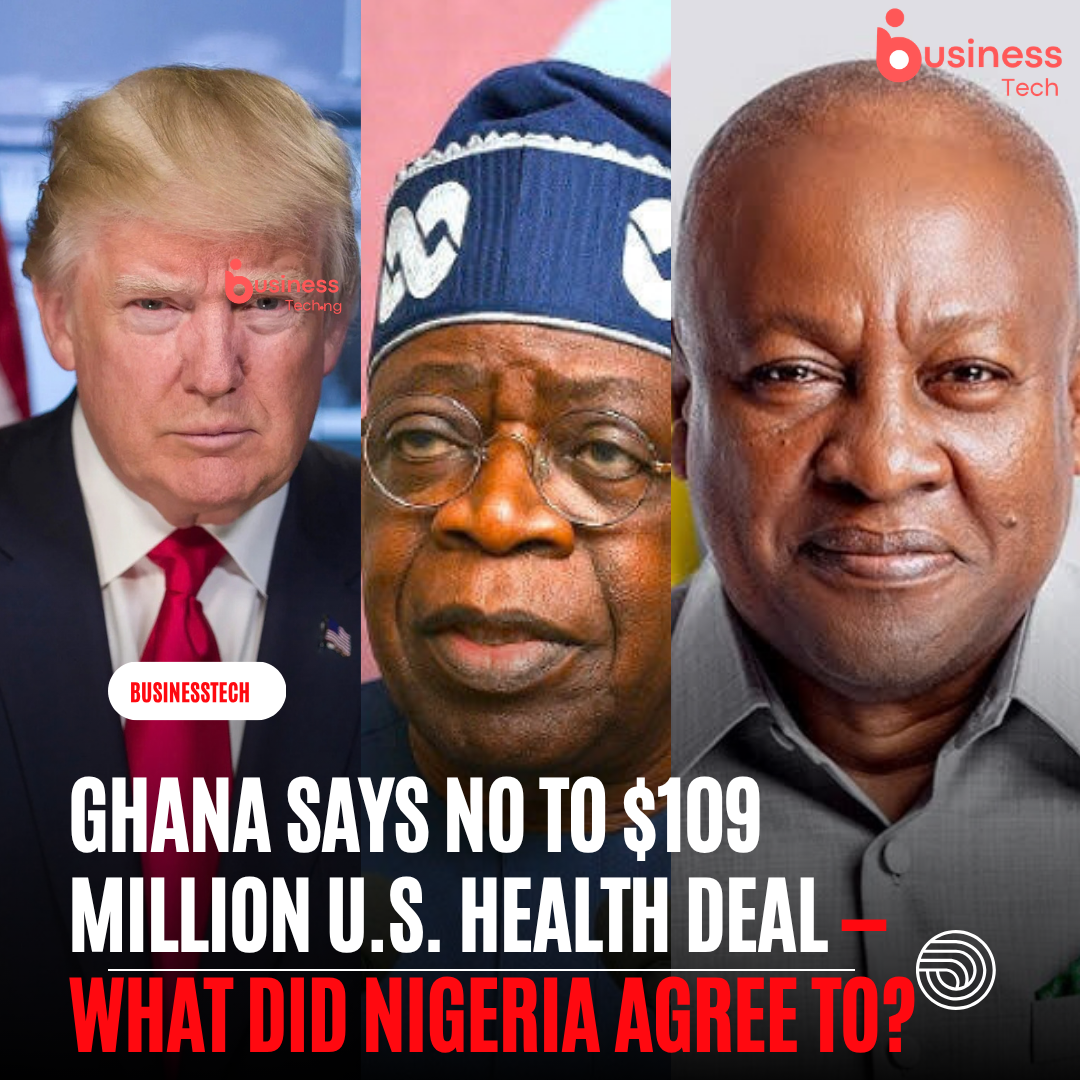
Ghana Rejects $109 Million U.S. Health Deal as Mahama Calls Terms ‘Humiliating’ — Did Nigeria Accept Similar Terms?
Some diplomatic rows are settled in private. This one was settled at a podium in New York.
The President has just returned from a foreign trip. Was this agreement discussed there, or was it not on the agenda at all? Nigerians are entitled to ask, because the deal was signed in December and the explanation has not caught up.
A neighbour’s president has now described in public what his country refused. Nigerians are asking what their own government accepted. Here are the questions, and they are addressed to the Ministry of Health, the presidency and the National Assembly.
- What is the full amount Nigeria will actually receive, and when will each payment arrive?
- The U.S. says it “intends” to provide nearly $2.1 billion, working with Congress. Is any of it guaranteed?
- Nigeria must find nearly $3 billion of new health spending. Where will that money come from?
- If Nigeria falls short, do we lose the American funding?
On our data
5. What categories of health data will be shared with the United States?
6. Does that include patient records, or only aggregated figures?
7. Who will host the data, in Nigeria or abroad?
8. Which country’s law governs it if there is a dispute?
9. Can any U.S. agency or private entity access it without Nigeria’s approval?
10. Has any Nigerian data already been shared since the agreement took effect?
On our sovereignty
11. Does NAFDAC keep full power to inspect every medicine and product brought in under this programme?
12. Is any Nigerian pathogen or sample information covered, and who will own the findings?
13. Was the religious emphasis of the funding part of the negotiation? If so, why was it missing from Nigeria’s own explanation?
On the process
14. Who negotiated this agreement for Nigeria, and who approved it?
15. Was the National Assembly consulted before signing?
16. Will the full text be published so citizens can read it themselves?
To our readers: which of these questions matters most to you? Do you trust the government to answer? Tell us in the comments.
To our officials: the public is not accusing you of anything. It is asking for the document. Publish it, explain it, and let Nigerians judge.
On September 25, President John Mahama told an audience at the Council on Foreign Relations why his government had refused a $109 million U.S. health compact, spread over five years. The money was meant to soften the blow of USAID’s dismantling. Mahama said the conditions were another matter.
He said the text required Ghana to hand over its pathogen profile and its medical records. “Who takes another country’s medical records?” he asked. Then came the line that will travel furthest: medicines brought in under the programme would have been exempt from inspection by Ghana’s Food and Drugs Authority. “It was humiliating,” he said. His Cabinet, he added, threw the document out faster than anything he had seen.
I have covered aid negotiations for four decades, and it is rare to hear a head of state describe one this bluntly. When a leader does, the neighbours start reading their own contracts.
Ghana has rejected a proposed health agreement with the United States that would have provided about $109 million in U.S. health funding over five years, with President John Dramani Mahama describing some of the proposed terms as “humiliating.”
The decision has now raised a different question across West Africa, particularly in Nigeria: what exactly did Nigeria agree to when it signed its own health agreement with the United States?
Nigeria and the U.S. signed a five-year bilateral health Memorandum of Understanding (MoU) in December 2025, with Washington committing nearly $2 billion in grant funding while Nigeria agreed to increase domestic health spending by nearly $3 billion over the period.
Unlike Ghana, Nigeria proceeded with the agreement.
The difference has become more significant following Mahama’s recent explanation of why Ghana rejected the U.S. proposal.
Why Ghana rejected the $109 million U.S. health deal
Ghana initially negotiated the agreement as part of a new U.S. approach to global health funding following Washington’s decision to dismantle USAID and restructure foreign assistance.
Reuters reported in April that Ghana had declined the proposed agreement because of concerns over the sharing of sensitive health data. Under the proposed arrangement, Ghana would have received about $109 million in U.S. health funding over five years.
The issue became clearer in September when Ghanaian President John Mahama publicly explained the concerns that had been raised by his government.
Speaking at the Council on Foreign Relations in New York on September 25, Mahama said Ghana’s Ministry of Health reviewed the proposed compact before it was taken to Cabinet.
According to Mahama, the proposal required Ghana to provide information about its pathogen profile as well as access to medical records.
He also said Ghana would have been required to contribute its own funds to the programme and that Ghana’s Food and Drugs Authority would have had limited or no authority to inspect medicines and other medical products brought into the country under the programme.
Mahama said Cabinet rejected the proposal unusually quickly.
“It was the compact that was thrown out in record time in our cabinet,” he said, adding that the Health Minister was instructed to inform the U.S. Ambassador that Ghana would not accept the arrangement.
Ghana had earlier raised concerns about the proposed data arrangements during negotiations.
The Associated Press reported that Ghana’s Data Protection Commission said the proposed access to health information went beyond what would ordinarily be required and raised concerns about safeguards around sensitive health data.
This is where the issue becomes particularly relevant to Nigerians.
On December 19, 2025, Nigeria and the United States signed a bilateral health MoU covering the period from April 2026 to December 2030.
According to Nigeria’s Federal Ministry of Information and National Orientation, the agreement covers disease surveillance, outbreak response, laboratory systems, pathogen sample collection and testing, healthcare workers, data systems, essential health commodities and strategic investment in the health sector.
The financial commitments are substantially larger than the Ghana proposal.
The Nigerian government said the United States would provide nearly $2 billion in grant funding over five years.
Nigeria, meanwhile, committed to increasing domestic health financing, with the government saying it would allocate at least 6% of executed annual Federal and State budgets to health, a commitment projected to mobilise nearly $3 billion during the period.
The agreement was presented by the Nigerian government as a move towards greater health-sector self-reliance rather than continued dependence on traditional foreign aid.
But the agreement also contains provisions concerning Nigeria’s health data systems.
The Nigerian government has publicly stated that the agreement will strengthen the country’s data systems and disease surveillance capabilities.
However, reporting on the detailed agreement has raised questions about how health information will be collected, stored and potentially shared.
TheCable reported in June that the U.S.-Nigeria agreement includes provisions for increased health surveillance and data monitoring to support early responses to disease outbreaks. The report also noted that the individual country agreement had not initially been made publicly available, although the broader U.S. global health strategy provided information about the framework.
Documents relating to Nigeria’s implementation plan indicate that the country is expected to expand the use of electronic health records across healthcare facilities.
The plan provides for digital medical record systems to be rolled out progressively, reaching all facilities by 2030. It also sets targets for the percentage of patient encounters to be entered into electronic health records after implementation.
This makes the question of health data particularly important.
Nigeria has hundreds of millions of people and one of Africa’s largest healthcare systems. A nationwide transition towards electronic health records could generate an enormous amount of health information.
The issue, therefore, is not simply whether Nigeria signed an agreement with the United States.
It is what protections apply to the information generated under that agreement, who can access it, for what purposes, and under what Nigerian laws and safeguards.
The concerns are not coming only from outside observers.
In March 2026, a lawyer, Bernard Okpi, filed a case at the Federal High Court in Abuja challenging the Nigeria-U.S. health MoU.
The case raised questions concerning privacy, transparency and the alleged transfer of sensitive health information to the United States. The defendants included the President, Attorney-General of the Federation, Federal Ministry of Health and Social Welfare, Senate President and Speaker of the House of Representatives.
That legal challenge does not establish that Nigeria’s agreement violates Nigerian law. It does, however, show that the agreement has become the subject of a formal legal dispute.
There have also been calls for greater public disclosure of the agreement.
The African Democratic Congress, for example, asked the Federal Government to clarify aspects of the agreement after pointing to differences between how Nigeria and the United States publicly described the arrangement.
Ghana’s refusal leaves Nigerians with an obvious question. If Accra found the terms unacceptable, what did Abuja put its name to?
The record shows a five-year memorandum signed on December 19. It runs from April 2026 to December 2030, with the U.S. providing nearly $2 billion in grant funding while Nigeria mobilises close to $3 billion for the health sector. It is one of at least 20 such agreements signed across Africa under the America First Global Health Strategy. Nigeria is not an outlier. It is part of a pattern, and Ghana is the country that broke it.
Officials in both capitals present the deal as a step toward self-reliance. Washington says it promotes accountability and shared responsibility. The Nigerian side points out that it aligns with the Health Sector Renewal Compact signed in 2023 by President Tinubu and all 36 state governors.
The difficulty lies in the fine print, and in what has not been published.
On data, the U.S. State Department has said the agreement includes provisions for data monitoring and enhanced health surveillance to enable rapid responses to disease outbreaks. Nigeria’s Ministry of Health has responded that both governments intend to negotiate a regulated data-sharing arrangement, in compliance with laws on data protection, privacy, ownership, access rights and hosting. Crucially, the ministry did not say what kind of data would be shared. That is the gap Ghanaians closed before signing and Nigerians are still asking about.
On money, the risk is not small. Countries that fail to provide their share of resources could lose all the funding in the agreement. Critics have noted that Nigeria has long missed the Abuja Declaration target of giving health 15 per cent of national budgets. One opposition ADC voice warned that this history introduces significant uncertainty into any multi-year agreement. Nigeria is being asked to find nearly $3 billion of new spending on top of a record that does not inspire confidence.
Then there is the politics. The State Department said openly that the MOU was negotiated in connection with reforms Nigeria has made to prioritize protecting Christian populations from violence, with dedicated funding for faith-based facilities. Health aid and foreign policy are plainly sitting in the same document.
None of this proves Nigeria accepted what Ghana rejected. But it explains why a health agreement has become a sovereignty debate. Ghana asked hard questions before it signed. Nigerians are now asking the same questions after the ink has dried.
There is another difference between the Nigerian and Ghanaian stories that Nigerians may want to examine.
When the U.S. Department of State announced the Nigeria agreement, it placed particular emphasis on Christian faith-based healthcare providers.
The U.S. State Department said the agreement would have a strong emphasis on promoting Christian faith-based healthcare providers and that dedicated funding would support Christian health facilities.
Washington said Nigeria’s approximately 900 faith-based clinics and hospitals serve more than 30% of Nigerians, while representing about 10% of healthcare service providers.
Nigeria’s own announcement focused more broadly on strengthening primary healthcare, disease surveillance, laboratories, healthcare workers, data systems and health financing.
The difference in emphasis led to calls for the Federal Government to provide greater clarity about the full contents and implementation of the agreement.
So, did Nigeria accept what Ghana rejected?
Not necessarily.
There is currently no basis to say that Nigeria secretly accepted the exact terms Ghana rejected.
The two countries negotiated their agreements separately, and Ghana’s proposed arrangement was ultimately rejected.
Nigeria, on the other hand, signed its own five-year health MoU with the United States.
What can be established is that both agreements belong to the same broader U.S. health-funding strategy, which shifts the model away from traditional aid towards government-to-government agreements, increased domestic financing and stronger U.S. involvement in health systems and data infrastructure.
Ghana decided not to proceed after raising concerns about the terms.
Nigeria proceeded.
That difference is why the contents of Nigeria’s agreement deserve public attention.
What Nigerians should be asking
The important question is not simply whether Nigeria received more money than Ghana was offered.
It is what Nigeria agreed to in return.
Among the questions surrounding the Nigerian agreement are:
- What categories of Nigerian health data can be accessed under the MoU?
- Who can access the data?
- Can individual patients be identified?
- Where will the data be stored?
- Can the information be transferred outside Nigeria?
- What Nigerian institutions supervise the data?
- What happens to the data after the agreement ends?
- What rules govern pathogen samples and laboratory information?
- What protections are available to Nigerian patients?
- What happens if Nigeria fails to meet its financial commitments?
- How much of the agreement is legally binding?
- And why was the agreement not subjected to a wider public debate before implementation?
These questions do not mean that the Nigeria-U.S. agreement is automatically harmful or unlawful.
The Federal Government has presented the deal as an important investment in Nigeria’s health system and a pathway towards greater domestic financing and self-reliance.
But Ghana’s decision has demonstrated that health funding agreements can raise serious questions about data protection, regulatory authority, domestic financing and national control over health systems.
The most striking part of the story is therefore not simply that Ghana rejected $109 million.
It is that Ghana’s rejection has brought renewed attention to a much larger agreement that Nigeria had already signed.
Ghana’s President says his Cabinet rejected the proposed U.S. arrangement after concerns about medical records, pathogen information, domestic financial obligations and the authority of Ghana’s medicines regulator.
Nigeria signed its own agreement months earlier, securing nearly $2 billion in U.S. grant funding alongside a planned increase of almost $3 billion in domestic health financing.
The Nigerian government says the agreement will strengthen health security, improve disease surveillance, expand primary healthcare and help Nigeria move towards self-reliance.
At the same time, questions have been raised about the agreement’s data provisions and the extent of U.S. involvement in Nigeria’s health information systems.
The key issue now is therefore transparency.
Ghana has publicly explained why it walked away. Nigerians deserve to understand, in equally clear terms, exactly what Nigeria agreed to.
That does not require assuming that Nigeria accepted Ghana’s rejected terms.
It requires reading the agreement, examining its data provisions and asking what protections exist for Nigerians whose health information will increasingly form part of the country’s digital health infrastructure.
For a country of more than 200 million people, that is a question too important to leave unanswered.
The figures behind Ghana’s refusal explain the anger. Ghana would have surrendered 25 years of citizens’ health records, five times the length of the funding. Up to 10 U.S. entities would have gained access to that data without prior approval. The agreement would have been governed by U.S. law. Ghana also faced $70 million in binding counterpart funding, while the American side remained subject to congressional approval.
Ghana’s Data Protection Commission described it as outsourcing the country’s health data architecture to a foreign body. A cybersecurity expert added that under the U.S. CLOUD Act, American agencies could demand that data without telling Ghana.
Mahama said his health sector faces a $74 million gap, but that Ghana would manage. Accra is now pushing what it calls the “Accra Reset,” an effort to cut reliance on foreign aid and build local capacity to make medicines and vaccines.
So Ghana said no. Nigeria said yes. That is where the story turns.
So where does this leave the two countries, and where does it leave the Nigerian public?
Ghana has made its choice and is living with the cost. Mahama says he is content to forgo a hundred-odd million dollars rather than sign terms he calls humiliating. The $74 million gap in his health budget is real, and the Accra Reset, with its promise of local manufacture of medicines and vaccines, is a long road. Sovereignty has a price, and Ghana has decided to pay it.
Nigeria has chosen differently, and the numbers explain part of why. A health system that carries roughly 30 per cent of the global malaria burden and one of the highest maternal and child mortality rates in the world cannot easily walk away from nearly $2 billion. The Nigerian government would argue, with some justice, that the alternative to a flawed agreement is no agreement, and that it has negotiated more than a simple copy of the template Ghana saw.
But those arguments carry weight only if the public can test them. On the evidence I have seen, the following questions remain unanswered.
First, what data will be shared? The Ministry of Health has spoken of a regulated arrangement still to be negotiated, yet it has not said what categories of data are involved.
Second, who holds and hosts that data, and under whose law? Ghana’s cybersecurity experts raised the reach of the U.S. CLOUD Act. Nigerians deserve to know whether the same concern applies here.
Third, how will Nigeria find nearly $3 billion of new spending, given its long-standing failure to meet the Abuja Declaration target? A missed commitment could put the funding at risk.
Fourth, what part did the protection of Christian communities play in the negotiation, and does it shape how the money is allocated across the country’s regions?
I have been filing stories on African aid deals since long before most of these officials entered government, and one lesson has held. Agreements survive when citizens understand them. They come under strain when citizens learn the details from a foreign capital or a neighbour’s president.
Ghana said no in public. Nigeria said yes, largely in private. Neither choice is inherently wrong. But only one of them has yet been explained to the people it affects.
The National Assembly, the Ministry of Health and the presidency now owe Nigerians a plain account of what was signed. Until they give one, the question in this headline will stay open.
Nigeria signed a five-year, $5.1 billion health MOU with the United States on December 19. The split is not equal. Washington intends to commit nearly $2.1 billion, working with Congress, while Nigeria raises its domestic health spending by nearly $3 billion. The U.S. describes that as the largest co-investment by any country under the strategy so far. About $200 million is set aside for more than 900 Christian faith-based health facilities.
The politics are not hidden. The State Department said the MOU was negotiated in connection with Nigerian reforms to protect Christian populations from violence. One critic noted that this religious emphasis was absent from Nigeria’s own official explanation.
The data question is the one Nigerians are asking. The U.S. says the agreement includes data monitoring and health surveillance for rapid outbreak response. Nigeria’s Ministry of Health says both sides intend to negotiate a regulated data-sharing arrangement, in line with domestic data protection, ownership, access and hosting laws, but it has not said what data would be shared. Countries that fail to provide their share of resources could lose all funding under these agreements.
Ghana was offered $109 million and said no. Nigeria signed a $5.1 billion arrangement, with the U.S. intending to provide nearly $2.1 billion and Nigeria committing nearly $3 billion of its own. The scale is far larger, the stakes are higher, and yet the public explanation has been thinner. Nigerians are not asking for a scandal. They are asking for a document.
The concern is simple. Ghana’s president has told the world exactly what he found objectionable: access to medical records, foreign oversight of health data, and limits on the regulator’s power to inspect medicines. Nigeria’s Ministry of Health has said only that a regulated data-sharing arrangement will be negotiated, without saying what data is involved. Silence on those points, after a neighbour’s public refusal, is what turns a health agreement into a sovereignty debate.
To be fair to Abuja, nothing published shows Nigeria accepted the terms Ghana rejected, or that any Nigerian data has been sold. A country facing some of the world’s worst maternal mortality and a heavy malaria burden has real reasons to seek funding. But real reasons do not replace transparency. Money that comes with conditions must come with disclosure, and citizens who will live with those conditions for five years deserve to read them.
So the questions stand, and the answers belong to the Ministry of Health, the presidency and the National Assembly. Publish the full agreement. Explain the data provisions in plain language. Tell Nigerians who can see their health information, where it is kept, and under whose law. Until that happens, the question in our headline remains open, and this newsroom will keep asking it on behalf of the people who are depending on the answer.
To be clear, nothing published shows Nigeria accepted Ghana’s terms. But the full text has not been made public, and that silence is the story. Abuja should tell its citizens what it signed.