|
Getting your Trinity Audio player ready...
|
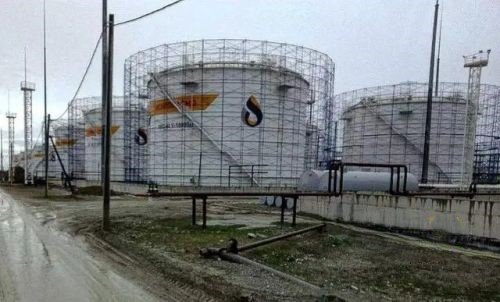
Russia has unveiled a new modular defense structure designed to shield its oil refineries and other critical energy infrastructure from the wave of Ukrainian drone strikes that has battered the country’s fuel production capacity for more than a year. The system, called Web, was developed by RT-Project Technologies, a subsidiary of Russia’s state-owned defense conglomerate Rostec, working in partnership with Standard-Elektrik, and was presented at a closed event in Tver, northwest of Moscow, according to reporting from The Defense Post and Militarnyi.
The structure itself is engineered around a fairly specific threat profile. Developers say the standard configuration is designed to withstand a direct hit from a drone weighing up to 200 kilograms traveling at 250 kilometers per hour, and the system can be scaled to protect facilities more than 25 meters high while covering large industrial sites rather than isolated single structures. According to Militarnyi, the Web structure has already undergone field testing for seismic stability, though testing of its resistance to different types of drone strikes is described as still ongoing, suggesting the system remains in a relatively early deployment phase rather than a fully proven, widely rolled-out solution.
The urgency behind Russia’s push for better refinery protection is not difficult to understand given how effective Ukraine’s drone campaign against its energy infrastructure has become. According to a recent analysis from the International Energy Agency, only five major Russian refineries remained untouched by Ukrainian drones as of late August 2026, and all five sit in eastern Siberia or the far east of the country, between roughly 3,500 and 6,500 kilometers from the Ukrainian border, distances that have so far kept them beyond the reach of Kyiv’s strike capabilities. The IEA’s report found that in the first eight months of 2026 alone, a Russian refinery was hit on average once every three days, a strike tempo that has forced Russian operators into a near-constant cycle of damage assessment and repair.
Ukraine’s tactics have also evolved considerably since the campaign against Russian energy infrastructure began accelerating in 2025. Rather than relying on single-drone strikes that existing passive defenses like protective netting were originally designed to intercept, Ukraine has increasingly deployed multiple waves of drones against individual targets specifically intended to overwhelm those defenses, according to the IEA’s analysis. That shift toward saturation-style attacks has exposed the limitations of the netting and camouflage measures many Russian facilities had previously relied on, and it helps explain why Moscow is now investing in a more robust, purpose-built protective structure rather than continuing to depend on simpler countermeasures.
The scale of damage inflicted by this sustained campaign has been severe enough to trigger what researchers have documented as a genuine fuel crisis inside Russia. Starting in August 2025, a sharp escalation in drone strikes on Russian refineries led to widespread production declines across the country’s oil industry, with independent oil and gas analyst Boris Aronstein describing the resulting disruption as the most severe crisis the sector had faced in recent years, driven specifically by the size, coordination and repeated waves of Ukrainian drone attacks that left Russian operators unable to complete repairs before the next strike arrived. Ukrainian media reported that the Ryazan refinery, one of the primary fuel arteries supplying Moscow, was struck by a powerful explosion in late August 2025, one of several high-profile hits that came to define that period.
More recent strikes in 2026 have added to the toll. A prolonged fire at the Tuapse oil terminal and refinery in Krasnodar Krai, which began on April 16, resulted in multiple deaths and injuries alongside significant environmental contamination from toxic emissions, according to documented reporting on the incident. A separate fire beginning April 29 struck the Perm refinery, operated by Lukoil, along with a nearby Transneft pipeline dispatch station, causing large-scale blazes that burned for days and disrupted regional oil transport operations. Attacks have continued through the summer and into September, with strikes reported on refineries in Russia’s Volgograd, Yaroslavl and Samara regions, among others, according to Reuters and Ukrainska Pravda reporting on the ongoing campaign.
Russia’s response has not been limited to the newly unveiled Web system. Russian oil company Bashneft equipped key facilities at its refineries with anti-drone netting earlier this year and has been in discussions with the country’s defense ministry about further boosting security at its sites, according to Reuters reporting citing Bashkortostan republic head Radiy Khabirov, who acknowledged additional, unspecified security measures were being kept classified. A Russian energy ministry official separately told a parliamentary meeting that plans existed to defend oil and gas facilities using missile systems, though Tatarstan Republic head Rustam Minnikhanov expressed skepticism about diverting air defense systems for that purpose, noting those systems remained committed to other military priorities.
The broader economic stakes for Russia extend well beyond any single facility. The IEA’s analysis noted that Russia has been feeding more crude oil through its remaining functional refineries in an effort to boost fuel exports, a response driven partly by new U.S. sanctions on Russian tankers and traders that have made exporting unprocessed crude increasingly difficult, adding financial pressure on top of the physical damage from the drone campaign itself. That combination of sanctions pressure and sustained infrastructure attacks has left Russian energy officials searching for solutions that go beyond incremental fixes like additional netting, which helps explain why a heavier, more purpose-built structure like Web has now moved from concept to public demonstration.
Whether the Web system, or the broader mix of netting, missile defense proposals and classified security measures Russian officials have referenced, proves sufficient to meaningfully slow Ukraine’s strike campaign remains to be seen, particularly given how quickly Ukraine has adapted its tactics to defeat earlier passive defenses. With ongoing testing still underway and no clear timeline yet for widespread deployment across Russia’s refinery network, the coming months are likely to serve as the real test of whether this latest defensive innovation can keep pace with an attack campaign that has already proven remarkably difficult to contain. Continuing coverage of how the Russia-Ukraine conflict is affecting global energy markets is available on Business Tech. Additional detail on the refinery damage assessment is available through the International Energy Agency’s official analysis, and further reporting on the Web protective system can be found through The Defense Post’s coverage of the announcement.