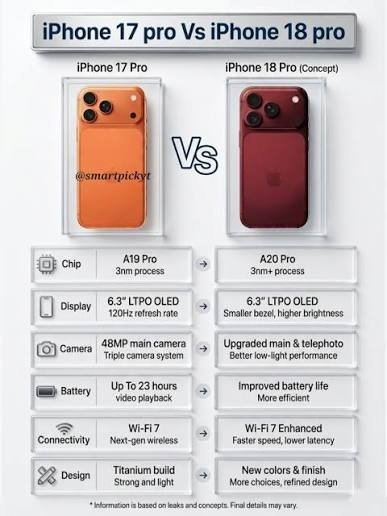
iPhone 18 Pro Max vs iPhone 17 Pro Max
Apple’s newest Pro Max landed alongside its first foldable iPhone last week, and at first glance, it looks almost identical to the phone it’s replacing. Same overall silhouette, same familiar Pro camera bump, nothing that screams “new generation” from across the room. But spend a little time with the spec sheets side by side, and the iPhone 18 Pro Max turns out to carry more genuine substance underneath than its conservative styling lets on.
Start with what didn’t change, because there’s a fair amount of it. The display is the same 6.9-inch ProMotion XDR OLED panel Apple used on the 17 Pro Max, still hitting a peak brightness of 3,000 nits, and essentially every core display specification carries over unchanged between the two models. Memory is identical too, with both phones shipping at 12GB of RAM, comfortably above the 8GB Apple considers the minimum threshold for running Apple Intelligence, giving the Pro line its usual bit of headroom over Apple’s standard models.
The most visually obvious change is actually a shrinking one. Apple trimmed down the Dynamic Island on the 18 Pro Max, and that smaller footprint isn’t purely cosmetic. It allows the phone to display up to three Live Activities simultaneously, compared to just two on the 17 Pro Max, a small but genuinely useful bump for anyone who tracks multiple things at once, like a food delivery order alongside a sports score or a timer.
Under the hood is where the more meaningful differences start showing up. The 18 Pro Max runs on Apple’s new A20 Pro chip, built on a 2-nanometer manufacturing process, a jump that should translate into real gains in both raw performance and power efficiency over whatever silicon powered the 17 Pro Max. Alongside the new chip, Apple is finally rolling out its own C2 modem on the Pro Max, replacing the Qualcomm modems that have powered essentially every iPhone for years. Bringing modem design in-house gives Apple tighter control over how the radio and processor work together, which Apple is positioning as a meaningful contributor to both efficiency and battery life rather than just a supply-chain decision.
Reviewers who’ve spent time with both phones side by side point to sustained performance as one of the more noticeable practical differences, not just benchmark numbers. The 18 Pro Max reportedly ships with a larger internal cooling system, which matters most during demanding, extended tasks like gaming or intensive video export, situations where phones traditionally throttle performance once they heat up. A bigger cooling setup paired with the more efficient A20 Pro chip should mean the 18 Pro Max holds its peak performance longer under sustained load, even if single benchmark runs don’t tell the full story. Battery life and charging speed have both reportedly improved as well, giving the new model an edge in exactly the areas that matter most for people who actually use their phone hard throughout the day rather than just glancing at spec sheets.
Camera hardware tells a similar story of Apple making a real, functional upgrade rather than just bumping a megapixel count. The 18 Pro Max keeps the same 48-megapixel main sensor resolution as its predecessor, but adds a physical variable aperture, a first for the Pro Max line, that can shift between f/1.48, f/1.8, f/2.8 and f/4.0 depending on the shot. A wider aperture setting pulls in more light for dim environments, while narrowing it deepens the focus range, useful for keeping everyone sharp in a group photo rather than isolating just the closest face. Apple paired that hardware change with a new set of manual Pro controls covering aperture, shutter speed, white balance, and a live histogram display, tools clearly aimed at people who take photography and video seriously rather than casual snapshot users, and a genuine differentiator from the fixed-aperture camera systems still found on the 17 Pro Max and most competing flagships.
Software-wise, the 18 Pro Max ships with iOS 27 installed from the factory, while the 17 Pro Max launched last year running iOS 26, though existing 17 Pro Max owners are already receiving the iOS 27 update, meaning software feature parity between the two phones will largely even out once everyone updates, with the notable exception of anything gated specifically behind the new hardware.
Connectivity picked up some smaller but worthwhile refinements too, including Bluetooth 6.0, up from 5.3 on the previous model, and Apple has moved the Pro Max line fully to eSIM in several markets, dropping physical SIM tray support entirely in favor of Apple’s advanced eSIM implementation, a shift the company has been gradually pushing across its lineup for a few years now.
Color options round out the more visible differences. The 18 Pro Max comes in Silver, Glacier, Burgundy and Black, with Black notably making a comeback after being absent from last year’s Pro lineup entirely. The 17 Pro Max, by comparison, launched in just three finishes: Silver, Deep Blue and Cosmic Orange.
For anyone currently holding a 17 Pro Max and wondering whether it’s worth jumping to the new model, the honest answer depends heavily on what you actually use your phone for. If photography, video work, or heavy sustained performance tasks like gaming and content creation are part of your daily routine, the variable aperture camera and improved cooling system represent genuine, usable upgrades rather than marketing dressing. If you’re mostly using your phone for messaging, browsing, and everyday tasks, the shared display, shared RAM, and largely unchanged design mean the 17 Pro Max will likely feel perfectly current for another year, especially once it picks up the same iOS 27 software running on the new model.