Last updated: September 28, 2026
Summary: A Connected Nation Still Fighting Its Own Infrastructure
Nigeria’s telecoms sector kept growing through 2026, adding millions of new mobile lines and pushing broadband penetration past the halfway mark of the population for the first time. But the growth sits on a fragile base. The main findings from Nigerian Communications Commission (NCC) data:
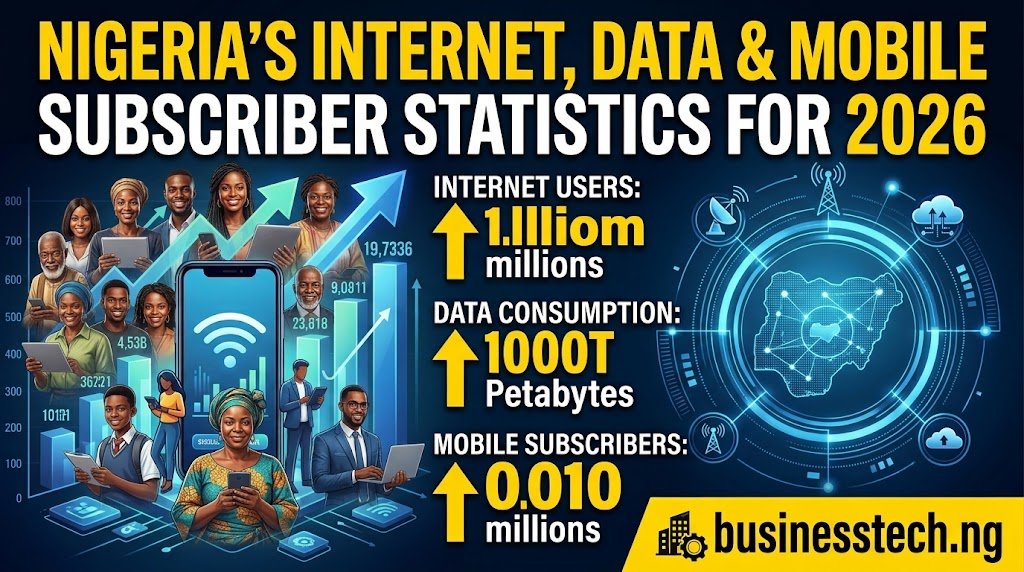
- Active mobile subscriptions passed 189 million by May 2026, with teledensity, the number of active lines per 100 people, reaching 87.50%.
- MTN and Airtel now control about 86% of the market between them, leaving Globacom and T2 (formerly 9mobile) fighting for the rest.
- Active internet subscribers hit 157.7 million in July 2026, with broadband penetration at 56.11% in May, up from about 51.97% in December 2025.
- Monthly data consumption reached 1.66 million terabytes in July 2026, more than 40% higher than the 1.15 million terabytes used a year earlier.
- The network is under physical strain. More than 5,000 fibre-optic cable cuts were recorded in the first six months of 2026 alone.
This first part covers the subscriber numbers, market share and data consumption trends in detail. The second part covers broadband quality, the infrastructure problems behind the growth, what it means for businesses and consumers, and the outlook for 2027.
Nigeria’s Mobile Subscriber Base in 2026
The Monthly Trend
| Month | Active mobile subscriptions | Teledensity |
|---|---|---|
| September 2025 | 173.54 million | 80.05% |
| January 2026 | 182.2 million | 84.06% |
| March 2026 | 185.72 million | 85.67% |
| April 2026 | 188.01 million | 86.73% |
| May 2026 | 189.68 million | 87.50% |
| June 2026 | approximately 192 million (MTN, Airtel, Globacom and T2 combined) | not separately reported in our sources |
Source: Nigerian Communications Commission (NCC), as reported by THISDAY, Legit.ng and TechAfrica News.
The subscriber base grew by roughly 16 million lines between September 2025 and May 2026, or about 9%, in eight months (our calculation). That is a fast pace for a market this size, and it follows a period of disruption in 2024 and 2025 when the mandatory linking of SIM registration with National Identity Numbers (NIN) caused earlier subscriber counts to dip before recovering.
Who Holds the Market
| Operator | Active subscribers (June 2026) | Market share |
|---|---|---|
| MTN Nigeria | 98.64 million | about 51.4% |
| Airtel Nigeria | 66.12 million | about 34.4% |
| Globacom | 23.68 million | about 12.3% |
| T2 (formerly 9mobile) | about 3.54 million | about 1.8% |
Source: NCC data reported by TechCrier, September 2026.
A Market Tilting Further Toward Two Players
The most important structural trend in 2026 is concentration. MTN and Airtel together held about 85.8% of active subscribers in June, up from a similar but slightly lower combined share earlier in the year. Globacom’s growth has been slow, though the operator did add subscribers, rising from 20.61 million in April 2025 to 23.18 million in April 2026, a net gain of about 2.57 million lines. T2 has struggled the most. It reported an unchanged subscriber base of 802,534 for three consecutive months, April through June 2026, though the NCC clarified this reflects the operator’s own reporting difficulties rather than genuinely flat numbers, since technical challenges meant T2 could not submit updated reports for that period.
For consumers, a market this concentrated in two operators can affect pricing power and the incentive to invest in service quality, since customers have fewer credible alternatives to switch to when service falls short.
Internet and Broadband Subscribers
The Growth Curve
| Period | Active internet subscribers | Broadband subscriptions | Broadband penetration |
|---|---|---|---|
| January 2026 | 151.6 million | 115.0 million | 53.07% |
| April 2026 | 156.86 million (approx.) | 120.68 million | 55.67% |
| May 2026 | 157.41 million | 121.64 million | 56.11% |
| June 2026 | 156.86 million | not separately confirmed | not separately confirmed |
| July 2026 | 157.71 million | not separately confirmed | not separately confirmed |
Source: NCC data as reported by THISDAY and Vanguard.
Growth has not been a straight line. Active internet subscribers actually dipped slightly from May’s 157.41 million to 156.86 million in June, before recovering to 157.71 million in July. The NCC’s own reporting noted that active subscriber numbers and data usage had both risen for 12 consecutive months up to July 2026 when measured against the same month a year earlier, even though some individual months showed small declines from the month before.
Which Technology Nigerians Use to Get Online
Mobile GSM networks, meaning ordinary mobile phone data connections, dominate completely. Of the 157.4 million internet subscribers recorded in May 2026, 157,021,888 connected via Mobile GSM technology. Fixed Wired connections through internet service providers such as Spectranet, Swift Networks and Cobranet, and Voice over Internet Protocol (VoIP) connections, made up a tiny fraction of the total, with VoIP recording just 225,538 subscribers in the same month. This means that for the large majority of Nigerians online, their internet experience is entirely dependent on the quality of mobile network coverage, not fixed broadband infrastructure.
Data Consumption Is Rising Faster Than Subscriber Numbers
| Month | Internet data usage (terabytes) |
|---|---|
| August 2025 | 1,152,347.24 |
| October 2025 | 1,235,459.47 |
| April 2026 | 1,410,000 (more than 1.41 million) |
| May 2026 | 1,500,000 (record 1.50 million) |
| June 2026 | 1,532,172.67 |
| July 2026 | 1,662,021.45 |
Source: NCC data reported by THISDAY and Legit.ng.
Comparing August 2025 to July 2026, monthly data consumption rose from about 1.15 million terabytes to 1.66 million terabytes, an increase of roughly 44% (our calculation), while the subscriber base grew far more slowly over the same period. This gap is the clearest evidence that existing users are consuming much more data each month, not just that more people are coming online. Streaming, social media, mobile banking and business use of cloud services are the likely drivers, though the NCC data does not break consumption down by application.
What This Means Alongside the Tariff Increase
This rising consumption is happening against a backdrop of higher data prices. The average cost of 1GB rose from about ₦287.50 to ₦431.25 after the NCC approved a 50% tariff increase in early 2025, and that pricing has held through 2026. Rising usage at a higher price point means telecom spending is becoming a larger part of household and business budgets, even though the per-gigabyte rate itself has not moved again this year.
Telecoms as an Economic Engine
The GDP Contribution Is Rising Fast
| Quarter | Telecoms contribution to real GDP | Nominal value |
|---|---|---|
| Q3 2025 | 7.67% | not separately reported |
| Q4 2025 | 8.12% | not separately reported |
| Q1 2026 | 9.19% | ₦4.71 trillion |
| Q2 2026 | 9.72% | about ₦5.2 trillion ($3.8 billion) |
Source: National Bureau of Statistics, as reported by NCC and Nairametrics.
Telecoms’ Q2 2026 contribution was its strongest in two years, and it now makes up 9.72% of the 16.35% that the wider information and communication sector contributes to real GDP. That wider sector grew 10.38% in Q2, more than double the 4.43% growth rate of the overall economy, which means digital connectivity is expanding faster than almost any other part of Nigeria’s economy. Chairman of the Association of Licensed Telecoms Operators of Nigeria, Gbenga Adebayo, has linked much of this growth to the 2025 tariff adjustment, which raised the naira value of the same services.
What Nigerians Spend on Data
In the first quarter of 2026 alone, Nigerians spent about ₦3.33 trillion on data, using an average of 28 gigabytes per subscriber over the quarter. Across the first half of the year, total consumption reached 7.1 million terabytes, and by May the country was using about 45,800 terabytes of data every single day.
Investment Behind the Growth
Telecoms operators invested more than ₦2.5 trillion in network infrastructure in 2025, and that spending has continued into 2026. Airtel alone committed over ₦287.6 billion (about $211 million) toward 4G and 5G tower deployment and capacity upgrades. The federal government’s Project Bridge, a planned rollout of 90,000 kilometres of fibre optic cable nationwide, is scheduled to begin in October 2026, and 12 states have adopted zero-rated Right-of-Way policies to make it cheaper and faster for operators to lay cable.
The Infrastructure Problem Behind the Growth Numbers
The subscriber and data figures tell a story of expansion, but they sit on top of a network under real physical stress.
Fibre Cuts Are a Daily Reality
The NCC recorded more than 5,000 fibre-optic cable cuts across Nigeria in just the first six months of 2026. Road construction, excavation and other civil works were named as major contributors, alongside vandalism. The regulator has warned that damaged fibre routes disrupt not just telecom services but banking, government services, education, healthcare and commerce, since so much of the digital economy runs over the same physical cables.
A Blurred Line Between Outages and Subscriber Loss
When a customer in Nigeria experiences dropped calls or slow data, the cause is often invisible to them, whether it is a damaged fibre route, vandalised equipment, or an operator simply being unable to reach a site for repairs. From the customer’s side, the result looks identical: the service does not work, and they may switch operators over a problem that has nothing to do with which network they chose.
The T2 Reporting Gap
T2’s frozen subscriber figures for three straight months in 2026 illustrate a broader data quality issue. When a smaller operator cannot reliably submit its numbers, published market-share tables can understate the real scale of subscriber movement in the market, since a company’s true position may differ from what static, unchanged figures suggest.
What This Means for Businesses, Advertisers and Investors
For Businesses
With over 81% of Nigerians now counted as mobile data users, digital channels reach a larger share of the population than almost any other medium. But the fibre-cut problem means businesses that depend on constant connectivity, banks, fintech platforms, logistics firms and e-commerce companies, need redundancy plans, since an outage can originate far outside their own systems.
For Advertisers and Media
A subscriber base above 189 million and rising data consumption support the case for mobile-first content and advertising strategies. The audience is largest on Mobile GSM connections, so content optimised for phone data usage reaches by far the most people.
For Investors
The telecoms sector’s growing GDP share, at 9.72% and rising, together with billions of naira in fresh infrastructure investment, points to continued expansion. MTN and Airtel’s dominant and growing market share suggests that new entrants face a steep climb, while the government’s Project Bridge fibre rollout could open opportunities for construction, equipment and maintenance contractors once it begins in October 2026.
How Nigeria Compares Regionally
Nigeria’s teledensity of 87.50% as of May 2026 and broadband penetration around 56% place it among Africa’s larger connected markets by absolute subscriber count, given its population of more than 200 million. A full side-by-side comparison with Kenya, Egypt, South Africa and Ghana would require each country’s own regulator data, which is beyond the scope of this report, but Nigeria’s scale alone, at nearly 190 million active lines, makes it one of the largest single telecom markets on the continent.
Outlook for 2027
Several developments will shape the numbers in this report over the coming year:
- Project Bridge. If the 90,000km fibre rollout begins on schedule in October 2026, expect gradual improvements in rural connectivity and network reliability into 2027, though a project of this scale typically takes years to show its full effect.
- 5G expansion. MTN and Mafab launched 5G after 2021 licensing, and Airtel has been investing specifically in 4G and 5G tower deployment. Wider 5G coverage would support higher data speeds for businesses and consumers.
- Market concentration. Watch whether Globacom and T2 can arrest their declining relative share, or whether MTN and Airtel’s combined dominance keeps growing.
- Fibre infrastructure protection. Continued high numbers of cable cuts would keep pressure on service quality regardless of how many new subscribers join the network.
- Data pricing. Any move by the NCC to revisit tariffs, in either direction, would directly affect both subscriber growth and total sector revenue.
Frequently Asked Questions
How many people in Nigeria have internet access?
Active internet subscribers reached 157.7 million in July 2026, according to the NCC, with broadband penetration at 56.11% as of May 2026.
How many mobile phone subscribers does Nigeria have?
Active mobile subscriptions reached about 189.68 million by May 2026, with some reports citing figures above 192 million by mid-year, and teledensity of 87.50%.
Which telecom company has the most subscribers in Nigeria?
MTN Nigeria leads with about 98.64 million subscribers as of June 2026, roughly 51.4% of the market, followed by Airtel with about 66.12 million, or 34.4%.
How much data do Nigerians use each month?
Monthly data consumption reached 1.66 million terabytes in July 2026, up from about 1.15 million terabytes a year earlier, an increase of roughly 44%.
How much does telecoms contribute to Nigeria’s economy?
The telecoms sector contributed 9.72% to real GDP in Q2 2026, about ₦5.2 trillion, its strongest contribution in two years.
Conclusion
Nigeria’s telecom sector in 2026 shows genuine, fast-paced growth: more subscribers, more data consumed, and a rising share of national GDP. But the numbers also expose real strain, a market concentrating around two dominant operators, thousands of fibre cuts disrupting service, and a cost of data that has settled at a higher level since 2025’s tariff increase. The scale of Project Bridge and continued operator investment will determine whether 2027 brings the reliability improvements that current subscriber growth alone cannot deliver.