
|
Getting your Trinity Audio player ready...
|
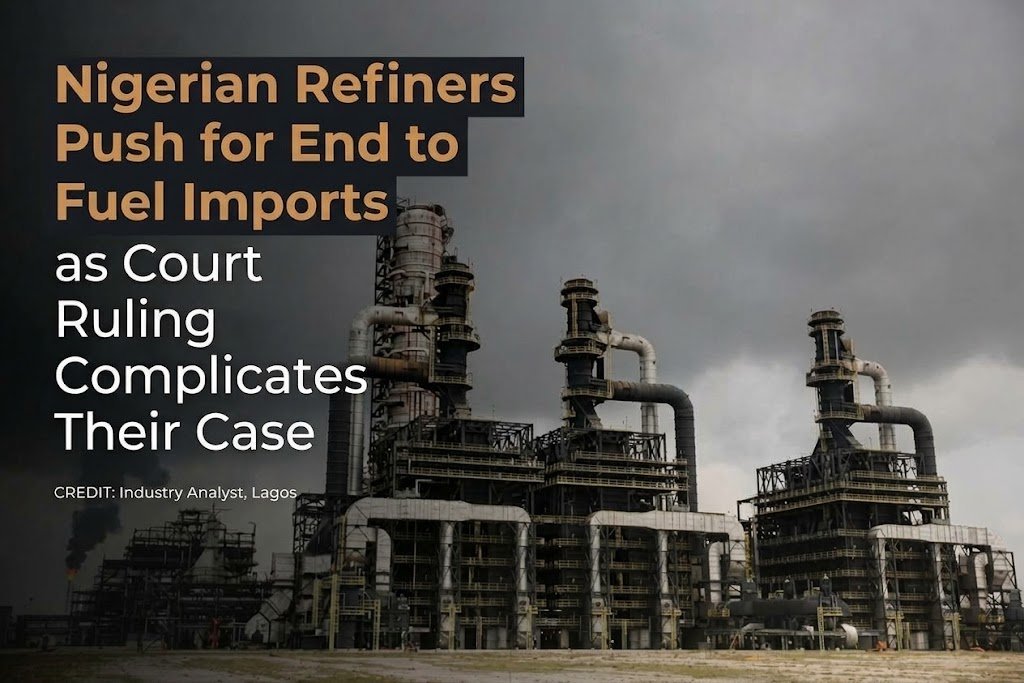
Nigerian Refiners Push for End to Fuel Imports as Court Ruling Complicates Their Case
Nigeria’s domestic refinery owners used a major industry summit in Lagos this week to press the federal government for a clear, staged path toward ending the country’s reliance on imported petroleum products, even as a fresh court ruling on the same day worked in the opposite direction.
Speaking at the third Nigeria Oil Refining Summit at Eko Hotel on Monday, Momoh Oyarekhua, chairman of the Crude Oil Refinery-Owners Association of Nigeria, laid out a ten-point agenda he said should guide the next phase of the country’s petroleum sector reforms. The central message was blunt: Nigeria has spent decades exporting crude oil only to import the refined products made from that same crude, and the group argues the country now has enough domestic refining capacity to start reversing that pattern for good.
Oyarekhua told the summit that Nigeria’s refineries must increasingly supply the domestic market directly, with the country eventually positioning itself as a refining hub for the wider African continent rather than continuing to treat imports as a permanent fixture of the fuel supply system. He framed the shift as the next necessary step after what he called a difficult but already completed decision to reform the petroleum-products market more broadly.
The specifics of CORAN’s agenda go well beyond a simple call to ban imports outright. The group wants stronger enforcement of the Domestic Crude Supply Obligation contained in Section 109 of the Petroleum Industry Act, a provision meant to guarantee that Nigerian crude producers make a portion of their output available to local refiners on workable commercial terms before that crude gets shipped abroad. CORAN also called for full institutionalization of the naira-for-crude policy, along with a domestic crude pricing framework that accounts for crude quality, delivery location, and the international shipping and logistics costs that refiners avoid by sourcing locally rather than importing feedstock from overseas.
On imports specifically, the association is asking for a progressive rather than immediate wind-down, with petroleum-product imports increasingly restricted to genuine, objectively determined supply shortfalls and strategic stockpile requirements rather than routine commercial activity. Alongside that, CORAN wants accelerated investment in shared infrastructure, including pipelines, storage depots, jetties, rail evacuation systems and other common-carrier facilities that multiple refiners could use rather than each having to build out its own separate logistics network. The group also proposed establishing strategic petroleum-product reserves specifically to cushion the market during scheduled refinery maintenance or unexpected operational disruptions, and it called for a formal national refining and export roadmap with measurable targets covering capacity utilization, refinery expansion, domestic supply levels, and the pace at which imports should be phased down.
The timing of the summit added an unexpected wrinkle to CORAN’s push. On the same day Oyarekhua was making his case in Lagos, the Federal High Court in Abuja ordered the Nigerian Midstream and Downstream Petroleum Regulatory Authority to continue issuing import licenses to eligible oil marketers, a ruling that directly cuts against the kind of progressive import restriction CORAN is asking regulators to pursue. That ruling sets up a genuine tension between the courts protecting existing import licensing arrangements and refiners arguing that continued, unrestricted imports undermine the investment case for expanding domestic refining capacity further.
CORAN’s frustration isn’t purely about government policy either. Oyarekhua and other refiners have pointed to a more immediate operational problem: some domestic refineries remain underutilized not because of insufficient market demand, but because they struggle to secure crude oil on commercially viable terms in the first place. Dangote Industries has raised a similar complaint separately, with the company’s Vice President of Oil and Gas, DVG Edwin, saying international oil companies operating in Nigeria have consistently frustrated the refinery’s requests for locally produced crude as feedstock, despite the Domestic Crude Supply Obligation rules meant to guarantee exactly that kind of access. Refiners under the CORAN banner have also alleged that foreign crude producers appear to prioritize selling to Asian buyers over supplying Nigeria’s own refining sector, a claim that, if accurate, would help explain why plants with real processing capacity aren’t running at the levels the country’s overall refining capacity would suggest is possible.
There are signs the underlying shift CORAN wants is already partly underway, even without a formal import ban in place. Data from the NMDPRA shows petrol imports fell sharply during the first quarter of 2026, while local refineries supplied roughly 3.18 billion litres of product over the same period, evidence that domestic refining is steadily capturing a larger share of Nigeria’s fuel market on its own, driven by rising output from Dangote’s refinery and other facilities at various stages of development.
Whether the government moves toward the kind of formal, staged import phase-down CORAN is pushing for, or continues allowing the courts and existing licensing frameworks to keep imports flowing alongside growing domestic capacity, is likely to shape how quickly Nigeria’s refining sector can scale toward the export ambitions the association has laid out. For now, Monday’s summit made clear that Nigeria’s refiners see themselves as having already proven the concept, and that the unresolved question is no longer whether domestic refining can meet the country’s needs, but whether policy and the courts will actually let it.