
|
Getting your Trinity Audio player ready...
|
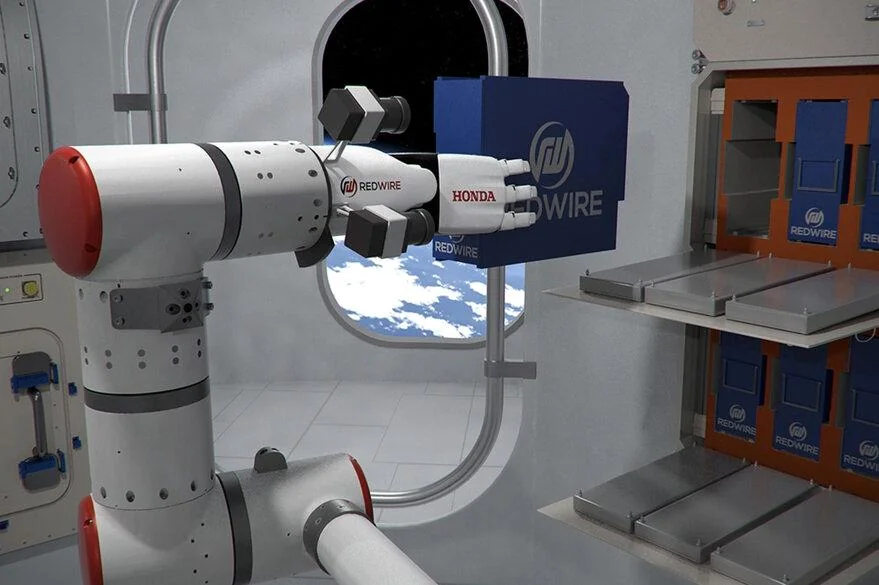
Honda is taking its robotics ambitions beyond Earth’s atmosphere, announcing Thursday that it is working with space infrastructure company Redwire to develop a robotic system designed to help automate research operations aboard the next generation of commercial space stations. The concept pairs Honda’s multi-fingered robotic hand with Redwire’s STAARK robotic arm and experiment locker technology, aiming to cut down the amount of time astronauts currently spend on hands-on laboratory work in orbit.
The timing of the partnership lines up directly with a significant shift already underway in how low Earth orbit gets used. NASA is planning to retire the International Space Station and transition to a new generation of commercially operated stations, a shift that comes with a notable change in operational assumptions. Unlike the ISS, which has supported continuous crews of astronauts for more than two decades, the commercial stations now in development are generally being designed around smaller crews and shorter astronaut stays, meaning there will be fewer human hands available to manage the kind of routine experiment handling and laboratory maintenance that currently consumes a meaningful share of astronaut time on the ISS. That structural change creates a clear opening for robotics to take over tasks that have traditionally required direct human involvement.
Tom Sladek, chief engineer at Honda’s Space Development Division, framed the collaboration around that exact problem. He said Honda’s space initiatives, including its robotic hand, are focused on enabling practical operations in orbit, and that working with Redwire allows the company to evaluate how robotics with human-like dexterity could support research activities aboard future commercial stations. That emphasis on dexterity matters considerably in this context, since much of the value of a robotic hand over a simpler mechanical gripper lies in its ability to handle the kind of varied, delicate manipulation tasks that laboratory experiments typically require, from opening sample containers to operating switches and instruments originally designed for human hands rather than robotic end effectors.
Redwire brings its own substantial track record in space robotics to the partnership. The company currently operates eight facilities aboard the International Space Station and has built out specific expertise through STAARK, a modular robotic arm system engineered for a range of on-orbit applications. According to Honda’s official announcement, Redwire’s STAARK platform has already completed testing demonstrating its capabilities, giving the partnership a foundation of flight-relevant robotics experience to build on rather than starting entirely from scratch on the arm and locker side of the system. Pairing that established hardware with Honda’s robotic hand technology allows the two companies to combine complementary strengths, Redwire’s space systems integration experience with Honda’s work on dexterous manipulation, rather than each company trying to independently solve the full scope of the problem on its own.
The collaboration remains at a conceptual and evaluation stage rather than a confirmed hardware development program with a specific station customer attached. Honda and Redwire representatives are set to attend the International Astronautical Congress in Antalya, Turkey, running October 5 through 9, 2026, where they plan to discuss the combined robotics concept directly with commercial space station developers and other prospective industry partners. That venue matters given how central the IAC has become as a gathering point for the companies currently racing to build NASA’s planned commercial successors to the ISS, making it a natural setting for Honda and Redwire to court interest from station developers who might eventually integrate this kind of automated research system into their own designs.
Honda’s move into space robotics fits into a broader pattern of the company looking beyond its traditional automotive and power equipment businesses for new growth avenues, a strategic shift that comes at a notable moment for the automaker’s finances. According to coverage of the announcement, Honda is currently navigating real financial pressure, including unprofitability and cash-flow constraints tied to its core business, making this kind of diversification into advanced robotics applications a meaningful signal of where the company sees longer-term opportunity even as it manages near-term challenges in its primary markets. Honda has pursued robotics research for decades, dating back to its well-known ASIMO humanoid robot program, giving the company a body of institutional expertise in dexterous manipulation and human-like robotic movement that it is now attempting to apply to the considerably different operating environment of orbital spaceflight.
For Redwire, the Honda partnership adds to a steadily expanding list of collaborations the company has pursued across its space infrastructure business throughout 2026. Just weeks earlier, Redwire announced a strategic teaming agreement with Japanese trading firm Kanematsu Corporation to expand its commercial reach in Japan, covering space power generation systems, microgravity research payloads and space robotics technology. Redwire President Mike Gold has framed that broader push toward international partnerships as a way to advance innovative space technologies supporting a wide range of commercial, scientific and national security applications, a strategy the Honda collaboration now extends into the specific domain of robotic automation for in-orbit laboratory work.
The practical stakes of getting this kind of automation right extend well beyond simple convenience for astronauts. As commercial space stations move toward smaller, shorter-duration crews, the economic viability of running meaningful scientific research programs in orbit increasingly depends on how much of that research can proceed without requiring constant hands-on astronaut involvement. A robotic system capable of reliably handling routine experiment setup, sample management and laboratory maintenance tasks could allow commercial station operators to support a broader range of research customers without needing to staff up with additional crew specifically to manage that workload, a cost consideration that matters considerably for companies trying to make commercial low Earth orbit stations financially sustainable once NASA’s ISS support eventually winds down.
Whether the Honda-Redwire concept ultimately gets adopted by one or more of the commercial station developers currently racing to build the ISS’s replacements will likely depend heavily on the reception the two companies get during next week’s discussions at the International Astronautical Congress, and on how quickly they can move from conceptual demonstration toward a flight-ready, qualified hardware system. For now, the partnership represents an early but notable signal that the dexterous robotic hand technology Honda has spent decades developing on Earth may find one of its most consequential next applications hundreds of kilometers above it. Continuing coverage of how robotics and automation are expanding into the commercial space industry is available on Business Tech. Additional detail on the partnership is available through Honda’s official press release, and further background on the underlying robotic arm system can be found through Redwire’s official site.