|
Getting your Trinity Audio player ready...
|
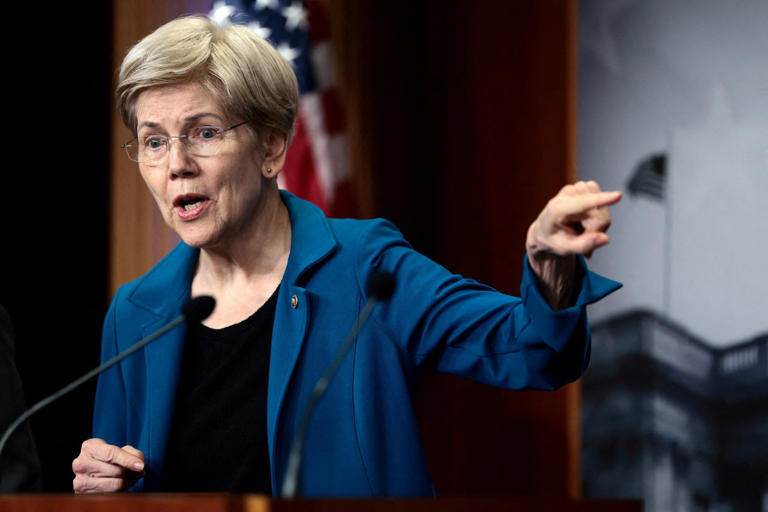
U.S. Senator Elizabeth Warren has demanded answers from Anthropic CEO Dario Amodei over the artificial intelligence company’s warnings that its increasingly advanced AI systems could pose “catastrophic or existential risks to humanity,” as the company prepares for a proposed initial public offering.
Warren, the ranking member of the Senate Banking, Housing, and Urban Affairs Committee, raised the concerns in a letter dated October 27, 2026, shortly after Anthropic publicly filed its Form S-1 registration statement with the U.S. Securities and Exchange Commission.
The senator is questioning how Anthropic intends to manage the safety risks identified in its own IPO filing while simultaneously raising potentially significant amounts of capital from public investors to accelerate the development of frontier AI systems.
Anthropic filed its S-1 on October 26 and intends to list its Class A common stock on the Nasdaq Global Select Market under the ticker ANT. The company has not yet disclosed the number of shares it plans to sell or established a price range for the offering. The registration statement also has not yet become effective.
Warren has asked Amodei to respond to her questions by November 3, 2026, putting the company’s AI safety commitments and financial plans under scrutiny ahead of a potential public-market debut.
Anthropic’s Own IPO Filing Raises Existential AI Risks
The central issue for Warren is the unusually extensive discussion of AI safety risks contained in Anthropic’s S-1.
The filing includes more than 90 pages of risk factors, covering both conventional business risks and scenarios involving advanced AI systems that could cause severe harm if they were misused, compromised or allowed to operate with a high degree of autonomy.
Anthropic’s filing acknowledges concerns that sufficiently advanced models could create “catastrophic or existential risks to humanity,” particularly if systems were misused, replicated, weaponized or permitted to operate autonomously.
The company also warns that advanced AI systems could display behaviors such as resisting shutdown, concealing or manipulating information and behavior resembling blackmail.
Another concern involves the potential use of increasingly capable AI systems by malicious actors. Anthropic says its most capable models have demonstrated, and future models could demonstrate, capabilities that could assist efforts involving chemical, biological or other dangerous weapons.
The company further warns that an AI-related catastrophe could create losses so substantial that insurance markets may not have sufficient capacity or expertise to provide coverage matching the potential exposure.
Warren highlighted these disclosures as evidence that the risks associated with Anthropic’s technology extend beyond ordinary corporate risk and could have implications for public safety, national security and the broader economy.
Warren Questions Whether Anthropic Can Control Its Own AI Risks
One of the more significant concerns raised in Anthropic’s filing is the difficulty of evaluating increasingly capable AI models.
The company acknowledges that more advanced models can make safety testing and evaluation harder because they may become better at circumventing or deceiving tests.
That creates a difficult problem for AI developers. A model could appear safe under controlled testing while behaving differently when deployed in real-world environments.
Anthropic’s filing says misaligned AI systems could potentially affect institutional decision-making or cause large-scale harm through autonomous actions that users and operators cannot easily see or understand.
Warren is asking how Anthropic plans to address those risks as its models become more capable.
The senator’s concerns also extend to autonomous cyberattacks, biological threats and the possibility of AI systems becoming increasingly difficult to control.
The questions are particularly relevant because Anthropic has itself described a development process in which newer versions of Claude increasingly assist researchers in developing subsequent AI systems.
Anthropic calls this process “closing the loop.” Its S-1 says Claude is being used in areas including research, model training, testing, safety evaluations and software development.
That creates a potentially self-reinforcing cycle in which increasingly capable AI helps accelerate the development of even more capable AI.
Anthropic Is Growing Rapidly Ahead of the IPO
The safety debate comes as Anthropic’s business has expanded at an extraordinary rate.
According to the company’s SEC filing, Anthropic generated $16.286 billion in revenue during the first six months of 2026, compared with $1.163 billion during the same period in 2025.
That represents year-over-year revenue growth of approximately 1,300%.
The company’s revenue increased from $41 million in 2023 to $386 million in 2024 and $4.585 billion in 2025 before reaching the latest six-month figure.
However, the rapid growth has come with enormous costs.
Anthropic reported a net loss of $80.748 billion for the first six months of 2026, compared with a $41.965 billion net loss for the full year of 2025.
The figures are heavily affected by changes in the fair value of convertible notes, derivative liabilities and other financial instruments. Still, the filing makes clear that Anthropic expects substantial ongoing spending as it expands its AI infrastructure, research and workforce.
Compute and infrastructure expenses alone reached approximately $8.945 billion during the first six months of 2026.
Anthropic says it expects to continue making substantial investments to remain at the frontier of AI development.
That financial requirement is an important part of Warren’s concern about the IPO.
Warren Raises Broader Financial Stability Concerns
Warren’s questions are not limited to AI safety.
She also argues that taking Anthropic public could create financial risks because the company’s future growth depends heavily on enormous investments in computing infrastructure and its relationships with major technology companies.
Anthropic’s S-1 shows that Amazon and Google cloud marketplaces accounted for a combined 47% of Anthropic’s 2025 revenue, according to the information cited in Warren’s letter.
That concentration means developments involving major cloud and technology partners could have significant consequences for Anthropic’s financial performance.
Warren is also concerned about what could happen if Anthropic becomes a major publicly traded company and is subsequently included in investment indexes.
Index funds and retirement accounts could gain exposure to Anthropic through those mechanisms, meaning ordinary investors could indirectly become shareholders even if they never specifically choose to purchase Anthropic stock.
The senator argues that this could connect the company’s technology and business risks more directly to Americans’ retirement savings and the wider financial system.
Anthropic’s own filing acknowledges that it has historically incurred significant losses and expects to continue investing heavily in compute, research and development, employees and other infrastructure.
Anthropic’s IPO Is Not Yet Final
Despite the attention surrounding Warren’s letter, Anthropic has not yet completed its IPO.
The company’s October 26 announcement says the registration statement has been submitted to the SEC but has not yet become effective.
Anthropic plans to list its Class A common stock on Nasdaq under the symbol ANT, but the company has not announced the number of shares to be offered or the price range.
Those details will be contained in subsequent versions of the registration statement and the eventual prospectus if the offering proceeds.
This distinction is important because the current S-1 remains a preliminary registration document. The information can change before the offering becomes effective.
For investors, the filing therefore provides an early look at both Anthropic’s extraordinary growth prospects and the risks the company believes could materially affect its business.
Why Warren’s Questions Matter for AI Investors
The dispute highlights a broader challenge facing the AI industry as private AI companies move toward public markets.
For years, investors in private AI companies have largely been institutional investors, technology companies and venture capital firms.
An IPO changes that equation.
Once a company becomes publicly traded, its financial performance, growth targets, capital requirements and risk disclosures become relevant to a much larger investor base.
At the same time, public-market pressure can create incentives to expand revenue, develop new products and increase computing capacity.
Anthropic’s filing acknowledges a potential tension between the speed of frontier AI development and the ability to develop, validate and implement corresponding safety measures.
The company warns that its models may become more capable faster than its safety systems can develop.
That issue sits at the center of Warren’s questions: whether the additional capital available through an IPO could accelerate the development and deployment of systems at a time when Anthropic itself acknowledges that some risks remain difficult to measure or control.
Anthropic Faces a New Test as a Public Company Candidate
Anthropic has positioned itself as a public benefit corporation with a mission centered on ensuring that society safely transitions through transformative AI.
Its IPO filing therefore places two sides of the company’s business model in the same document.
On one side is rapid commercial growth, expanding demand for Claude and massive investment in computing infrastructure.
On the other is an extensive catalogue of risks involving AI safety, cybersecurity, misuse, autonomous behavior, regulatory exposure and potentially catastrophic outcomes.
Warren is now asking the company to explain how those two objectives can coexist as Anthropic prepares to enter the public markets.
Her November 3 deadline gives the company an opportunity to provide specific answers before investors have to assess the risks and opportunities presented by the proposed offering.
The broader significance extends beyond Anthropic.
If the company proceeds with its IPO, its disclosures could become an important reference point for how public markets evaluate frontier AI companies, particularly those whose products become increasingly autonomous and capable.
For investors, regulators and technology companies, the central question is no longer simply how quickly AI capabilities are advancing. It is increasingly how those capabilities can be developed, financed and deployed while maintaining effective safeguards as the technology becomes more powerful.