|
Getting your Trinity Audio player ready...
|
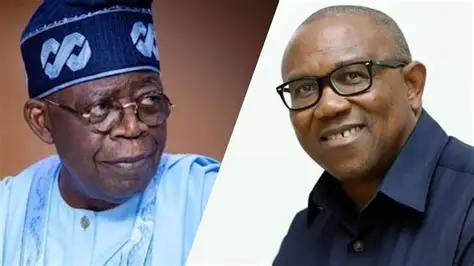
Senator Adams Oshiomhole has questioned the policy proposals of former Anambra State Governor Peter Obi, arguing that the presidential candidate of the Nigeria Democratic Congress (NDC) has not presented a clear alternative to President Bola Tinubu’s administration ahead of the 2027 general election.
Oshiomhole, who represents Edo North Senatorial District, made the remarks during an interview on Channels Television’s Politics Today on Thursday, November 5, 2026. He challenged Obi to explain what he would do differently if elected president, particularly on security, economic management and policies introduced by the current administration.
The senator also criticised what he described as Obi’s short-term approach to economic issues, contrasting it with his view of Tinubu’s leadership and long-term national development priorities. His comments have added to the political debate over the policy direction opposition candidates intend to pursue as preparations for the 2027 presidential election continue.
During the interview, Oshiomhole said Obi had failed to provide a sufficiently clear response when asked what he would do differently from the Tinubu administration on national security.
“Peter Obi has not offered any alternative,” the senator said, adding that when the former Anambra governor was asked what his approach to security would be, his response was that the answer was “in his heart.”
Oshiomhole used the exchange to question whether Obi had presented detailed proposals that Nigerians could examine and compare with the policies already being implemented by the Federal Government.
He also described Obi as a trader, arguing that the logic of a trader was centred on short-term turnover rather than the long-term interests of a country. He contrasted that description with what he called a statesman’s responsibility to consider future generations and build institutions that would serve them.
The comments reflect Oshiomhole’s support for Tinubu’s administration and his argument that continuity should be considered as Nigerians assess the options before them in 2027. He said he respected the constitutional right of opposition politicians to contest the presidency but maintained that Tinubu should be allowed to continue after addressing the initial challenges associated with his administration.
Oshiomhole questions Obi’s position on student loans and fuel subsidy
Beyond the question of national security, Oshiomhole challenged Obi to clarify whether he would retain some of the major policies introduced under Tinubu, particularly the student loan programme.
He questioned whether a future administration led by Obi would abolish the scheme, arguing that the programme was introduced to help students whose parents might not be able to afford the cost of higher education.
The senator suggested that opposition politicians should explain which policies they intend to retain, modify or discontinue rather than simply criticise the current government. His argument was that voters needed to understand the practical differences between the competing political platforms before making decisions at the ballot box.
The student loan programme has been one of the significant education-related initiatives of the Tinubu administration. It is intended to provide eligible students with financial assistance to pursue higher education, although questions about access, repayment arrangements and the broader cost of education remain part of the national policy debate.
Oshiomhole’s comments put the future of the programme among the issues he believes Obi should address. However, his questions during the interview should not be treated as evidence that Obi has announced plans to abolish the scheme.
The senator also questioned Obi’s position on the removal of the petrol subsidy, referring to what he described as differences between the former Anambra governor’s comments and those of former Vice-President Atiku Abubakar.
Oshiomhole recalled that Obi had supported subsidy removal but later appeared to differ from Atiku, who had advocated restoring the subsidy. He also referred to subsequent statements suggesting that the two politicians had moved towards a common position.
According to Oshiomhole, these exchanges made it difficult to determine precisely what Obi would do if elected president.
Fuel subsidy policy remains a major issue in Nigeria because of its implications for government spending, petrol prices, transportation costs and household living expenses. The removal of the subsidy under Tinubu brought significant changes to the country’s fuel pricing system and generated continuing debate over its economic and social consequences.
Supporters of subsidy removal have argued that ending the arrangement could reduce the financial burden on government and allow resources to be directed towards other priorities. Critics, however, have continued to raise concerns about the impact of higher energy and transportation costs on ordinary Nigerians.
Oshiomhole’s challenge was therefore centred on the need for Obi to explain how his administration would approach the policy and whether he would maintain the existing arrangement or introduce a different system.
Exchange rate policy becomes another point of disagreement
The senator also brought Nigeria’s foreign exchange policy into the discussion, praising Tinubu for unifying the country’s exchange rate.
He argued that the 2027 election would give Nigerians an opportunity to compare the economic policies of the candidates and decide which direction they wanted the country to take.
Oshiomhole contrasted Tinubu’s exchange rate reforms with the multiple exchange rate arrangements that existed under previous administrations. He criticised the former system, arguing that people with access to government connections could benefit from differences between official and other exchange rates.
He also referred to the administration of former President Olusegun Obasanjo, during which Atiku served as vice-president. Oshiomhole alleged that the government failed to guarantee regular payment of workers’ salaries and criticised the exchange rate arrangements associated with that period.
These statements formed part of his argument about the economic choices facing Nigerians in 2027. They were political assessments made during the television interview rather than an independent evaluation of the full economic records of the administrations discussed.
The exchange rate debate remains important because it affects the cost of imported goods, business operations, foreign investment and the purchasing power of Nigerians. Changes in the value of the naira can also influence the cost of production for companies that depend on imported machinery, raw materials and other supplies.
The policies introduced by successive governments have therefore remained a major subject of discussion among politicians, economists, businesses and households.
Oshiomhole defends Tinubu’s workers’ welfare measures
Oshiomhole also defended the Federal Government’s approach to workers’ welfare, pointing to a monthly transport allowance of ₦70,000 approved for public sector workers for six months, beginning in November 2026.
He argued that the intervention demonstrated the President’s concern for workers, particularly those earning lower salaries.
Using a worker earning ₦70,000 as an example, Oshiomhole said an additional ₦70,000 would double the person’s monthly income to ₦140,000 during the period covered by the arrangement.
“I think this government is doing well,” he said, arguing that the additional payment represented a significant increase for workers at that income level.
The Federal Government approved the transport intervention following a meeting with the Nigeria Labour Congress (NLC) on October 27, 2026. The agreement also included plans to pay outstanding peculiar allowances in three equal monthly instalments beginning in November.
However, the arrangement has not received unanimous support from organised labour. The Trade Union Congress (TUC) rejected the transport allowance, arguing that workers needed a permanent salary increase rather than temporary financial assistance.
The disagreement highlights the different positions within organised labour over how government should respond to the pressure on workers’ incomes. While temporary allowances can provide short-term support, labour groups have also raised concerns about the need for lasting improvements in wages and purchasing power.
Oshiomhole raises tax allegations against Obi
In a separate part of the interview, Oshiomhole accused Obi of failing to pay taxes in Nigeria, alleging that the former Anambra governor kept substantial assets offshore in a tax haven.
The senator claimed that Obi had acknowledged the issue, although the allegation was presented during the interview as Oshiomhole’s account and should not be treated as an independently established finding.
The tax issue adds another dimension to the political exchange because questions about public officials’ financial interests, tax compliance and transparency are likely to attract attention as the 2027 election approaches.
For any such allegation to be established, relevant financial records, tax documentation and responses from the person concerned would need to be considered. Oshiomhole’s remarks alone do not establish that Obi committed a tax offence.
Obi, who governed Anambra State from 2006 to 2014, was the Labour Party’s presidential candidate in the 2023 general election. He finished third in the contest behind Tinubu and Atiku.
In May 2026, Obi emerged as the presidential candidate of the Nigeria Democratic Congress ahead of the next general election, according to reports on his political move. His entry into the NDC has made him one of the opposition figures involved in the developing contest over the country’s political direction.
2027 election debate shifts towards policy alternatives
Oshiomhole’s comments raise a central question for the emerging 2027 presidential contest: how will opposition candidates explain what they intend to change if they take over from the current administration?
For voters, the issue goes beyond criticism of the government. They will need to assess the proposals presented by the different candidates on security, employment, education, healthcare, taxation, energy, infrastructure and the management of public finances.
Political parties and candidates are expected to communicate their priorities through policy documents, campaign statements, public interviews and engagements with citizens. These proposals can help voters understand how a candidate intends to address the country’s challenges and what changes may follow if the candidate wins.
The debate over alternatives is particularly important because economic decisions often involve difficult choices. Changes to fuel subsidy arrangements, exchange rate management, taxation and public spending can have consequences for households and businesses. Candidates therefore face questions not only about what they oppose but also about how they would implement their preferred policies.
Oshiomhole’s criticism suggests that he wants Obi to provide more specific explanations of his positions on the policies raised during the interview. His comments also show how the ruling party’s supporters are framing the 2027 debate around continuity, economic reforms and the consequences of changing existing policies.
For Obi and other opposition politicians, the wider campaign period will provide opportunities to explain their positions and respond to criticisms. Their proposals will be open to scrutiny from voters, political opponents, journalists and policy experts.
The discussion is also likely to extend beyond the leading political figures to the parties supporting them. Nigerians will have to consider whether proposed policies are sufficiently detailed, how they would be funded, which institutions would implement them and what safeguards would be put in place to measure their results.
As the 2027 general election approaches, exchanges between politicians are expected to become more frequent. Oshiomhole’s interview has placed Obi’s policy positions under renewed public discussion, particularly on security, student loans, fuel subsidy and foreign exchange management.
The senator maintains that Tinubu should continue in office and has questioned whether Obi has provided a clear alternative to the President’s policies. The remarks represent Oshiomhole’s political position, while the broader debate over the candidates’ proposals and records will continue as the election campaign develops.