|
Getting your Trinity Audio player ready...
|
Fibre is changing Nigeria’s Internet. The hard part is getting everyone connected, as broadband penetration and fibre optic expansion accelerate
Nigeria’s internet is getting noticeably faster, and the numbers behind that shift are hard to ignore. New data from Ookla shows that the number of homes and businesses connected to fibre-to-the-premises networks jumped from 84,141 in the fourth quarter of 2025 to 265,000 by June 2026, more than tripling in roughly six months. For the first time, fibre has overtaken fixed wireless access to become Nigeria’s dominant fixed broadband technology, a milestone that signals a genuine shift in how the country’s internet infrastructure is being built, even if the scale of what remains unconnected tells a more complicated story.
The speed improvements are real and measurable. Median fixed download speeds, excluding satellite connections, rose 155 percent between 2023 and the first half of 2026, climbing from 13.50 Mbps to 34.47 Mbps. Upload speeds nearly doubled to 25.17 Mbps over the same period, while latency, the time it takes data to travel across the network, dropped from 47.9 milliseconds to 35.8 milliseconds. Those improvements weren’t confined to Nigeria’s fastest users either. The bottom 10 percent of connections, representing the country’s slowest internet experiences, saw download speeds nearly triple, from 2.24 Mbps to 6.04 Mbps, while the fastest 10 percent improved from 74.37 Mbps to 90.04 Mbps. That kind of gain across the entire speed distribution suggests the infrastructure investment driving this improvement isn’t just benefiting affluent urban users with existing access, though the gap between Nigeria’s fastest and slowest connections remains enormous.
Broadband penetration overall has followed a similar upward trajectory. According to the Nigerian Communications Commission, broadband penetration climbed from roughly 45.6 percent in January 2025 to about 53 to 55 percent by mid-2026, depending on the reporting period referenced. Total broadband subscriptions rose from around 99 million to somewhere between 115 and 120 million over that stretch, while total active internet subscriptions across the country reached 154.7 million as of April 2026. Nigerians are consuming data at a rapid clip too, with monthly usage averaging roughly 1.3 to 1.4 million terabytes, a figure driven by streaming, social media, cloud services, and a growing base of businesses that depend on connectivity to operate.
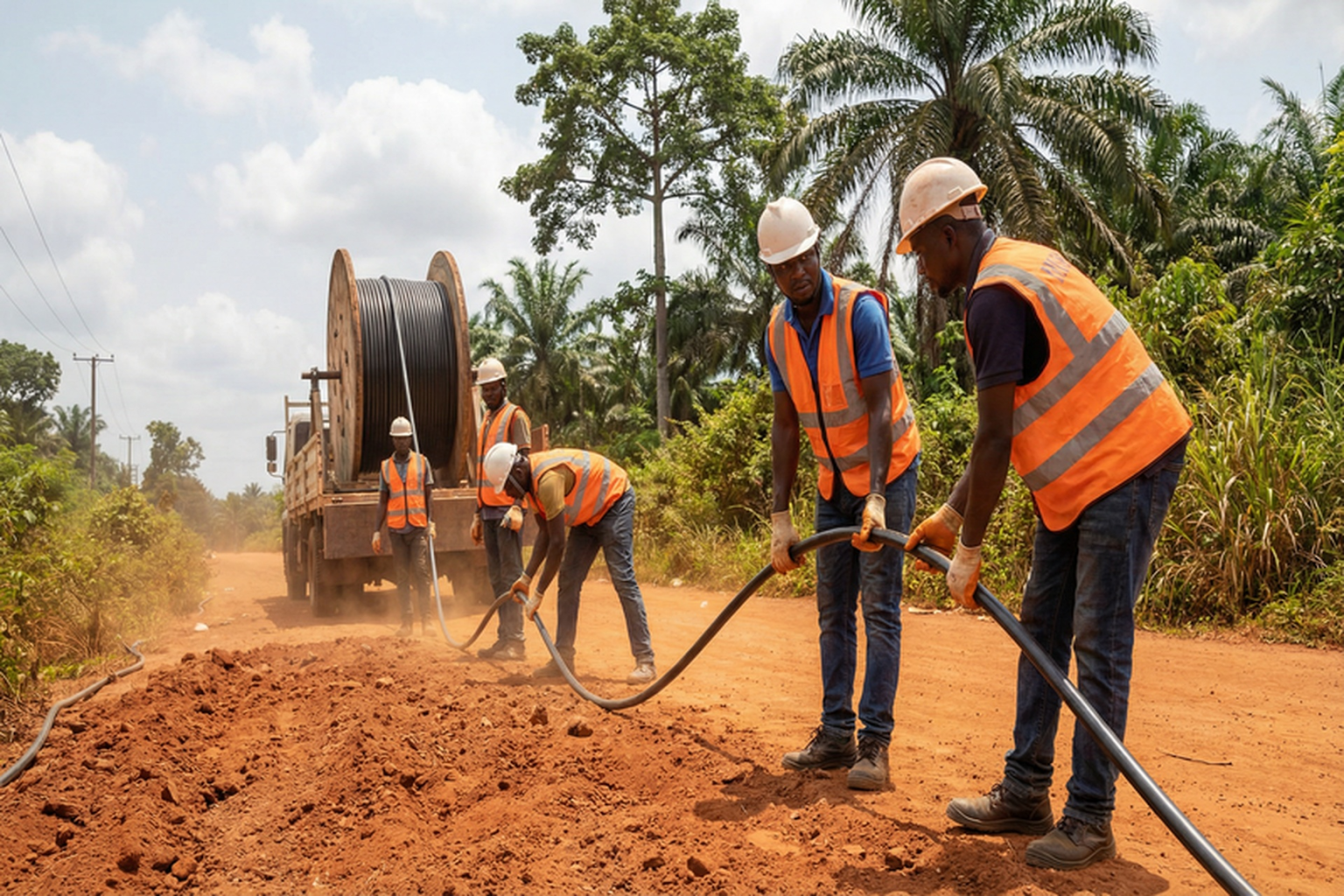
None of this growth happened by accident. Nigeria’s National Broadband Plan, which runs through 2025 with a follow-on target of 80 percent penetration for underserved populations by 2027, set the policy framework pushing operators toward faster infrastructure rollout. The government has also worked to streamline right-of-way approvals, the often bureaucratic and locally contested process operators must navigate to legally lay fibre cables through communities, cutting down on the delays and land disputes that have historically slowed network expansion. Alongside that, Nigeria launched Project Bridge, a $2 billion initiative aiming to build a 90,000 kilometer fibre backbone across the country, structured as a special purpose vehicle with the government holding a minority stake between 25 and 49 percent while development finance institutions and private equity fund the bulk of construction. The project is projected to create 20,000 direct jobs and 150,000 indirect ones, and officials have tied it to ambitions of adding as much as 1.5 percent to national GDP.
Mobile operators have played an equally significant role in the broader connectivity push, even though fibre-to-the-home is where the most dramatic percentage gains are showing up. Airtel Nigeria added more than 1.5 million subscribers between December 2025 and January 2026 alone, its largest single-month gain since 2016, bringing its total base to 53.5 million while also expanding its fibre backbone by 25 percent and doubling active 5G sites across the country’s top 20 cities. MTN Nigeria added 1.2 million subscribers over the same window, reaching 81.1 million. Those figures illustrate a telecom market where mobile and fixed infrastructure investment are advancing in parallel, each addressing a different layer of the connectivity gap.
Despite the momentum, Nigeria remains well short of its 70 percent broadband penetration target, and the country’s fibre rollout still bypasses a staggering share of the population. Even with 101,000 kilometers of fibre now laid, industry estimates suggest well over 130 million Nigerians still lack meaningful access to the infrastructure passing near or through their communities, a gap driven by the economics of extending fibre into low-density rural areas where the cost of laying cable per potential subscriber is far higher than in dense urban neighborhoods. Fibre cuts, caused by everything from road construction to vandalism, continue to disrupt service reliability in areas that do have coverage, and right-of-way friction, while improved, has not disappeared entirely, particularly in states and local governments where fee structures and permitting processes remain inconsistent.
For users with the weakest connections, download speeds rose from 2.24 Mbps in 2023 to 6.04 Mbps in the first half of 2026. Among users with the strongest connections, speeds increased from 74.37 Mbps to 90.04 Mbps.
In other words, the biggest gains are happening at the bottom. Nigeria is not just making its fastest internet connections faster; it is also improving the experience of people who previously had some of the weakest connections.
The gap between those gains tells us something important about the current stage of Nigeria’s fibre rollout. The country is not primarily getting faster by pushing already-fast connections to ever-higher speeds. It is getting faster by moving more people onto better networks.
That is a more consequential change for a developing broadband market. Moving a household from a 2 Mbps connection to 6 Mbps can fundamentally change what it can do online. Moving another household from 74 Mbps to 90 Mbps is an improvement, but the practical difference is considerably smaller.
“Fibre plays a key role in driving data communication for now,” Mukesh Chandra, former chief technology officer at Globacom and a telecom infrastructure consultant, told TechCabal. “Without fibre, heavy data traffic can’t be transported from wireless or wireless access networks, which connect end users to the internet using either Wi-Fi, mobile data networks or fixed wireline broadband connections.”
Digital Economy Minister Bosun Tijani has framed the challenge in terms that go beyond simple infrastructure metrics, describing the home as increasingly central to how Nigerians work, learn, and access services, a shift that makes fibre-to-the-home connectivity less of a convenience and more of a foundational requirement for participation in the country’s expanding digital economy. That framing captures the stakes accurately. Nigeria’s population of over 220 million represents one of the largest untapped digital markets in the world, and the difference between a household with reliable, affordable fibre access and one without increasingly determines access to remote work opportunities, online education, digital banking, and the broader wave of tech-enabled services that have taken root across Lagos, Abuja, and other major cities but have been slower to reach smaller towns and rural regions.
The trajectory Nigeria is on suggests continued fibre expansion is likely, driven by both government policy and competitive pressure among operators racing to capture subscribers in a market that is still, by most measures, only about halfway connected. But closing the remaining gap will require a different set of solutions than the ones that produced the tripling of fibre connections over the past six months. Reaching the 130 million Nigerians still without adequate access means solving problems that dense urban fibre rollouts don’t force operators to confront: financing infrastructure in areas with lower expected returns, maintaining service reliability against physical damage and theft, and ensuring that affordability keeps pace with expanded coverage so that access, once available, actually translates into adoption. The fibre is spreading faster than almost anyone predicted a year ago. Making sure it reaches everyone is the harder, slower problem still ahead.