|
Getting your Trinity Audio player ready...
|
Xpeng’s robotics unit valued at over $6.3 billion after record funding round, as humanoid robot IRON heads toward mass production in China
Xpeng has just pulled off the largest private funding round its humanoid robotics business has ever seen, and the numbers involved put it firmly at the center of China’s fast-moving embodied AI race. The Chinese automaker said its robotics unit raised more than $900 million in its first funding round, a figure the company describes as a new record for a single private financing in China’s embodied AI sector. The round was led by IDG Capital, with backing from strategic investors Tencent and Alibaba, and values the robotics business at more than $6.3 billion.
Gaorong Ventures also participated in the round alongside IDG Capital, and Xpeng framed the deal as the largest single private-equity funding round ever completed in China’s embodied intelligence sector, a claim that, if accurate, marks a meaningful milestone for an industry still working out how to translate humanoid robot demos into commercially viable products. The announcement came from Xpeng’s headquarters in Guangzhou, where the company, listed on both the New York Stock Exchange and Hong Kong Stock Exchange, described itself as a leading global Physical AI company rather than simply an EV maker branching into robotics.
The structure of the deal is worth understanding, because it isn’t a simple cash injection into an existing division. Xpeng is carving its robotics business out into a standalone entity called Dogotix, giving it its own valuation and its own dedicated financing channel, while Xpeng retains overall control of the operation. According to a filing with the Hong Kong Stock Exchange, the transaction gives Dogotix a pre-money valuation of $5 billion, with the implied post-transaction valuation reaching roughly $6.3 billion once the associated equity incentive plan is fully utilized, excluding any additional investment or warrant exercises down the line. Of the roughly $900 million being raised, Xpeng’s own subsidiary is contributing $200 million, while external investors are putting in the remaining $600 million.
That carve-out approach mirrors a pattern that’s become increasingly common among companies working on capital-intensive, longer-horizon technology bets like humanoid robotics and autonomous driving. Spinning the unit into a separate legal structure with its own investor base lets a company like Xpeng raise significant outside capital for a business that may not turn a profit for years, without diluting the parent company’s own stock or forcing robotics R&D costs directly onto its automotive balance sheet. Given that Xpeng is still working through the kind of margin pressure typical of a scaling EV manufacturer, that separation gives the robotics unit room to chase a genuinely different, much longer investment timeline.
Xpeng says the new capital will go toward developing robotics hardware and software, training and refining its physical AI models, collecting high-quality training data, building out end-to-end mass-production facilities, and supporting international expansion. Part of the funding is also earmarked for long-term incentive programs meant to retain executives and key personnel working on the robotics effort, a detail that signals Xpeng views this less as a side project and more as a core strategic bet on where the company is headed next.
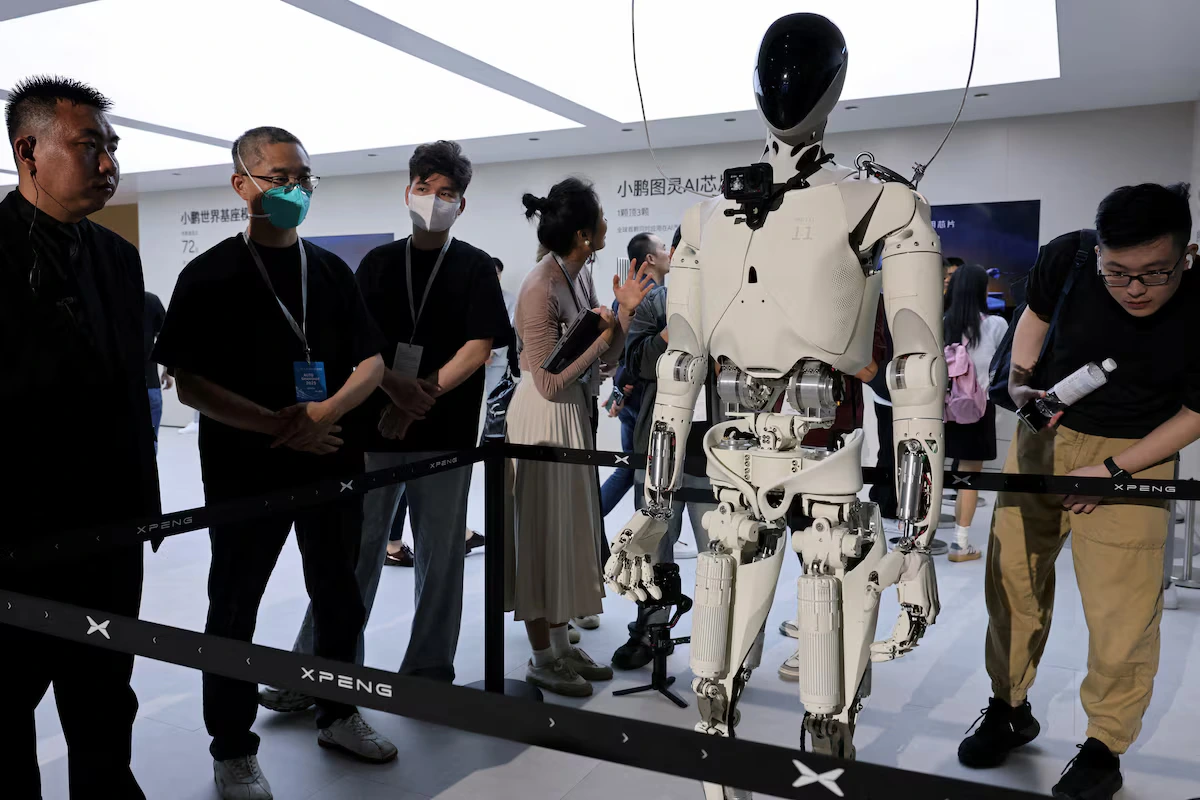
The product at the center of all this is IRON, Xpeng’s humanoid robot, which the company unveiled in a next-generation form back in November 2025. IRON is built around three in-house developed Turing AI chips that together deliver a combined 2,250 TOPS of computing power, a substantial figure that puts real weight behind Xpeng’s claim of building genuine physical AI rather than a scripted demo bot. The company describes IRON’s human-like form and movement as a deliberate design choice, arguing that a body built to move the way people do makes it far easier for the robot to learn from human behavioral data and operate naturally in spaces designed for human activity. The idea, according to Xpeng, is a feedback loop where deploying IRON at scale generates real-world and human-demonstration data, which feeds back into training better models, which then unlocks new applications and generates further high-quality data. It’s the same data-flywheel logic that’s driven progress in autonomous driving, now being applied to general-purpose robotics.
On the timeline, Xpeng plans to begin mass production of IRON by the end of this year, with initial deployments starting inside its own retail stores and industrial campuses before wider commercial sales and deliveries in both China and overseas markets begin in 2027. The company has said it intends to ramp monthly production capacity to more than 1,000 units as manufacturing scales up, and has already reorganized its internal robotics center into nine second-tier departments to manage that growth, with founder and CEO He Xiaopeng personally taking on the additional role of CEO of the robotics business back in June.
The timing of the announcement is notable too. Xpeng revealed the robotics financing roughly an hour before releasing its second-quarter earnings, and the contrast between the two pieces of news was stark. Xpeng shares slipped in premarket trading after the company reported a wider-than-expected quarterly loss of RMB1.29 per share against analyst expectations of RMB0.29, alongside revenue of RMB19.74 billion that, while up 8% year-over-year, still missed consensus estimates of RMB20.57 billion. Pairing a record robotics funding announcement with a disappointing earnings report looks like a deliberate move to give investors a growth story to focus on alongside the near-term financial miss, and it’s a strategy other Chinese automakers pursuing adjacent AI and robotics bets have leaned on as core vehicle margins stay thin.
Xpeng isn’t alone in chasing humanoid robotics as the next major platform bet coming out of China’s EV industry. Tesla has its own Optimus program, and several Chinese robotics startups have drawn heavy venture interest over the past two years as investors search for the next category-defining hardware business built around large-scale AI models. What sets Xpeng’s approach apart is the direct lineage from its automotive AI stack, including its in-house chip design work and years of experience training perception and control systems for autonomous driving, expertise it’s now explicitly repurposing for a walking, manipulating robot rather than a car. Whether that translational bet pays off commercially will become clearer once IRON actually starts shipping to customers in 2027, but for now, the size of this funding round suggests some of the most sophisticated investors in Chinese tech are willing to bet heavily that it will. More detail on the transaction is available in Xpeng’s official announcement through PR Newswire.