|
Getting your Trinity Audio player ready...
|
CBN Withdraws N3.31 Trillion From Nigerian Banks in OMO Auction as Liquidity Tightens After Rate Cut
The Central Bank of Nigeria pulled about N3.31 trillion out of the banking system at its Open Market Operations auction on October 6. About N2.17 trillion in OMO bills matured and flowed back to lenders, so the net drain came to roughly N1.14 trillion. The headline figure is large, but the cash banks actually lost is about a third of it, and that gap explains much of what the market is doing right now.
The auction drew heavy interest. Investors bid N3.511 trillion against the N2 trillion the central bank first put up, and the CBN allotted N3.309 trillion. That is about 165 percent of the original offer. The CBN split its offer between the 147-day and 182-day tenors, and buyers clearly preferred the longer paper. The 182-day bill cleared at a stop rate of 16.92 percent, while the 147-day bill cleared higher at 17.22 percent. The 182-day tenor took N2.671 trillion of the total, or 80.7 percent. Investors accepted a slightly lower yield in exchange for a longer lock-in, which suggests they are not expecting short-term rates to climb from here.
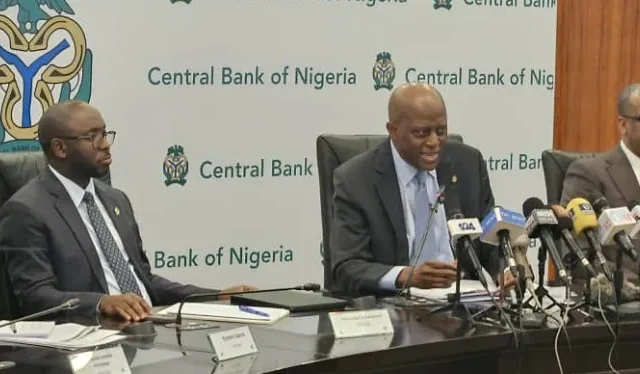
The auction should be read alongside what the central bank did a few weeks earlier. On September 22, after its 307th Monetary Policy Committee meeting in Abuja, the CBN cut the Monetary Policy Rate by 350 basis points to 23 percent from 26.5 percent. The committee also reset the Standing Facilities Corridor to +50/-300 basis points, which puts the Standing Lending Facility at 23.5 percent and the Standing Deposit Facility at 20 percent. The Cash Reserve Ratio was kept at 45 percent for commercial banks, 16 percent for merchant banks and 75 percent for non-TSA public sector deposits.
So the CBN lowered its benchmark rate and then went on draining naira from the system. That looks contradictory only if the rate cut is treated as a straightforward loosening. The CBN explained that the 26.5 percent policy rate had drifted away from market pricing, with the interbank rate sitting near 22 percent, and that Governor Olayemi Cardoso cautioned against reading the decision purely as easing. The reset was partly about making the official rate mean something again. Liquidity operations are how the central bank keeps short-term money market rates anchored near its new corridor while it does so.
The scale of the mop-up in recent weeks is considerable. Across five September auctions, the CBN sold about N17.51 trillion in OMO bills while N10.89 trillion matured, a net withdrawal of around N6.62 trillion. The September 29 auction was the heaviest, with N4.69 trillion allotted against N2.43 trillion in maturing securities. The October 6 sale was smaller than that, but it still removed more cash than it returned. It also kept the CBN’s liquidity strategy consistent from one month to the next, with the central bank continuing to treat surplus naira as a risk to manage.
Bank balance sheets showed the effects almost immediately. Lenders cut their overnight deposits with the CBN through the Standing Deposit Facility by N941.85 billion in a single day. Placements had stood at about N4.70 trillion after the auction, and about N3.76 trillion remained in the facility after the drop. A fall in SDF balances does not tell you where the money went. Banks may have used it to settle their OMO purchases, move into government securities, or fund customers. What it does confirm is that cash sitting idle at the central bank is shrinking as banks reposition.
Pricing in the money market moved the same way. Market reports said the auction pushed the average funding cost up by 32 basis points to 20.59 percent. A slightly more expensive overnight market is the intended result of an operation like this. It nudges banks toward the middle of the new corridor and away from the habit of parking money at the deposit window.
Demand for government paper stayed strong the following day. At the October 7 Treasury bills auction, the CBN offered N900 billion on behalf of the Federal Government and drew N1.77 trillion in subscriptions, and the Debt Management Office allotted N968.47 billion. The 364-day bill stop rate fell to 15.85 percent, and investors bid N1.68 trillion for the one-year tenor, far more than the two shorter maturities combined. Details of Treasury bill issuance and results are published by the Debt Management Office. The picture across both auctions is of investors with plenty of naira to deploy and a clear preference for longer maturities at a time when rates are being reset lower.
Where the pressure builds next is on the calendar. OMO maturities are projected to supply N9.05 trillion, or about 68.3 percent, of expected October inflows. That is a large amount of cash due back to banks and investors this month. If the CBN keeps rolling over those bills and adding new ones at similar sizes, the net effect on liquidity could stay muted even as the gross numbers look dramatic. If it sells less than what matures, liquidity will rise quickly. Market participants will be watching each Tuesday auction for which way the central bank leans.
The backdrop of low inflation gives the CBN more room to do this. Headline inflation stood at 15.39 percent in August, according to the National Bureau of Statistics, which is well below the new 23 percent policy rate. The MPC also pointed to stronger economic growth, relative exchange-rate stability and gross external reserves of about $55.25 billion as of September 18. A wide gap between the policy rate and inflation means real returns remain positive, which helps the CBN justify a cut without appearing to abandon price stability. It also explains why OMO bills continue to attract such strong bids at yields near
The harder question is what all of this means for lending. Banks that park less money at the CBN, and that find OMO bills a little less attractive than they were at 26.5 percent, are expected over time to push more funds into credit. That is the transmission the MPC says it wants. Analysts have noted that the bigger issue is whether the cash finds its way into lending and investment instead of staying concentrated in low-risk financial assets. At the moment there is little evidence either way. Government securities still pay well, the CRR remains high at 45 percent for commercial banks, and a bank’s decision to extend new loans depends on risk and borrower demand as much as on the cost of funds.
For businesses and households, the practical takeaway is that cheaper credit will not arrive overnight. A policy rate cut sets the direction, but loan pricing changes only as banks reprice their own funding costs and as competition for good borrowers picks up. For savers, lower Treasury bill and OMO yields mean the best fixed-income returns of the past two years are gradually narrowing, even if 16 to 17 percent still compares well with inflation.
For banks, the near-term task is managing liquidity day to day. With the SDF corridor floor at 20 percent and OMO yields above it, lenders have a choice between short-term placements, government securities and loans, and each carries a different return and risk. The central bank’s repeated mop-ups make sure the cheapest option, holding surplus cash, remains less attractive than the alternatives the CBN wants banks to prefer.
The next MPC meeting is scheduled for November 23 and 24, so the October auctions will be the main guide to the CBN’s liquidity stance until then. Further coverage of the banking sector and its policy backdrop is available on Business Tech.