|
Getting your Trinity Audio player ready...
|
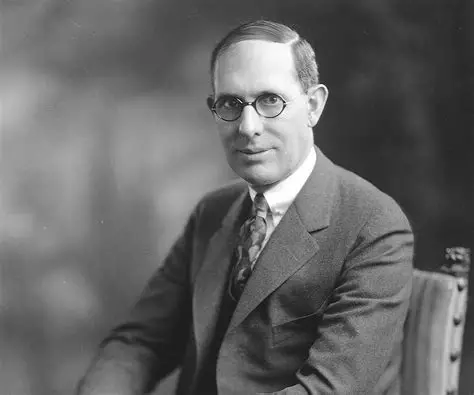
Inventor Charles F. Kettering spent his working life in the untidy business of trying things that mostly did not work. He earned lasting recognition for inventing the electric starter, which replaced the hand crank in motor cars. People widely credit him with the line, “Keep on going and the chances are that you will stumble on something, perhaps when you are least expecting it.” People often repeat the quote alongside a blunt companion remark: nobody ever stumbles over anything while sitting down.
The reason the line keeps circulating is that it describes discovery honestly. People like to imagine breakthroughs as the result of a clear plan, carried out in order. Kettering’s version is less flattering and more accurate. Progress often arrives sideways, and it tends to find people who are already in motion. Notice also the modest phrase “the chances are.” He does not promise a result. He describes a probability that rises with effort.
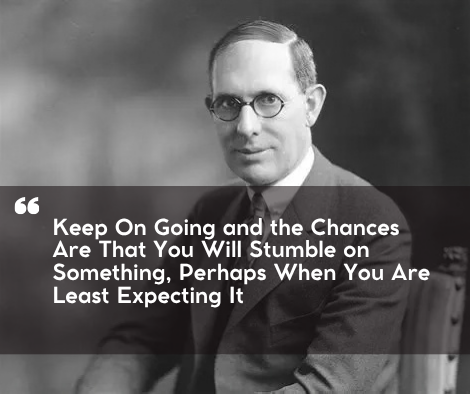
“Keep On Going and the Chances Are That You Will Stumble on Something, Perhaps When You Are Least Expecting It” – Charles F. Kettering
His own record fits the advice. Kettering was born on an Ohio farm in 1876, earned an electrical engineering degree from Ohio State University in 1904 and went to work at National Cash Register. In 1909 he left with a colleague to form the Dayton Engineering Laboratories Company, soon known as Delco. Within a few years his team had built all-electric starting, ignition and lighting systems for cars, first installed in the 1912 Cadillac. He later led research at General Motors from 1920 until 1947. Nothing in that path suggests a man waiting for inspiration. It shows a man who kept testing until something worked.
The quote is easy to misread as a slogan about positive thinking, and that misses what is practical in it. Kettering is not saying that hope produces results. He is saying that movement produces exposure. Every attempt puts a person in front of information they did not have before: a customer objection, a flaw in a design, a contact they would never have met at home. The unexpected discovery is usually something that only becomes visible once you are already walking.
Consider two people who each want to start a small food business. The first spends months refining a menu in private, waiting until everything feels ready. The second starts selling lunches to colleagues on Friday, learns within two weeks that the real demand is for early breakfast, and changes direction. The second person did not plan that outcome. They stumbled on it, but only because they were out there moving.
Motion creates the conditions for luck
Many people describe a lucky break as something that happened to someone else. Kettering’s framing treats luck as partly a consequence of behaviour. A person who applies for ten roles meets more chances than one who applies for one. A founder who speaks to fifty customers hears things a founder who speaks to five will never hear. The discovery still feels like an accident when it arrives, but the conditions for it were built through repeated action.
This is also why the phrase “when you are least expecting it” matters. The timing cannot be forced. What can be controlled is the volume and variety of attempts, and that is where effort should go.
Keep going does not mean keep repeating
It would be unfair to read the quote as advice to repeat the same failing action forever. Kettering worked as a researcher, and researchers change their method as they learn. Continuing means staying in the work while adjusting it. A salesperson whose pitch keeps failing should keep going, but with a different pitch. A writer whose drafts are rejected should keep submitting, but with sharper drafts. The persistence is in the pursuit, and the flexibility is in the approach.
There is also a simple honesty test. Ask whether your last month of effort taught you anything new. If it did, you are still exploring. If it did not, the answer is to change what you are doing, not to stop.
Why this advice still holds true today
Modern work rewards people who find things nobody planned for, from a product that customers use in an unexpected way to a career move that arrives through a casual conversation. Waiting for certainty is expensive, because certainty rarely comes before action. Kettering’s advice remains useful because it lowers the pressure to see the whole path. You do not need the full route. You need the next step, taken while you are still in motion, and a willingness to notice what turns up along the way.