|
Getting your Trinity Audio player ready...
|
Huawei Sets 2027 Launch for New Ascend AI Chips as It Steps Up Its Challenge to Nvidia
Huawei laid out its next round of AI chip launches on Thursday, confirming that two new processors, the Ascend 960DT and Ascend 960PR, will hit the market in 2027 as the Chinese tech giant keeps pushing to carve out ground against Nvidia in the global race for AI computing hardware. The announcement came from rotating chairman David Wang, speaking at the company’s Huawei Connect event in Shanghai, and it builds directly on a roadmap Huawei first sketched out roughly a year earlier under a different rotating chairman, Eric Xu.
According to Wang, the 960DT is set to launch in the first quarter of 2027, with the 960PR following in the third quarter of the same year. Neither chip’s exact specifications were detailed publicly, but the timing itself tells you something about how Huawei is thinking about this race. Rather than trying to leapfrog Nvidia on raw chip performance alone, a fight that’s been made considerably harder by years of US export controls cutting Huawei off from the most advanced foreign manufacturing equipment, the company is putting real weight behind connecting large numbers of its own chips together so they can function as one much bigger system.
That’s where UnifiedBus comes in. Wang described the technology as the key link tying together Huawei’s next generation of large AI computing systems, essentially the connective tissue that lets individual Ascend chips talk to each other fast enough to behave like a single, far more powerful machine. Huawei says it’s already built 11 separate semiconductors specifically designed around UnifiedBus for use in these large-scale systems, and the strategic logic behind all that investment is fairly straightforward once you understand what training modern AI models actually requires. No single chip, no matter how advanced, can handle the computing load behind today’s largest AI programs on its own. Getting genuinely competitive performance means linking thousands of chips together, and the efficiency of that linkup, not just the individual chip specs, ends up determining how well the whole system actually performs in practice.
That approach mirrors exactly what’s made Nvidia so hard to dislodge from AI data centers around the world. Nvidia’s own interconnect technology, called NVLink, does much the same job of letting multiple Nvidia GPUs work together as a unified system, and it’s arguably as central to Nvidia’s market dominance as its chip designs themselves, since it locks customers into an entire ecosystem rather than just a single product. Huawei appears to be betting that UnifiedBus can play a similar role for its own hardware, giving Chinese AI developers, and any customers elsewhere still willing to work with Huawei despite US pressure, a reason to build around Huawei’s full stack rather than mixing and matching individual components.
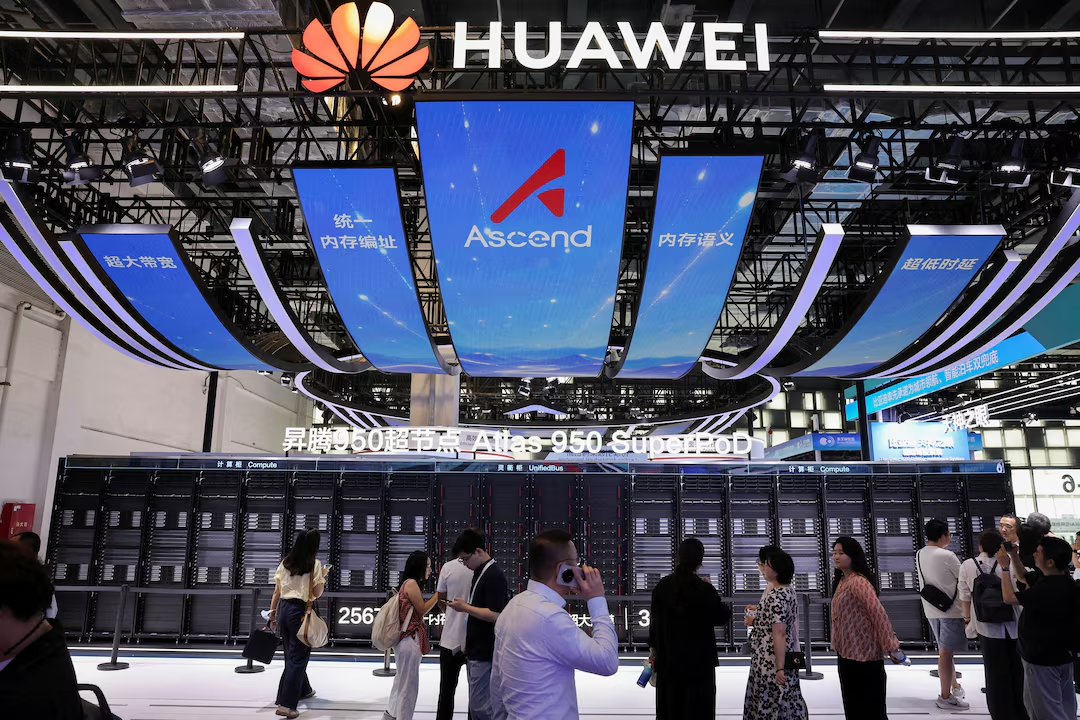
The scale Huawei is already operating at on this front is notable. Wang said the company has shipped more than 1,000 of what it calls supernodes, smaller linked systems that bundle multiple AI chips together to work on a single task, to more than 370 customers so far. He didn’t specify exactly how many chips fit inside a single supernode or name any of those customers directly. Going back to Eric Xu’s roadmap presentation from the prior year, Huawei had also detailed a bigger production called the Atlas 960 SuperPoD, a supernode-class system Xu said would eventually pack up to 15,488 Ascend 960 chips spread across 220 cabinets covering roughly 2,200 square meters, alongside a claim that its predecessor, the Atlas 950 SuperPod, would deliver 6.7 times the computing power and 15 times the memory capacity of the NVL144 system Nvidia planned to launch in 2026. Whether those specific performance multipliers hold up against real-world Nvidia hardware once both systems are actually deployed at scale is something outside benchmarking will eventually need to settle, but the ambition behind the comparison is unmistakable.
Developer adoption remains one of the trickier parts of Huawei’s pitch, and Wang was upfront about where things currently stand. He put Huawei’s AI chip ecosystem at 5,270 monthly active developers, a number that, whatever momentum it represents, is nowhere close to the scale of Nvidia’s developer base, which has had years to entrench itself through CUDA and a software ecosystem that’s become close to an industry default for AI researchers worldwide. Building competitive hardware is only half the challenge Huawei faces; getting enough developers comfortable building and optimizing for Huawei’s chips specifically is the other half, and it’s generally regarded as the harder problem to solve, since switching costs and existing tooling investments tend to keep developers anchored to whatever platform they already know well.
Huawei’s broader chip strategy has also included its Kunpeng CPU line, used in general-purpose servers rather than AI-specific workloads, with Eric Xu previously confirming new Kunpeng 950 and 960 versions rolling out in 2026 and 2028 respectively, alongside a companion cluster computing product called the TaiShan 950 SuperPod aimed at general computing tasks rather than AI training specifically.
What’s clear from Thursday’s announcement is that Huawei isn’t treating US export restrictions as a wall it can’t get around, but as a constraint it’s building its entire strategy in response to. Unable to freely buy the most advanced chips available on the global market, Chinese tech companies including Huawei have increasingly leaned into connecting larger numbers of whatever chips they can produce or access domestically, extracting more aggregate computing power through system-level engineering rather than through individual chip breakthroughs alone. Whether that approach ultimately closes the gap with Nvidia, or simply keeps Huawei competitive within China’s borders while Nvidia continues dominating everywhere export controls don’t apply, is likely to become clearer once the 960DT and 960PR actually ship in 2027 and independent benchmarks start rolling in.