Months of disrupted shipping through the Strait of Hormuz have pushed Gulf governments into one of the biggest infrastructure spending pushes the region has seen in years, as energy exporters scramble to build routes around a waterway that suddenly cannot be trusted.
The strait, a narrow passage between Iran and Oman, has historically carried around a fifth of the world’s oil flows and has been a target of Iranian threats for decades. For much of the past six months it has been effectively unusable for large stretches of shipping traffic, forcing producers across Saudi Arabia, the United Arab Emirates, Iraq, and Kuwait to redirect crude wherever they can and accelerate projects that were, until recently, treated as long-term contingency plans rather than urgent priorities.
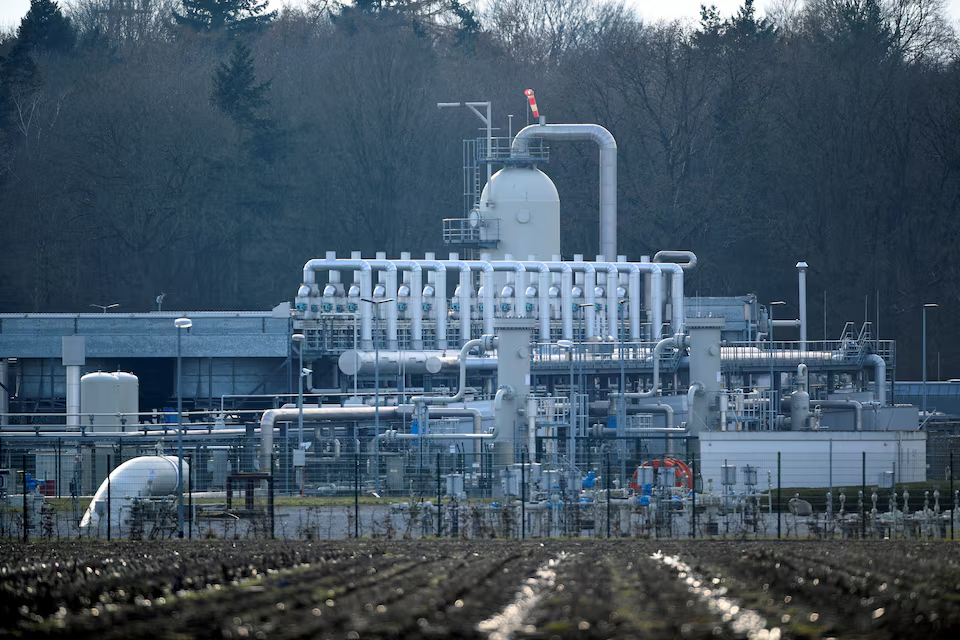
That shift in urgency is now translating into money. Gulf states are steering billions of dollars into pipelines, ports, and rail links designed to move oil and gas overland or through alternative coastlines entirely, bypassing Hormuz altogether. Analysts at Goldman Sachs have estimated that seven pipeline and export-infrastructure projects currently under construction, planned, or under consideration could, taken together with existing capacity, shield more than 45 percent of the region’s pre-war export volume from future disruptions to the strait by the end of next year. That figure is projected to climb past 60 percent by the end of 2028 as more projects come online.
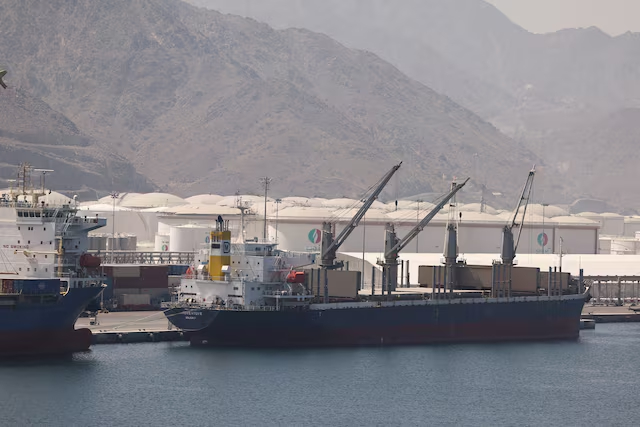
Two of the most advanced projects are already underway. The United Arab Emirates is building a second pipeline route to the port of Fujairah on the Gulf of Oman, aiming to roughly double its export capacity outside Hormuz once complete. In Iraq, work has begun on the Basra-Haditha pipeline, part of a broader effort by Baghdad to diversify away from its heavy reliance on the southern port city of Basra, which has limited alternative outlets and where oil exports fell by more than half in the months after the conflict began. Iraq is also negotiating expanded exports through Turkey’s Ceyhan port and is working toward new outlets through Syria’s Baniyas and Jordan’s Aqaba, each of which would require new pipeline links to reach the coast.
Saudi Arabia, the world’s largest oil exporter, is reportedly considering a two-million-barrel-a-day expansion of its existing pipeline to the Red Sea, according to people familiar with the discussions. The kingdom has effectively had a westward outlet since the original Petroline was built decades ago, but the current push would significantly widen that capacity at a moment when the calculus around Hormuz has changed. Kuwait, which has fewer alternative routes of its own, is in talks with both Saudi Arabia and the UAE about tapping into their pipeline systems to move its crude to market without relying on tankers transiting the strait.
The infrastructure ambitions extend beyond oil and gas pipelines. A Dubai-based port operator is reportedly in discussions to develop an entirely new port along the UAE coastline specifically to reduce the country’s dependence on Hormuz-adjacent shipping lanes. Trade volumes are already being rerouted toward Saudi ports on the Red Sea and the UAE’s eastern ports, though officials and shippers alike have acknowledged that existing capacity at those alternative hubs is not yet large enough to absorb the full volume that would normally pass through the strait, creating bottlenecks even as the longer-term projects move forward.
Even land-based connectivity is part of the response. Turkey and Saudi Arabia have discussed building a railway linking the two countries with Jordan and Syria over the next three to four years, with Turkish officials saying other Gulf states could eventually join the project. The scale of interest signals how far governments are willing to go to reduce their collective exposure to a single chokepoint, even where the payoff is years away.
Financing this buildout is where the story gets more complicated. Most Gulf governments can draw on decades of accumulated oil wealth to fund these projects domestically, and sovereign wealth funds across the region, among the largest pools of capital in the world, are already being deployed to accelerate construction timelines. But some states are also expected to look outward, courting international infrastructure funds and private investors as they try to hit ambitious foreign direct investment targets that predate the war but have taken on new urgency now that economic diversification feels less optional than before. Total costs across the region could run into the hundreds of billions of dollars over the coming years, according to estimates cited by people close to the planning.
None of this, analysts caution, actually solves the underlying vulnerability. Pipelines running across Gulf states remain exposed to the same kind of low-cost, asymmetric attacks that have targeted tankers in the strait itself, meaning the new infrastructure reduces reliance on one chokepoint without eliminating the broader risk that a determined actor could disrupt regional energy flows. Iran has also signaled it retains leverage beyond direct strikes. Tehran reportedly asked Yemen’s Houthi movement to move against the strait if the United States targeted Iranian power infrastructure, according to sources who spoke with Reuters, underscoring how the conflict has drawn in actors well beyond the two principal combatants.
There are signs of a partial thaw. Hormuz has seen some reopening of traffic in recent weeks, though volumes remain well below pre-war levels and there is no clear resolution in sight to the broader standoff between Iran and the United States. Iran is reportedly preparing a list of conditions for a fuller reopening of the strait, following requests from international mediators, while separate reporting has suggested Washington has floated easing sanctions on Tehran in exchange for guarantees around the waterway’s status. Control over the strait remains one of the most contentious sticking points in any eventual settlement.
For Gulf economies that have spent decades betting on oil revenue funneled through a handful of maritime corridors, the past six months have forced a rapid reassessment of what secure export capacity actually requires. Whether the current wave of pipeline and port construction ultimately outpaces the conflict that triggered it, or simply adds a new layer of infrastructure to defend, will likely shape how these economies are positioned the next time tensions in the region flare.