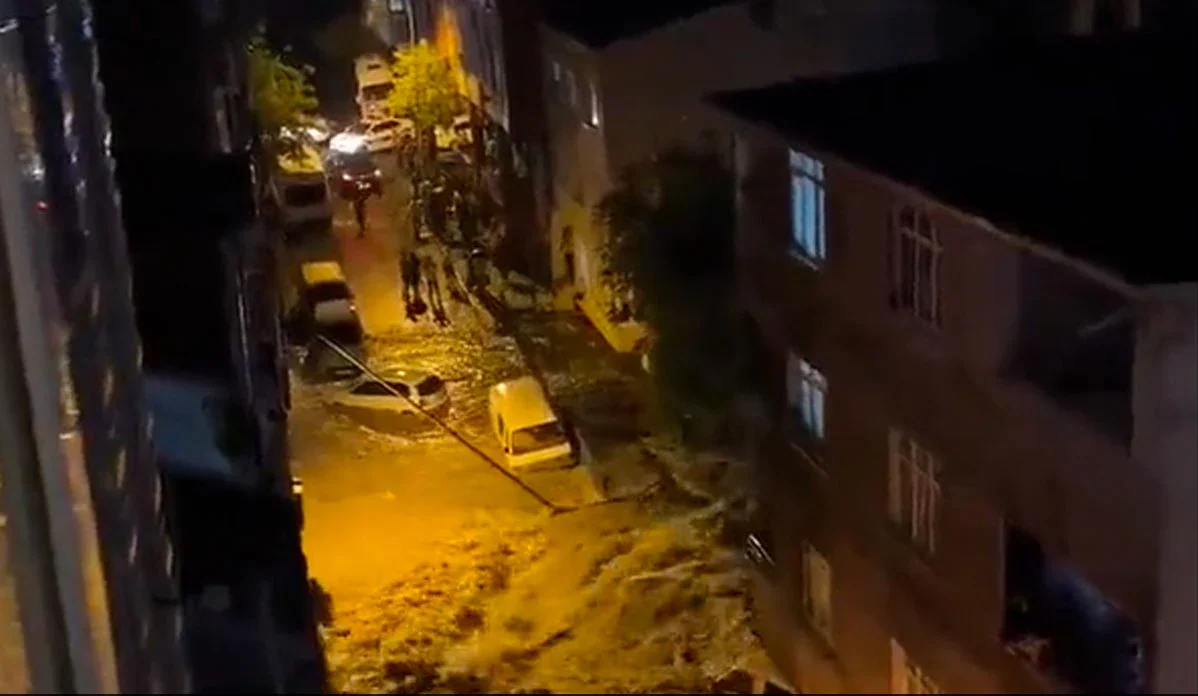
Large parts of Istanbul spent Wednesday dealing with water in places it does not belong. Rain that started on Tuesday evening and grew heavier through the following day flooded streets, underpasses, homes and shops across Türkiye’s biggest city. By nightfall the Istanbul Governor’s Office had logged 2,518 weather-related reports to emergency services, and a 14-year-old boy had died after being electrocuted in a flooded park.
The count covers the period from 6 a.m. to 8 p.m. and is broken down in the governor’s office figures. Flooding accounted for 1,277 incidents, followed by 47 cases of people stranded, 15 landslides, 13 fallen trees and two damaged roofs. Water reached 808 homes, 280 workplaces and 76 vehicles. Because the categories describe separate kinds of trouble, the totals do not simply add up to the headline number, which also includes other storm-related requests for help.
The heaviest rain fell in the Ömerli area of Beykoz, where the governor’s figures show 193.84 kilograms of rain per square metre, a measure that is equivalent to millimetres. Other readings reported during the day were higher, and some pointed to a few hundred in the worst-hit spots, but numbers differ depending on the station and the time window used. Figures reported for other districts included around 170 in Eyüpsultan and Sarıyer and about 130 in Arnavutköy. Whatever the precise totals, the common thread is that a very large amount of water arrived in a short time.
The death occurred in the Balat neighbourhood of Fatih district. According to the governor’s office, the boy stepped into a puddle at Çukurbostan Park and was electrocuted. He was taken to hospital unconscious and could not be saved. Officials said an investigation had been opened. The circumstances are a reminder that flooding creates hazards beyond rising water, and that standing water near street lighting, cables and electrical fittings can be lethal.
Authorities had been preparing since the national weather service issued warnings. A crisis coordination centre was set up at the Istanbul regional directorate of the Disaster and Emergency Management Authority, known as AFAD. About 8,000 personnel and 2,000 vehicles and work machines were deployed, drawn from AFAD, the Istanbul Metropolitan Municipality and district councils. The provincial health directorate said 378 emergency health teams and five national medical rescue teams were working across the city.
The pictures from the ground showed how quickly conditions changed. In Sarıyer, passengers on a bus caught in rising water climbed onto the roof while they waited to be reached. Cars and buses elsewhere were left surrounded by water. In Esenyurt, bystanders were reported to have pulled a woman out of floodwater that was carrying her away, and firefighters freed a person trapped in a flooded basement. Water also entered the Grand Bazaar and the Spice Bazaar, two of the city’s best-known commercial and tourist sites, and the Kağıthane stream overflowed, temporarily closing a major road.
To limit the risk, the governor’s office banned motorcycles and other two-wheeled vehicles from 9 p.m. on Wednesday until further notice. It also suspended in-person classes at public and private schools for Thursday, 15 October, and granted administrative leave to certain public employees. Health, security and rain-response staff were excluded so that essential services could stay fully manned. Governor Davut Gül urged residents to stay home unless travel was necessary. He advised people living in basement flats to spend the night on upper floors, asked everyone to keep away from stream beds, underpasses and other flood-prone areas, and said anyone without a safe place to stay could call the 112 emergency line.
Despite the scale of the disruption, the picture at the governor’s 8 p.m. update was less severe than the street scenes suggested. No roads remained closed, airport runways were operating and no flight cancellations had been reported at that point. Traffic was another matter. Congestion across the city reached about 90 percent, and many residents spent far longer than usual trying to get home. Emergency crews were still working through incidents as the update was issued.
Why does a heavy burst of rain cause this much trouble in a city like Istanbul? Part of the answer is the built environment. A dense city of millions has a great deal of paved surface, so rain that would soak into soil in open country runs straight toward drains, streams and low points. When intensity outpaces drainage capacity, water collects in underpasses, basements and valley neighbourhoods, and small streams can quickly overflow. The Intergovernmental Panel on Climate Change has noted that climate change can intensify heavy rainfall and that urban expansion and inadequate drainage raise flood risk in cities. Scientists generally need a dedicated analysis before pinning a single storm on climate change, and none has been published for this event, so it is fair to say only that the conditions fit a pattern researchers have warned about.
Several questions will shape the coming days. The investigation into the teenager’s death will need to establish how a puddle in a public park became live with electricity, and who was responsible for the equipment involved. Councils and utilities will assess damage to roads, homes and businesses, and many affected residents will be looking for guidance on repairs and claims. The decision on whether schools reopen normally will depend on conditions and on what forecasters expect next. Residents can follow official notices and the latest instructions through the Istanbul Governorship.
For anyone in or travelling to the city, the practical advice from officials is consistent. Avoid underpasses and low-lying roads when it is raining heavily, do not walk through standing water near electrical equipment, keep away from stream beds, and move to higher floors if water is entering a basement. Call 112 in an emergency, and check official channels before setting out. Readers who follow world and technology news can find more reporting on Business Tech.