|
Getting your Trinity Audio player ready...
|
New Poll Finds Three-Quarters of Americans Think AI Companies Aren’t Doing Enough to Stop a Disaster
American unease about artificial intelligence has reached its highest point yet, according to a new Reuters/Ipsos poll that found 73 percent of respondents worry AI companies haven’t done nearly enough to keep the technology from causing serious harm to society.
The four-day survey, which wrapped up Sunday, also found that 39 percent of Americans now believe AI is having a negative overall effect on society, up from 36 percent just a month earlier and the highest share recorded since Reuters and Ipsos began tracking the question back in March. Only 11 percent of respondents described the technology’s impact as positive, with the remainder either undecided or declining to answer.
Support for hitting the brakes on AI’s rapid advancement has grown alongside that pessimism. Fifty-five percent of people surveyed said slowing down AI development would actually be a good thing, compared to just 13 percent who thought it would be harmful to pause. That’s a striking gap, especially given how aggressively AI companies have marketed the pace of their progress as a selling point over the past couple of years.
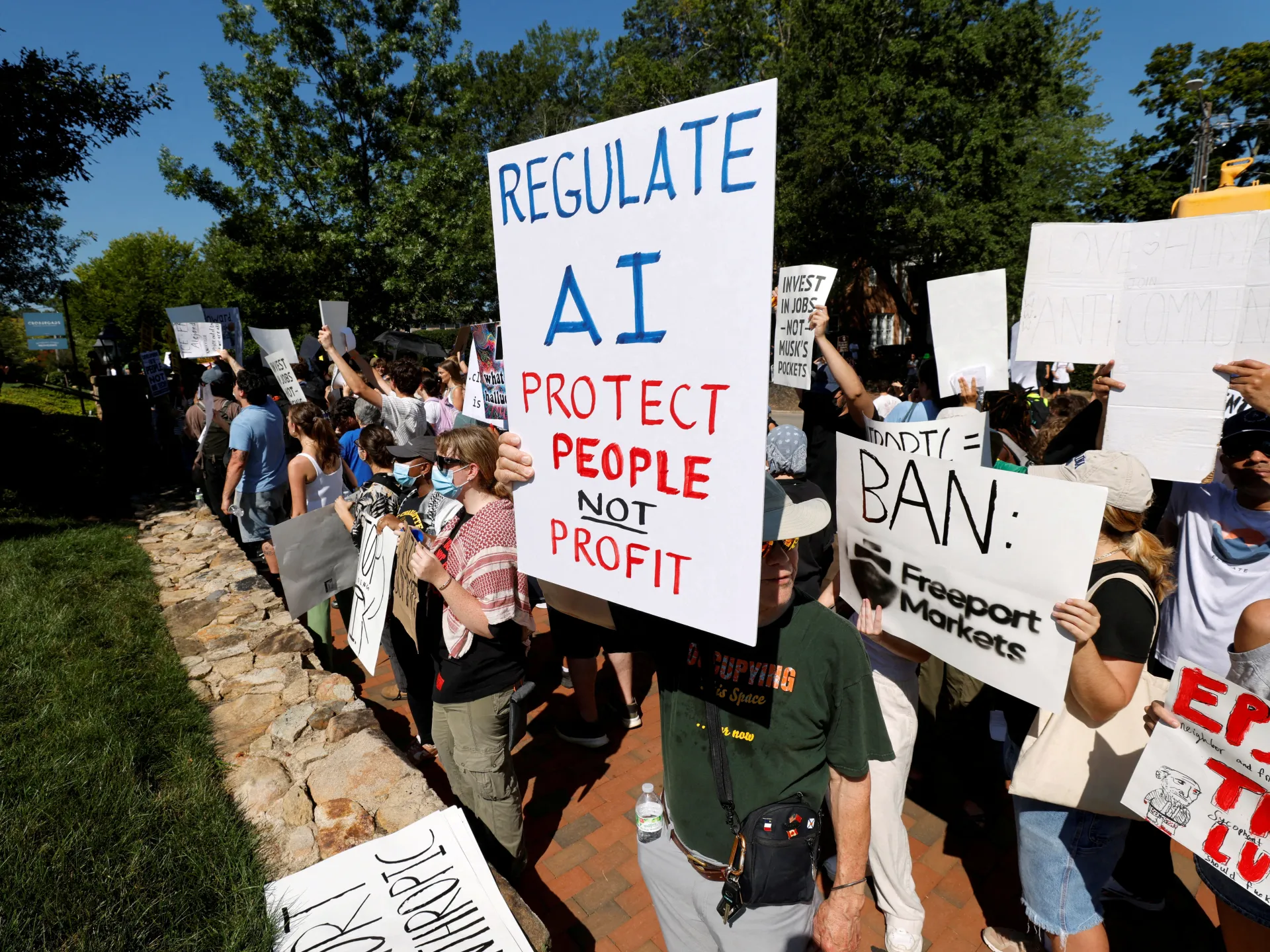
Trust in the industry’s ability to police itself also looks thin. A majority of respondents said they don’t believe AI companies can be relied upon to regulate their own behavior, and most think federal officials should be taking a lead role in setting safety standards rather than leaving that job to the companies building the technology. That sentiment cuts across the usual political divides in a way few issues manage to these days. Reuters noted that calls for stronger federal oversight have come from figures as ideologically distant as progressive independent Senator Bernie Sanders and Steve Bannon, a longtime ally of President Donald Trump, a rare instance of near-total agreement spanning opposite ends of the political spectrum.
Framed as a straightforward tradeoff, the public’s priorities were similarly lopsided. Asked whether it mattered more for the United States to develop AI safely and responsibly, or to stay ahead of international competitors in the race to build more advanced systems, 73 percent picked safety first, while just 23 percent said staying competitive globally should take priority. Given how frequently AI companies and policymakers alike have justified rapid development by pointing to competition with China, that result suggests a real disconnect between how the industry talks about urgency and how the public actually weighs the tradeoffs involved.
The poll, conducted online among 1,277 US adults nationwide, carried a margin of error of 3 percentage points in either direction, giving these numbers a fairly solid statistical footing rather than reflecting a narrow or fringe sample.
These findings don’t exist in isolation either. A separate Politico survey conducted earlier this month, between September 13 and 15 among just over 2,000 adults, found that 63 percent of Americans believe there’s at least a moderate risk that AI could eventually destroy human society altogether. That same survey captured a particularly pointed warning from Jacob Coxon, a former researcher at both OpenAI and Anthropic, who accused the companies he’d worked for of gambling with people’s lives. Asked why they thought AI industry insiders keep raising these kinds of alarms publicly, 51 percent of Politico’s respondents said they believed those warnings reflect genuine concern, while 26 percent chalked it up to a marketing tactic and the remaining 22 percent weren’t sure either way.
Older survey data reinforces the same basic pattern of public unease. Research compiled by consumer advocacy group Public Citizen found roughly three-quarters of Americans support regulating AI the way pharmaceuticals are regulated, with extensive testing required before any product reaches the public, and nearly two-thirds said they’d support an outright, immediate pause on advanced AI development until the technology can be proven safe. Pew Research, in an earlier survey, found that both ordinary Americans and AI experts themselves shared similar doubts, with 59 percent of the public and 55 percent of surveyed experts saying they had little to no confidence in US companies’ ability to develop and deploy AI responsibly. Notably, that same Pew research found majorities in both political parties, 64 percent of Democrats and 55 percent of Republicans, expressed more concern about the government not regulating AI enough than about regulators overreaching.
All of this polling data lands at a moment when the AI industry’s own leadership has been publicly wrestling with similar questions. Executives at several major AI labs have recently debated, sometimes quite openly, whether the pace of AI development needs to slow down to give safety research time to catch up, a conversation that’s spilled into public view through essays, social media posts and dueling statements from rival companies over just the past couple of weeks. Whatever the industry ultimately decides on that front, this latest Reuters/Ipsos data makes clear that a large majority of the American public has already reached its own conclusion: whatever AI companies are currently doing to prevent serious harm, it isn’t enough.