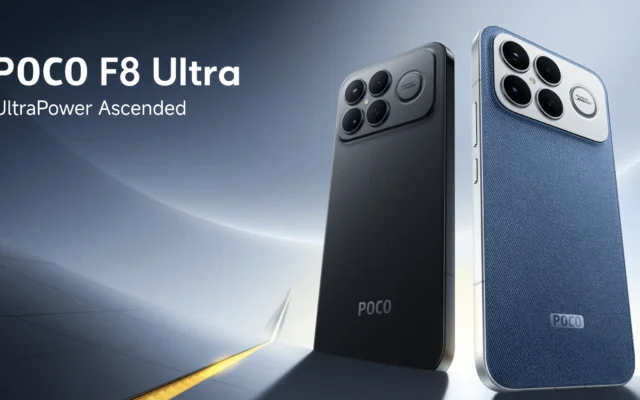
POCO has launched its most ambitious phones yet, unveiling the F9 Ultra and F9 Pro on September 1 with a pitch built almost entirely around one number: 185. That’s the refresh rate on both phones’ AMOLED displays, and it’s also the frame rate POCO claims gamers can hit in supported titles, a figure that pushes well past what most flagship phones, including plenty far more expensive ones, currently offer. The launch marks a clear step up in ambition for a brand that built its reputation on delivering flagship specs at bargain prices, though this generation comes with pricing that reflects just how far POCO has moved upmarket.
Both phones are built around Qualcomm’s Snapdragon 8 Elite Gen 5 platform, but the real story behind the headline gaming performance is a second, dedicated chip working alongside it. POCO paired the main processor with what it calls the VisionBoost D8, a co-processor specifically engineered to boost gaming performance rather than handle general computing tasks. According to POCO, this dual-chip setup enables native frame rates of up to 185FPS across more than 20 supported games, with an additional five titles able to reach that same ceiling through frame-rate interpolation, a technique where the co-processor generates intermediate frames between what the GPU actually renders to smooth out motion on screen. It’s worth understanding that distinction clearly: the 185Hz display refresh rate itself is a straightforward hardware spec, but the 185FPS gaming figure depends heavily on this interpolation pipeline working as intended in specific supported titles, not on every game hitting that number through native rendering alone.
POCO’s own software suite reinforces that gaming-first positioning further. The WildBoost Engine handles broader performance optimization across the system, while Smart frame rate technology and AI Super Resolution can run simultaneously, aiming to deliver both smoother motion and sharper visual detail during actual gameplay rather than forcing users to choose one benefit over the other. A 3D IceLoop cooling system rounds out the performance package, designed to keep both phones running smoothly during extended gaming sessions rather than throttling performance once internal temperatures climb, a common weakness in phones that chase high frame rate numbers without adequate thermal management to sustain them.
The two models diverge meaningfully once you get past their shared chipset foundation, and those differences matter for anyone deciding between them. The F9 Ultra features a larger 6.9-inch HyperRGB AMOLED display capable of reaching up to 4,500 nits of peak brightness, while the F9 Pro comes in at a more compact 6.59 inches. Both panels share the 185Hz refresh rate and POCO’s HyperRGB technology, but the size and brightness gap gives the Ultra a clearer edge for anyone prioritizing screen real estate for content creation or extended viewing sessions. Battery capacity tells a similar story of tiered differentiation, with the F9 Ultra packing an 8,050mAh silicon-carbon battery, POCO’s largest ever, against the F9 Pro’s smaller but still generous 6,330mAh cell, a capacity that still comfortably exceeds what most competing flagships offer. Both phones support 100W wired charging, capable of restoring roughly half a charge in about 15 minutes according to POCO.
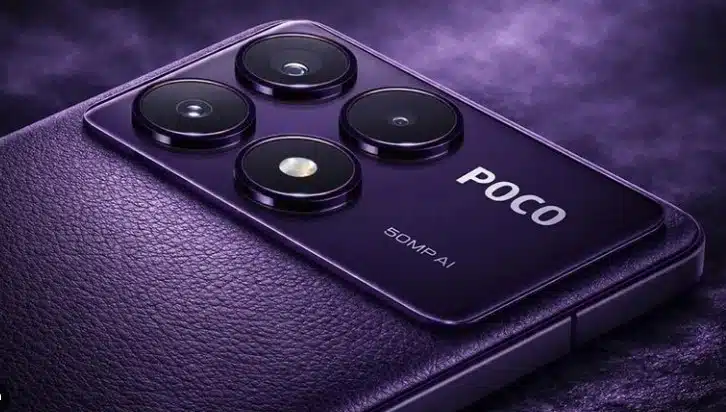
Camera hardware also separates the two models, and this is where the Ultra’s premium positioning becomes clearest. Both phones share a 200-megapixel primary sensor, the Samsung S5KHP5, featuring a 1/1.56-inch sensor format, an f/1.68 aperture, and both optical and electronic image stabilization, marking the first time POCO has used a 200-megapixel main sensor on any phone in its lineup. The F9 Ultra goes further, adding a 50-megapixel periscope telephoto lens and a 50-megapixel ultra-wide camera alongside a 32-megapixel front-facing camera, a considerably more capable overall camera system than what the F9 Pro offers, positioning the Ultra more directly at content creators and vloggers who need genuine zoom flexibility rather than relying purely on digital cropping.
Audio gets attention too, with POCO expanding its existing partnership with Bose for both models. The F9 Ultra specifically carries forward what POCO calls a 2.1-channel sound setup with a dedicated subwoofer, a configuration that reviewers praised on last year’s equivalent model as producing some of the strongest audio output of any smartphone released that year, a genuine differentiator in a market where most phone speakers remain an afterthought regardless of price tier.
Pricing reflects just how significantly POCO has repositioned this generation compared to its budget-focused roots. The F9 Ultra starts at $799, or $729 during POCO’s early bird ordering window, climbing to $1,199 for the top storage configuration, while the F9 Pro launches at a comparatively more accessible price point, reportedly around PHP 49,999 in the Philippines for the 12GB RAM and 256GB storage configuration, equivalent to roughly $880. That pricing represents a genuine departure from POCO’s earlier reputation as the budget-friendly Xiaomi sub-brand, and some coverage of the launch has explicitly flagged this as a major price increase compared to previous F-series generations, a shift that puts these phones in direct competition with established flagship players rather than undercutting them purely on cost.
It’s also worth noting a detail some independent reporting has flagged regarding regional configuration differences. According to analysis from Tech Times, the F9 Pro reportedly ships with roughly 26 percent less battery capacity than its Chinese market counterpart, the Redmi K100 Pro, a discrepancy not mentioned in POCO’s own press materials. Additionally, benchmark figures POCO has publicized, including an AnTuTu score of 4,165,108 for the F9 Ultra, come from the company’s own internal testing labs rather than independent third-party verification, a detail POCO itself acknowledged in a footnote on its launch materials noting that actual results may vary.
For a brand that spent years defining itself around delivering flagship-adjacent specs at genuinely disruptive prices, the F9 series marks a clear evolution toward competing directly with established premium players rather than undercutting them from below. Whether that repositioning pays off commercially will depend heavily on how the phones perform in actual independent reviews once they reach a broader market, but on paper, POCO has assembled a genuinely competitive gaming-focused flagship package, even if the pricing now asks buyers to pay considerably closer to what they’d spend on a Samsung or established flagship alternative.
Full specifications and regional pricing are available through POCO’s official product page. For more coverage of flagship smartphone launches and gaming hardware, visit Business Tech.