
Skip to content

Wall Street Banks Turn on Each Other
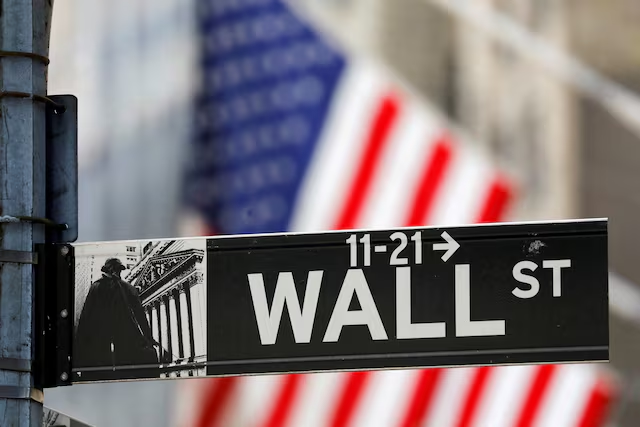
Wall Street banks turn on each other as Basel III capital rules fight nears endgame The years-long battle over how much capital America's biggest banks must hold is entering its final stretch, and the fight has shifted shape. What started as a united front of Wall Street lenders pushing back against regulators has splintered into something messier: a turf war between the country's largest banks over who ends up carrying the heaviest burden once the rules are finalized. The Federal Reserve is closing in on completing its long-delayed rewrite of bank capital standards, known in industry shorthand as the Basel III endgame. The framework, first proposed in 2023 in the wake of the regional banking failures that took down Silicon Valley Bank and others, was originally meant to force the largest lenders to hold roughly 19 percent more capital against their risk-weighted assets. That number triggered a fierce, coordinated lobbying campaign from the banking industry, one that included multimillion-dollar ad blitzes, congressional testimony from CEOs like JPMorgan's Jamie Dimon, and warnings that tougher rules would choke off lending to households and small businesses. That campaign worked. Regulators retreated, and in March 2026 the Fed's vice chair for supervision, Michelle Bowman, unveiled a scaled-back re-proposal that, combined with related changes to a separate capital surcharge for globally systemic banks, would modestly reduce capital requirements for many lenders rather than increase them. Bowman described the revised approach as one that would keep bank capital "robust" while better calibrating requirements to the risks banks actually carry. But finishing the rule has exposed a rift that the original fight had mostly papered over. The dispute now centers less on the overall size of the capital cushion and more on how that burden gets distributed across different kinds of banks. On one side sit the country's largest commercial and consumer lenders, Bank of America and JPMorgan Chase, whose business is built around deposits, mortgages and everyday lending. On the other side are the markets and trading-heavy investment banks, Goldman Sachs and Morgan Stanley, whose revenue leans far more heavily on trading desks and capital markets activity. The disagreement traces back to a technical but consequential piece of the rules: the surcharge applied to the eight U.S. banks designated as globally systemically important, or GSIBs. That surcharge, first finalized in 2015, uses calculation inputs that have not been updated in over a decade. Banks have argued for years that those stale inputs no longer reflect how much the global economy, and the banks themselves, have grown since then. Bowman has said the Fed intends to adjust some of those inputs to account for that growth, an idea regulators had floated before but shelved amid the broader fight over the rules. That adjustment sounds like a technical fix, but it reshuffles who wins and who loses. JPMorgan Chase, according to Bloomberg Intelligence analysis, was hit hardest under the original 2023 proposal and has kept its shareholder payouts relatively conservative in order to build up a capital buffer in anticipation of tougher requirements. Goldman Sachs, meanwhile, disclosed in its most recent quarterly filing that its own GSIB surcharge sits at 3.5 percent for 2026 and 2027, with an increase to 4 percent expected by 2028, and cautioned that the figure could shift again depending on how the Fed's outstanding surcharge proposal is finalized. Every basis point in that surcharge translates directly into how much capital a bank has to hold idle rather than deploy toward lending, trading or buybacks, which is why banks that expect to come out ahead under a revised formula have far less incentive to keep fighting alongside those who expect to come out behind. That's the dynamic reshaping the endgame fight now. Commercial banks like JPMorgan and Bank of America argue that trading-heavy firms benefit disproportionately from favorable treatment of market risk and derivatives exposure under the proposed standardized approaches, while consumer lending and mortgage books get treated more conservatively. Investment banks counter that their businesses face different, and in some ways more volatile, risk profiles that justify how the rules are calibrated. Both sides are lobbying the Fed, the Office of the Comptroller of the Currency and the FDIC separately now, rather than presenting the unified industry position that defined the 2023 and 2024 phases of the fight. The Federal Reserve had signaled it hoped to release final rules around August 2026, and Bloomberg Intelligence analysts have suggested that once the rules are finalized, large banks could unleash a new wave of share buybacks, since much of the roughly $155 billion in excess capital the eight largest U.S. banks have been holding as a buffer could be freed up if the final requirements land as leniently as expected. That prospect adds urgency to the internal Wall Street fight, since the final calibration will determine which banks get to release capital back to shareholders first and which remain constrained. Critics of the whole process, including some consumer advocates and former regulators, argue the retreat from the original 2023 proposal represents a missed opportunity to shore up the financial system against future shocks, particularly at a moment when private credit markets have grown rapidly and largely outside the reach of bank-style capital rules. They point out that the same industry pushing hardest for relief is, according to public disclosures, sitting on tens of billions of dollars in surplus capital already, undercutting the argument that tighter rules would meaningfully constrain lending. For now, the outcome hinges on how the Fed threads the needle between two powerful factions of its own regulated industry, each pushing in a different direction. Whatever the final calibration looks like, the fact that the biggest names on Wall Street are now lobbying against each other rather than in lockstep marks a notable shift from the early days of the fight, when a united industry front was enough to force regulators back to the drawing board once already. Meta Description: Wall Street's biggest banks are fighting each other as the Fed nears a final Basel III capital rules decision, splitting JPMorgan and Bank of America from Goldman Sachs and Morgan Stanley. Focus Keyword: Basel III endgame capital rules Related Keywords: Wall Street bank capital requirements, JPMorgan Goldman Sachs capital fight, Federal Reserve bank regulation, GSIB surcharge rules, bank capital buybacks 2026, Basel III final rule

Wall Street Banks Turn on Each Other as Basel III Capital Rules Fight Nears Endgame The years-long battle over how much capital America’s biggest banks must hold is entering its final stretch, and the fight has shifted shape. What started as a united front of Wall Street lenders pushing back against regulators has splintered into … Read more