
|
Getting your Trinity Audio player ready...
|
TDK has shown what it describes as the first direct retinal projection display for smart glasses built around a meta-optic mirror, a flat, nearly transparent reflector that can sit inside an ordinary lens. The Japanese electronics group announced the demonstration on October 2, 2026, and says a working prototype will be on show at CEATEC 2026 in Japan from October 13, followed by the electronica trade fair on November 10 to 13. The claim of a world first comes from TDK itself, and independent testing has yet to confirm how the display performs.
The reason this matters is simple. Retinal projection has long promised smart glasses that look like regular eyewear, yet the optics needed to bounce a laser into the eye have usually stood in the way. In earlier direct retinal projection systems, a curved mirror sat in front of the wearer’s eye and steered laser light onto the retina. That mirror works, but its shape and placement make it hard to build glasses that pass for everyday frames. TDK’s answer is to replace the curved part with a flat surface patterned with nanoscale reflectors.
According to the company, the mirror is only 150 nanometers thick and has a visible-light transmittance of roughly 80 percent. For comparison, a human hair is tens of thousands of nanometers wide. The structure is engineered so that the angle at which light is reflected changes depending on where it strikes the mirror. That lets one flat surface take laser light arriving from different directions and send it out at the angle needed to reach the retina, which is the job the curved mirror used to do. TDK says this is what allows the element to be embedded in a lens while keeping the transparency of a regular eyeglass lens.
A second benefit is privacy. TDK says its retinal projection glasses stop the projected image from being visible to people facing the wearer, a problem often called image leakage. Many head-worn displays can show a faint glow or reflection of the content to anyone standing in front of the user, which matters in meetings, on public transport and anywhere people are wary of being recorded or watched. Because the light is aimed at the wearer’s retina, the company argues that bystanders cannot see what is being displayed. That is TDK’s statement, and it is the kind of claim that hands-on demonstrations in Tokyo and Munich are likely to test.
Cost is the other pressure point. Waveguide displays, which currently dominate the category, rely on complicated optical structures and can be expensive to make. TDK says the meta-optic mirror can be produced with processes comparable to semiconductor manufacturing, which would open a path to cost-competitive mass production. Semiconductor-style fabrication is attractive because it scales, but the company has not published yield figures, unit costs or a manufacturing partner, so that remains a goal rather than a result.
There is an important limit in the current design. The mirror operates in monochrome only. TDK says it wants to demonstrate full-color operation and reach mass production within the next few years, but it did not give dates or specifications. The announcement also leaves out the figures that reviewers usually ask about first, including resolution, field of view and brightness in daylight. Until those numbers appear, the demonstration is best read as proof of an optical concept rather than a finished display.
The mirror is one piece of a larger plan. TDK says it already has an ultra-compact full-color laser module, among the smallest of its kind, along with a visible-light full-color laser control device that can reach 4K resolution. The 4K-capable device was first announced in October 2024 and uses a lithium niobate thin film to control laser color by voltage rather than current, which TDK said allows color control more than ten times faster than conventional methods. Together with the new mirror, these parts cover the light source, the control electronics and the reflective optics, which are the main building blocks of a retinal projection system.
TDK is not doing this alone. The company says it has a business cooperation agreement with QD Laser, which is listed on the Tokyo exchange, to combine QD Laser’s retinal projection technology and patents with TDK’s laser modules, control devices and mirrors. That pact, first announced on June 1, 2026, covers joint development of next-generation RGB light source modules and optical engines for smart glasses, along with a partial transfer of patent rights to TDK. The two firms have worked together since 2020, and their earlier prototype glasses used TDK’s laser module with QD Laser’s projection method. Details of the partnership are on the TDK press release.
To see why the industry keeps returning to this approach, it helps to understand what retinal projection changes. Instead of forming an image on a screen or a lens that the eye must focus on, the system draws it straight onto the retina. TDK has said for years that this makes images readable regardless of the wearer’s eyesight, and that wearers can look at the real world and the projected content without refocusing. A tester who tried TDK’s 2023 system noted a trade-off: retinal projection demands precise alignment and can be less forgiving when the eye moves away from the projector. How well a flat meta-optic mirror handles that sensitivity is one of the questions the new prototype will have to answer.
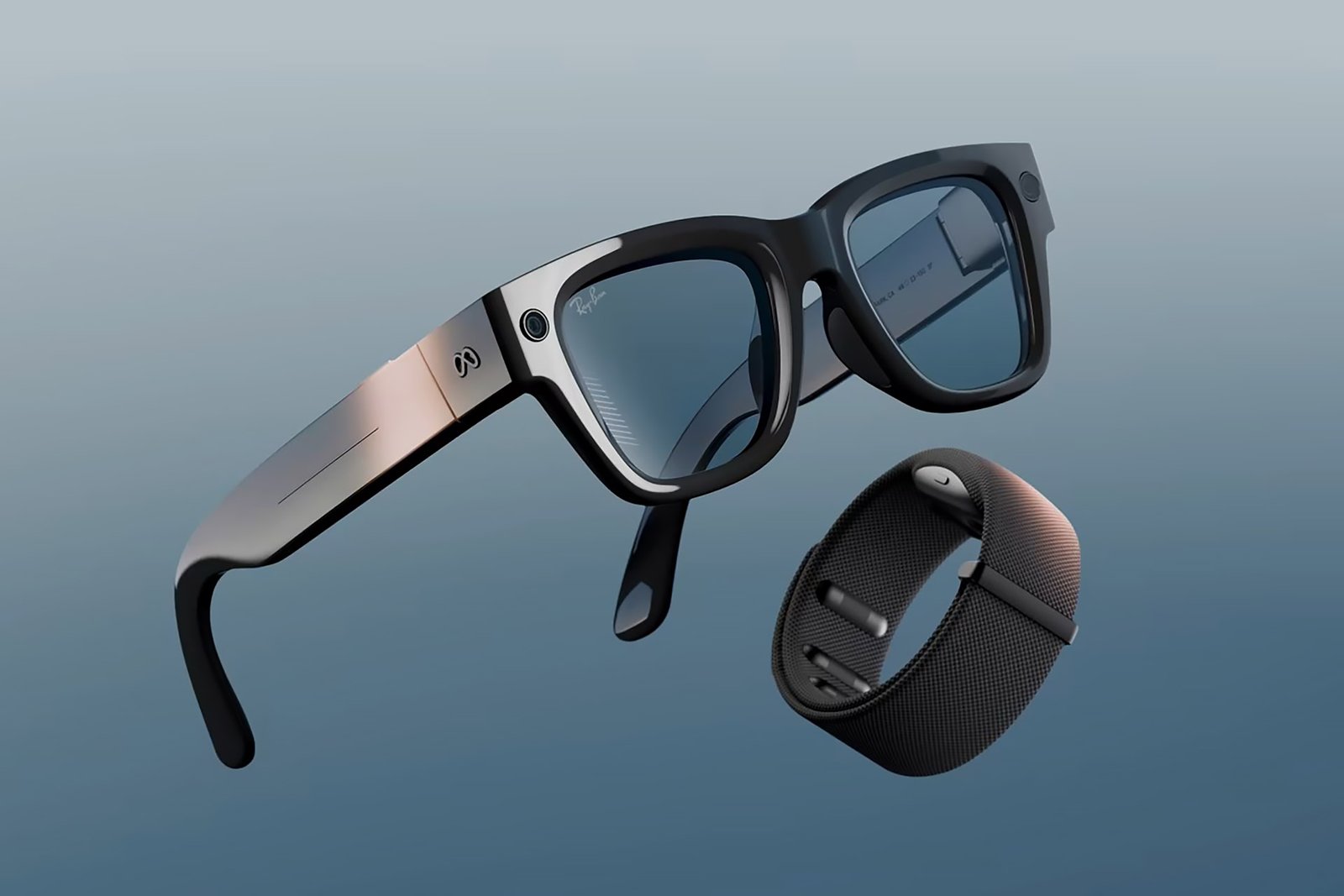
The timing fits a market that is moving quickly. Meta introduced its Ray-Ban Display glasses with an integrated display in September 2025, and consumer interest in glasses that offer information at a glance has grown since. TDK says smart glasses are an application it expects to grow within the AI ecosystem, which it has named a key strategic area. For a company that reported fiscal 2026 sales of 16.6 billion US dollars and employs about 107,000 people, according to its own announcement, a display component that other glassmakers could adopt is a logical extension of its component business.
What to watch next is fairly clear. First, the CEATEC and electronica demonstrations will give journalists and engineers a chance to judge image sharpness, eye-box tolerance and how well the lens holds up in bright light. Second, TDK will need to show a full-color version, since a monochrome display limits what everyday glasses can offer. Third, the semiconductor-style manufacturing claim needs numbers, such as expected volumes and costs, before eyewear brands can plan around it. Further technical background is available in TDK’s meta-optic mirror feature story.
For now, the most defensible reading is that TDK has removed one of the biggest design obstacles to retinal projection in glasses, the bulky curved mirror, and replaced it with a thin, mostly transparent one. Whether that translates into glasses people want to wear all day depends on the details TDK has not yet shared. Readers who follow how global hardware advances reach African startups, retailers and investors can find more technology coverage at BusinessTech Nigeria.