
|
Getting your Trinity Audio player ready...
|
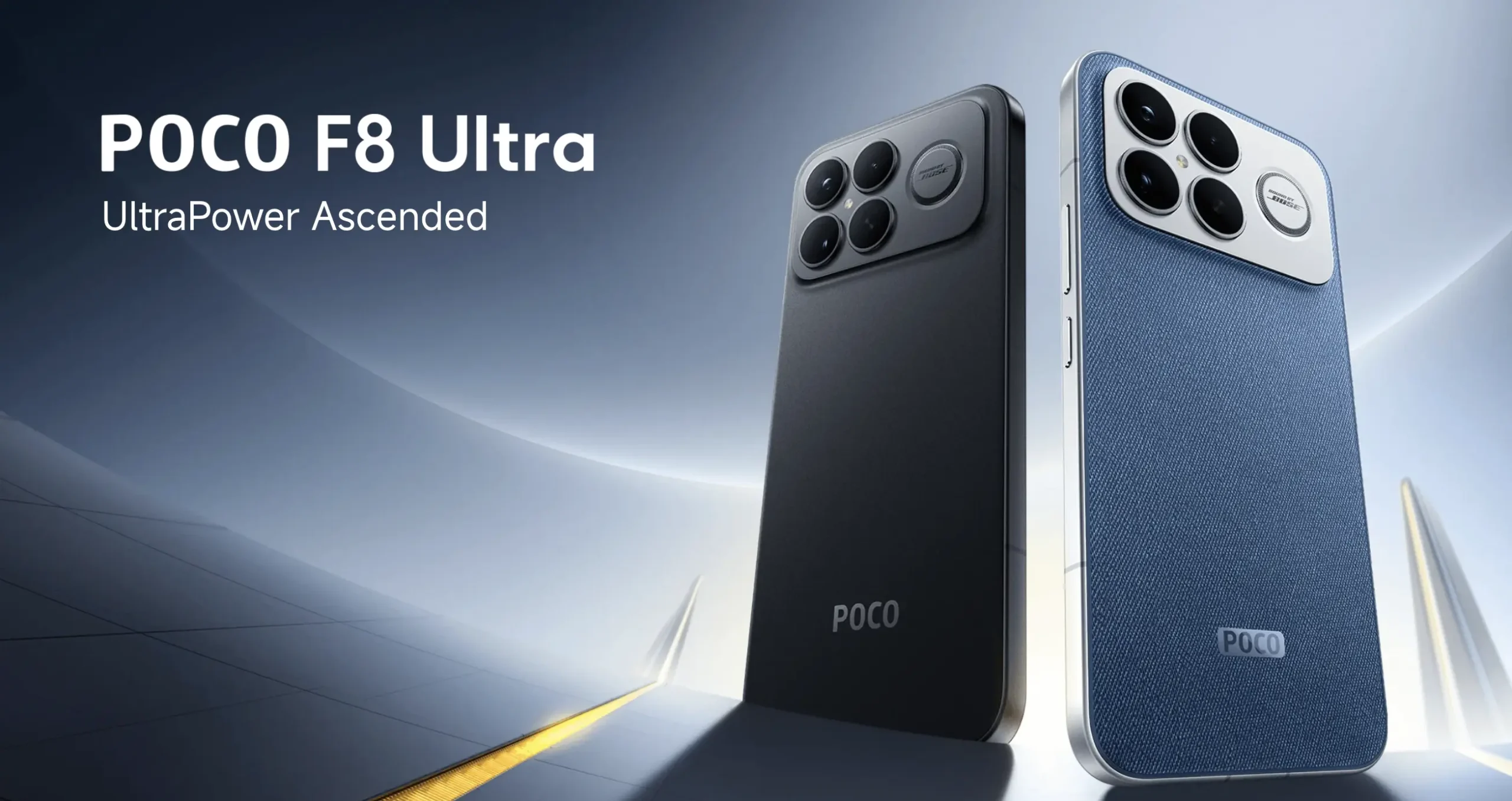
POCO has officially launched the POCO X8, a budget smartphone built around a single obsession, keeping the phone alive far longer than anyone expects from a device this affordable. Unveiled globally this week alongside its higher-capacity sibling, the POCO X8 Power, the standard X8 starts at $269 and leans almost entirely on massive battery capacity and genuine durability credentials to stand out in one of the most competitive corners of the smartphone market.
At the center of the POCO X8’s pitch is an 8,340mAh typical battery, a figure POCO says represents a 63.2 percent increase in capacity compared to its predecessor. That’s a substantial jump for a single generational update, and it’s built on silicon-carbon battery technology using 13 percent silicon content, an approach that allows manufacturers to pack more energy density into roughly the same physical battery footprint compared to older lithium-ion chemistry. It’s worth noting that regional battery figures vary somewhat, with some markets reportedly seeing a 9,000mAh cell in the standard X8, a detail that reflects how frequently budget phone manufacturers tune battery specifications by region based on local certification requirements and component sourcing.
POCO isn’t just claiming a bigger number and calling it a day. The company says the X8 has passed extensive testing across extreme temperature environments, mechanical stress scenarios, and repeated battery life cycles, earning a TÜV SÜD 5-star Battery Performance Certification in the process, an independent validation that carries real weight given how often battery longevity claims from budget phone makers go untested by any outside body. Charging is handled through 67W HyperCharge wired charging, and the phone also supports 22.5W wired reverse charging, letting it function as a portable power bank for other devices, a genuinely useful feature for anyone who’s ever needed to top off a smartwatch or a pair of earbuds while out and about.
Beyond battery life, the display is where POCO has clearly put its second-biggest chunk of engineering budget. The X8 packs a 6.83-inch panel running at 1.5K resolution with a 120Hz refresh rate, reaching up to 3,500 nits of peak brightness across 25 percent of the screen, a spec that should make the display genuinely usable in direct sunlight, historically one of the more frustrating limitations of budget-tier phone displays. POCO describes the panel as using flagship-grade luminous material, aimed at delivering brighter visuals while keeping power draw in check, a detail that matters given how much a bright, high-refresh display can otherwise eat into battery life on paper.
Performance duties fall to Qualcomm’s Snapdragon 6s Gen 4 mobile platform, built on a 4-nanometer manufacturing process and paired with an integrated Adreno GPU. This isn’t a flagship-tier chipset by any measure, and POCO isn’t pretending otherwise, the company’s own messaging frames the X8 around solid everyday performance, fast app launches, smooth multitasking, and responsive task switching rather than chasing benchmark leadership. For a phone at this price point, that’s a reasonable and honest positioning, prioritizing a chipset that won’t overheat or drain the battery unnecessarily over one that posts impressive but largely irrelevant synthetic benchmark scores for most everyday users.
Software runs on Xiaomi’s HyperOS 3, layered with Xiaomi HyperIsland for quick access to smart features and Google Gemini built in as the phone’s native AI assistant, giving budget buyers access to the same generative AI assistant increasingly standard across Google’s own Pixel lineup and a growing number of Android phones generally. POCO has also included Xiaomi Offline Communication, a feature that helps keep users connected even without active network coverage, a genuinely practical addition for anyone traveling through rural areas or regions with spotty cellular infrastructure. Audio gets a boost too, with support for up to a 300 percent volume boost aimed at louder, more immersive sound for gaming and media playback.
Pricing scales across three configurations. The base 6GB RAM and 128GB storage model starts at $269, the 8GB RAM and 256GB storage version runs $299, and the top-tier 12GB RAM and 256GB storage configuration tops out at $349. That pricing structure gives buyers reasonable flexibility to choose based on storage and multitasking needs without forcing everyone into a single fixed spec, a fairly standard approach for this segment but one that still matters for budget-conscious shoppers trying to avoid overpaying for RAM or storage they don’t actually need.
The India launch, scheduled for September 4, positions the X8 and X8 Power to fill a clear gap in POCO’s own lineup. With the existing X8 Pro retailing around ₹39,999 and the X8 Pro Max around ₹49,999 in India, the standard X8 and its Power sibling are expected to land somewhere below ₹35,000, carving out accessible options built specifically around battery endurance and durability rather than flagship-adjacent chip performance. That positioning makes sense given how much competition exists in India’s budget and mid-range segment specifically, where all-day battery life frequently matters more to everyday buyers than raw processing benchmarks that rarely get pushed in typical daily use.
Taken as a whole, the POCO X8 represents a fairly clear-eyed bet on what budget phone buyers actually prioritize in 2026. Rather than chasing flagship-adjacent camera systems or top-tier chipsets that inflate the price without meaningfully improving day-to-day usability for most people, POCO has doubled down on the two things that genuinely shape how a budget phone feels to live with over months of ownership, a display bright and smooth enough to actually enjoy, and a battery big enough that charging anxiety stops being part of the daily routine.
Full specifications and regional pricing are available through POCO’s official product page. For more coverage of budget smartphone launches and mobile technology, visit Techora.