|
Getting your Trinity Audio player ready...
|
Apple CEOs and Their Iconic iPhones
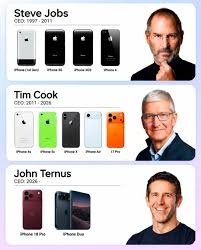
Apple just handed the keys to a new CEO for only the third time in company history, and the timing couldn’t be more fitting. John Ternus officially took over from Tim Cook on September 1, mere weeks before Apple shipped the iPhone 18 Pro lineup and prepared to launch its first-ever foldable phone, the iPhone Duo, this October. It’s a changing of the guard happening right in the middle of one of the more consequential product moments in the iPhone’s history, and it invites an obvious question: what iPhone will define each of Apple’s leaders, and what does that say about how each of them actually ran the company?
Start with Steve Jobs, because there’s really no other place to start. Jobs unveiled the original iPhone in January 2007, a device that didn’t just launch a product line, it reshaped an entire industry’s idea of what a phone was supposed to be. No physical keyboard, a multitouch screen, and a browser that actually rendered the real internet rather than a stripped-down mobile version of it. Jobs ran Apple through the iPhone’s foundational years, iterating through the 3G, 3GS and 4 before health problems forced him to step back. His final iPhone moment as CEO came just one day before he passed away in October 2011, when Apple introduced the iPhone 4s, notable as the very first iPhone to include Siri. Jobs handed the company to Tim Cook that August, and the products people associate most strongly with Jobs remain the ones built on pure, unapologetic simplicity: one iPhone, one size, one vision, take it or leave it.
Cook inherited a company that had just proven the iPhone concept worked. What he did over the next fifteen years was scale it into something closer to global infrastructure. Cook’s tenure gets unfairly flattened sometimes into “the guy who wasn’t Jobs,” but the actual list of decisions under his watch tells a different story. He pushed through the iPhone 6 and 6 Plus in 2014, breaking from years of Jobs-era screen sizing to give people genuinely larger phones, a call that looked risky at the time and ended up defining smartphone design industry-wide. He greenlit the iPhone X in 2017, killing off the Home button entirely in favor of Face ID and gesture navigation, another decision that the rest of the smartphone industry quietly copied within a couple of product cycles. Cook also built out the budget end of the lineup, learning from the iPhone 5c’s mixed reception to eventually land on the SE and later the “e” naming scheme, giving Apple a genuine low-cost entry point it hadn’t really had before. And he’s the one who split the lineup into standard, Pro and Pro Max tiers, a structural change that’s arguably done more for Apple’s profit margins than any single piece of hardware innovation across his entire run.
Beyond the iPhone specifically, Cook’s fifteen years also gave Apple the Apple Watch, AirPods, Apple Pay, and the transition of the entire Mac lineup to Apple’s own silicon, expansions that took Apple well beyond being a phone company with some side projects. Harvard Business School professor David Yoffie, who’s written case studies on Apple’s leadership, has said Cook managed to scale the iPhone to a level that genuinely surprised people who thought that kind of growth wasn’t realistically achievable. When Cook stepped down, Apple’s market value sat in territory that would have seemed absurd to project back in 2011, when the stock actually dropped 5 percent on the news that Jobs was handing him the company. Cook, for his part, described leading Apple as the greatest privilege of his life in the message marking his own transition out of the CEO seat.
Which brings things to Ternus, and to a genuinely different kind of succession story than Apple’s last one. Where Cook came up through operations and supply chain, a background that made some early observers doubt whether he had the product instincts to lead a company built on Jobs’ design obsession, Ternus arrives as a career hardware engineer. He joined Apple in 2001, spent years working directly on the iPhone, iPad, Mac, Apple Watch and Vision Pro, and became senior vice president of Hardware Engineering back in 2021. Cook himself, in the memo announcing the transition, described Ternus as having the mind of an engineer paired with the soul of an innovator, a framing that positions Ternus closer to a hands-on product leader than Cook ever really was.
The symbolism of Ternus’s first weeks as CEO is hard to miss. He inherited the iPhone 18 Pro launch just days into the job, and he’s now steering Apple through the release of the iPhone Duo, the company’s first true foldable phone and arguably its biggest single hardware departure since the iPhone X ditched the Home button under Cook. If Jobs is remembered for inventing the iPhone and Cook for scaling it into a platform that touches nearly everything people do with their phones daily, Ternus’s opening act puts him in position to be remembered as the CEO who reshaped the iPhone’s physical form for the first time in its history. At 51, and with a reported timeline that could keep him at Apple’s helm for another decade or more, Ternus has considerably more runway ahead of him than behind him to define what his own iconic iPhone era actually looks like.
For now, the handoff itself is the story. Three CEOs, three very different backgrounds, and three iPhones that each mark a genuine inflection point: the original, for inventing the category; the iPhone X, for tearing up the design Jobs left behind and rebuilding it around gestures and Face ID; and now the iPhone Duo, arriving in Ternus’s very first months in the job, as the device that will likely end up defining whether his tenure gets remembered as an engineer’s steady evolution of Cook’s playbook, or as the start of something Apple hasn’t tried before.