|
Getting your Trinity Audio player ready...
|
The Ikko MindOne Pro Is a Tiny Square Phone From, Of All Companies, an Earbud Brand
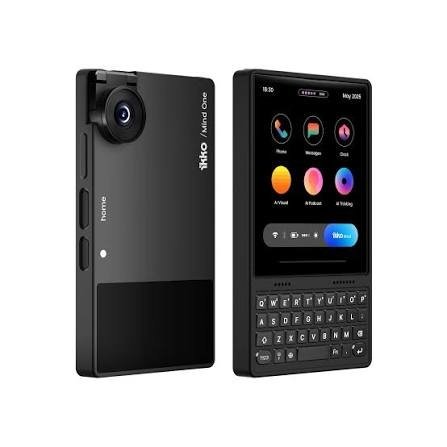
Sometimes the most interesting hardware ideas come from companies you’d least expect to build them. Ikko, a Hong Kong-based audio company that’s spent years earning a loyal following for its earbuds and in-ear monitors rather than anything resembling a smartphone, has jumped into phone hardware with something genuinely unusual: the MindOne Pro, a card-sized AI phone built around a nearly square 4-inch display that looks like it wandered off a Galaxy Z Flip or Motorola Razr without ever actually folding.
That’s really the easiest way to describe what makes the MindOne Pro visually interesting. Modern foldable phones have made compact, boxy cover screens familiar to a lot of people who’ve never actually owned a foldable themselves, mostly through review videos and store displays. Ikko took that shape, the small, roughly square screen you’d normally only see on the outside of a flip phone, and built an entire standalone device around it instead, skipping the hinge and folding mechanism altogether. The result sits somewhere between a genuinely pocketable phone and a modern take on the tiny candy-bar phones people used to carry before screens started their steady climb toward six inches and beyond.
Camera duties are handled by a 50-megapixel sensor mounted on a flip-up hinge, a clever workaround for a phone this compact that doesn’t have room for a front-facing selfie camera cut into its already tiny display. Flipping the single rear camera upward to double as a selfie camera is a genuinely practical solution to a hardware constraint that a device this size would otherwise struggle with, and it adds a bit of mechanical charm to a phone that otherwise reads as fairly minimalist.
Under the hood, the MindOne Pro runs Android 15, giving it access to the standard Google Play ecosystem and mainstream Android apps, though how well those apps actually adapt to a screen this small and unusually shaped is very much an open question that reviewers will need to test firsthand once units start shipping widely. Layered on top of stock Android is Ikko’s own companion software, which the company calls Ikko AI OS, built around a suite of AI tools the company is positioning as one of the phone’s core selling points rather than an afterthought bolted onto standard Android.
The more unusual claim in Ikko’s pitch is built-in global internet access, which the company says works for free across 60 regions, including major markets like the US, UK and Australia. Exactly how that connectivity works technically, whether it’s tied to an embedded eSIM data allowance, a partnership with a global connectivity provider, or something else entirely, isn’t fully detailed in Ikko’s own marketing, but the pitch is clearly aimed at travelers and anyone tired of juggling local SIM cards or expensive roaming plans every time they cross a border.
Pricing for the MindOne Pro currently sits at $429 as a discounted pre-order price, down from a $499 regular price, with the device available in four finishes: Pearl White, Jet Black, Blush Pink and Ice Blue. Ikko is also selling a handful of companion accessories alongside the phone itself, including a snap-in case priced around $89 and a lanyard case starting at $10, the kind of small ecosystem-building move that suggests Ikko is treating this less as a one-off experiment and more as a genuine product line it intends to support.
Reviewers who’ve gotten early hands-on time with the MindOne Pro have leaned into the nostalgia angle pretty heavily, several drawing direct comparisons to older, genuinely pocketable phones like the iPhone 5S, a device that’s become something of a shorthand reference point for anyone who misses being able to comfortably use a phone one-handed without stretching a thumb across half a foot of glass. That framing positions the MindOne Pro as an interesting middle ground in a market that’s otherwise fairly polarized between full-size smartphones on one end and deliberately stripped-down “dumbphones,” like the Light Phone, on the other. A phone this small that still runs full Android and a real camera system, rather than forcing a choice between modern capability and genuine pocketability, is a niche that hasn’t had many serious entrants in years.
Whether Ikko’s leap from audio hardware into phones actually pays off long term remains to be seen, especially once the MindOne Pro moves past pre-orders and into the hands of a wider range of everyday users who’ll stress-test how well a near-square screen actually handles day-to-day apps that were never designed with that aspect ratio in mind. But as an idea, it’s the kind of genuinely different swing that’s become fairly rare in a smartphone market where most new releases amount to incremental camera and chip upgrades wrapped in nearly identical shells. An earbud company deciding its next big move was a tiny square phone is exactly the sort of unexpected move that’s easy to root for, even before knowing whether it actually works well in practice.