|
Getting your Trinity Audio player ready...
|
Microsoft, Schneider Electric Expand Gulf AI Data Centers
The Gulf has become one of the most closely watched fronts in the global race to build out artificial intelligence infrastructure, and two of the companies most visibly shaping that buildout, Microsoft and Schneider Electric, are now doubling down on the region in ways that go well beyond a single announcement. A recent CNN Business segment framed the moment plainly: both companies are betting big on the Gulf, and the scale of capital, power capacity, and physical infrastructure now flowing into the region suggests that bet is only getting bigger.
Microsoft’s commitment to the UAE alone illustrates how far this has gone. The company has pledged $15.2 billion in investment spanning 2023 through 2029, a package that includes a $1.5 billion equity stake in Abu Dhabi’s G42, more than $4.6 billion in data center capital expenditure, and over $1.2 billion in local operating expenses through 2025. Microsoft has said it will spend a further $7.9 billion between 2026 and 2029, a figure the company has described as nearly quadrupling local data center computing capacity to the equivalent of 81,900 Nvidia H100-class chips. Earlier this year, Microsoft and G42 also announced a 200-megawatt expansion of UAE data center capacity, to be delivered through G42’s Khazna Data Centers unit, with capacity expected to start coming online before the end of the year.
That expansion is not happening in isolation. Microsoft secured export approval from the U.S. Commerce Department in 2025 to ship advanced Nvidia chips to its Gulf data centers, becoming the first company to receive that kind of clearance under the current administration’s export framework. Given how tightly controlled advanced chip exports have become in the context of broader U.S.-China technology tensions, that approval mattered as much as the capital itself, since it signaled Washington’s willingness to let American cloud infrastructure and cutting-edge silicon flow into Gulf partnerships under specific security conditions.
Saudi Arabia has become the other major pillar of Microsoft’s regional strategy. The company confirmed that its Saudi Arabia East datacenter region will become available in November 2026, a milestone Microsoft has tied directly to the kingdom’s Vision 2030 economic diversification plan. According to Microsoft, the new region is meant to let organizations run AI workloads locally rather than relying on infrastructure outside the country, addressing both latency and data sovereignty concerns that have shaped how Gulf governments approach cloud adoption. Alongside the datacenter launch, Microsoft also announced the AI Arabia Center of Excellence, a collaboration with Saudi Arabia’s Ministry of Communications and Information Technology aimed at building local AI skills and research capacity rather than simply exporting Microsoft’s existing cloud products into the market.
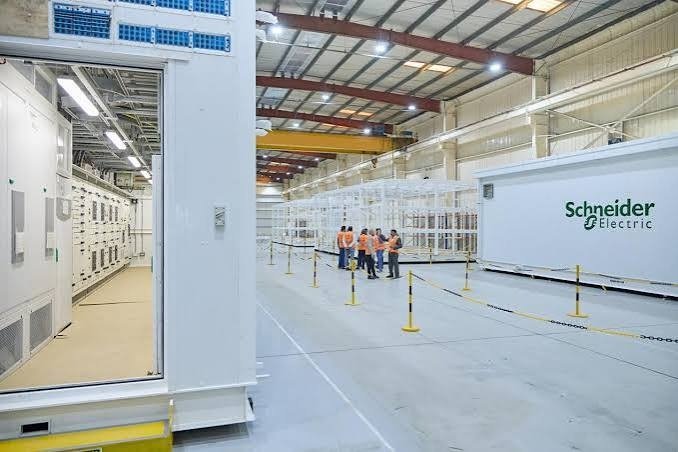
Schneider Electric’s role in this buildout is less about headline-grabbing dollar figures and more about the physical backbone that makes any of it possible. Data centers of the scale Microsoft and its Gulf partners are describing need power distribution, cooling, and energy management systems that can handle enormous and often unpredictable computing loads, and that is squarely Schneider Electric’s business. The company has been expanding its footprint across the wider region, including a deal to supply power and cooling infrastructure for Iraq’s first commercial Tier III data center, a project built with technology and connectivity investment group T964 that the company has described as a milestone for Iraq’s digital infrastructure. That kind of project shows Schneider Electric’s Gulf and Middle East strategy extending beyond the UAE and Saudi Arabia into markets earlier in their data center development curve.
Globally, Schneider Electric has been just as aggressive. The company announced a $700 million investment through 2027 to expand U.S. manufacturing and research facilities, and followed that with nearly $2.3 billion in supply agreements with American data center operators, including a $1.9 billion deal with Switch to power AI facilities in North America. Schneider Electric and Microsoft have also worked together on the Industrial Copilot, an AI tool built to automate tasks like writing control code and reviewing technical documentation for industrial and energy clients, with the companies reporting engineering teams cutting certain modernization work by roughly half using the tool. That partnership stretches back further than the current AI boom. Schneider Electric and Microsoft have maintained a long-running global alliance built around cloud and IoT technology, and the current Gulf infrastructure push looks like an extension of that relationship rather than a new one built from scratch.
What makes the Gulf particularly attractive to both companies is the combination of available capital, government ambition, and land and energy resources that are harder to secure quickly in more built-out markets like the United States. Sovereign wealth funds across the UAE and Saudi Arabia have shown a willingness to commit billions toward AI infrastructure specifically because it aligns with each government’s economic diversification goals, whether that is Abu Dhabi positioning G42 as a global AI player or Saudi Arabia tying its Vision 2030 plan to becoming a regional technology hub. Regional AI data center capacity has been projected to roughly triple by 2030, and both Microsoft and Schneider Electric appear positioned to capture a large share of the infrastructure spending that comes with that growth.
The CNN segment’s mention of orbital data centers also hints at where some of this thinking may eventually head, even if that remains a much earlier-stage idea compared to the ground-based buildout happening right now. For the moment, the more immediate story is straightforward: Microsoft is committing tens of billions of dollars to secure cloud and AI capacity across the UAE and Saudi Arabia, while Schneider Electric is building the power and cooling systems that let those facilities actually run at scale, and both companies are treating the Gulf as one of the most important growth markets in their respective AI infrastructure strategies for the rest of the decade.