|
Getting your Trinity Audio player ready...
|
China Readies Humanoid Robots for Combat as Military Pushes Battlefield AI Robotics
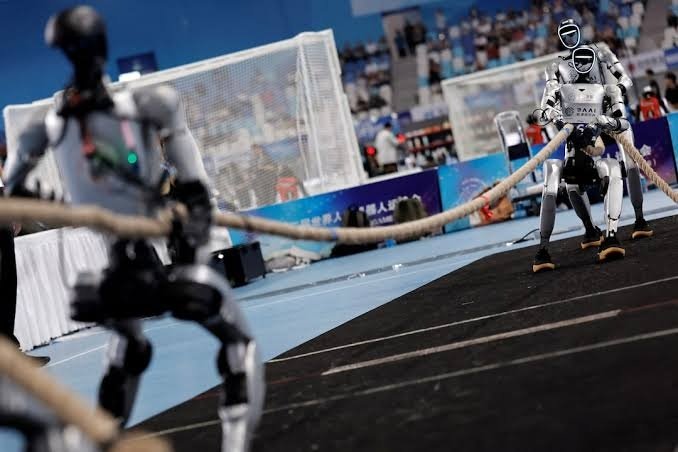
Last month, humanoid robots competed in front of cheering crowds at China’s World Humanoid Robot Games, running faster than Usain Bolt’s 100-meter record, throwing boxing combinations, and occasionally tumbling over in ways that turned into viral clips online. Two days after the Games wrapped, the People’s Liberation Army’s official newspaper, PLA Daily, looked at the same footage and drew a very different conclusion, calling for researchers to speed up the transfer of these technologies out of laboratories and onto military training grounds as robotic “combatants.”
That editorial wasn’t an isolated comment. According to a Reuters review of more than 100 Chinese military procurement notices, academic studies, patents, official publications, government records and defense-company materials, China’s defense establishment is accelerating research into humanoid robots for military use and actively planning for their eventual deployment on the battlefield. The scope of that research effort spans procurement contracts, university partnerships and defense-industry development work, painting a picture of a coordinated, long-term push rather than scattered experimentation.
It’s worth being clear about where things currently stand. Reuters found no evidence that China has actually deployed an armed humanoid robot with an operational PLA unit. China’s defense ministry and the National University of Defense Technology, the PLA’s top research institution focused on military technology, did not respond to requests for comment on humanoid robots’ military applications. And the robots themselves still face real technical limits. They remain energy-intensive and prone to unreliability outside of tightly controlled demonstration environments, a gap that matters enormously once you consider what an actual combat zone looks like. Aaron Johnson, a professor of mechanical engineering at Carnegie Mellon University, noted that battlefield environments introduce far more unpredictable variables than any showcase or testing facility, and that unpredictability is exactly what challenges a humanoid robot’s balance, sensing and decision-making systems in ways controlled demos don’t reveal.
Despite those limitations, China’s military planning documents suggest a fairly specific vision is already taking shape for how humanoids might eventually be used in urban combat. One scenario describes six “combat robots,” a mix of humanoids, robot dogs and unmanned vehicles, split across two assault teams working alongside human ground troops to clear an enemy-occupied building floor by floor and room by room. It’s a granular, tactical use case rather than an abstract concept, which suggests Chinese military planners have moved past asking whether humanoids belong on a battlefield and are now working through exactly how they’d be integrated into existing unit structures and combat procedures.
The ambitions described in Chinese military commentary go further than support roles, too. A July 2025 article in PLA Daily argued that humanoid missions could eventually shift “from supporting combat toward primary combat,” and specifically discussed the possibility of robots being authorized to fire on a human target once that target had been verified by a person. That detail matters because it points toward a system where a human still makes the final call on lethal force, even if the robot itself is doing the targeting and engagement, a distinction that’s likely to become a significant point of debate as this technology matures and militaries around the world grapple with how much autonomy to grant armed systems.
China has also been using robotics imagery for a more overt messaging purpose. In December, the PLA’s Eastern Theater Command released an AI-generated montage depicting military robots, including humanoids and four-legged quadruped units, overwhelming Taiwan’s defenses in a hypothetical future conflict scenario. Whatever its technical accuracy, that kind of release functions as much as strategic signaling as it does military planning, a way of projecting future capability and resolve to audiences in Taiwan, the region, and beyond.
China is far from alone in exploring this space. The United States Army launched its own competition last year aimed at developing what it calls “militarized humanoid capabilities,” systems intended to eventually operate alongside human soldiers in the field. That parallel effort underscores that humanoid robotics for military applications isn’t a uniquely Chinese ambition but rather an emerging front in a broader global competition among major military powers, each trying to figure out how fast this technology can realistically mature and how to integrate it responsibly, or at least strategically, into existing force structures.
The commercial robotics industry underpinning all of this has been advancing quickly in China over the past few years, driven by companies building humanoids for factory automation, logistics and service industries. UBTech’s Walker S humanoid, for example, has been demonstrated performing warehouse and assembly-line tasks, picking up and moving objects in simulated factory environments. That civilian-sector progress in balance, manipulation and mobility is precisely the kind of foundational capability that military researchers are looking to adapt for combat applications, since building a humanoid robot from scratch specifically for military use would be far more expensive and slower than repurposing platforms that already have years of commercial development behind them.
This dual-use dynamic, where the same underlying robotics research serves both a factory floor and a potential future battlefield, is becoming one of the more consequential threads running through the broader AI and robotics race between major powers. It also raises harder questions that extend beyond pure engineering: how quickly will these systems become reliable enough for genuinely unpredictable combat conditions, what legal and ethical frameworks will govern their use, and how will military planners balance an enthusiasm for cutting-edge robotics against the sobering reality that today’s most advanced humanoids still struggle with tasks far simpler than clearing a building under fire.
For now, what’s clear is that China’s interest in humanoid robots has moved well past novelty and entertainment value, even as the actual hardware remains a long way from proven battlefield readiness. The gap between showcasing a robot that can box and dance at a public exhibition, and fielding one that can reliably operate as part of an armed assault team in an actual conflict zone, remains substantial. But the volume and specificity of the planning documents reviewed by Reuters suggests China’s military establishment is treating that gap as an engineering problem to be solved on a timeline, not a distant hypothetical, and that alone marks a meaningful shift in how seriously this technology is being taken at the highest levels of Chinese defense policy.