
|
Getting your Trinity Audio player ready...
|
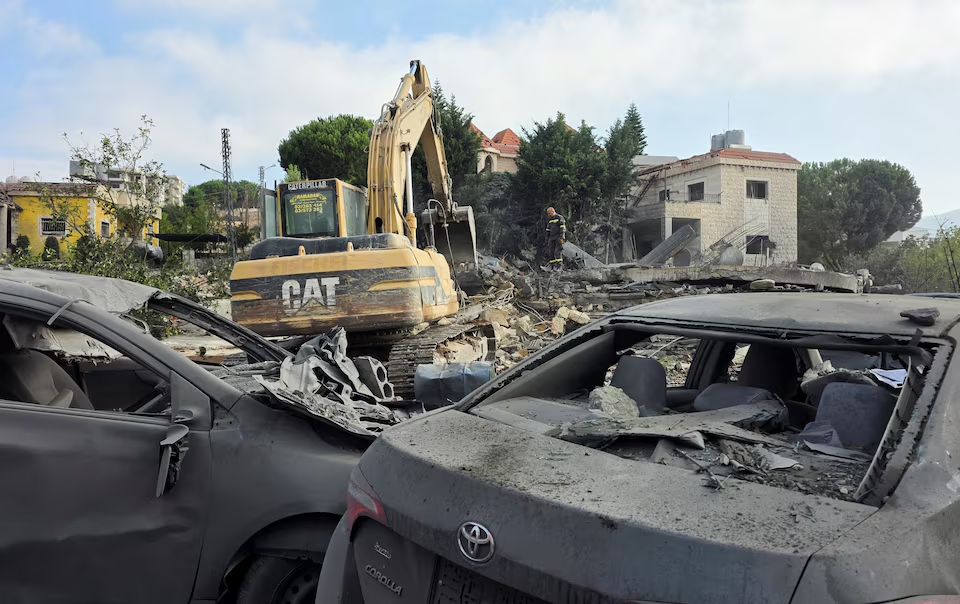
The ceasefire holding together Lebanon and Israel is looking more fragile by the day, and Monday’s developments made that painfully clear. Israeli strikes on the southern Lebanese town of Kfar Rumman killed at least 11 people early in the morning, including two children and two medics, according to Lebanon’s National News Agency. The attack came just a day after a separate round of Israeli strikes killed at least seven people across southern Lebanon on Sunday, and it’s pushed Lebanese President Joseph Aoun to make an increasingly urgent appeal to Washington for help stopping the violence before the truce collapses entirely.
Sunday’s strikes, which Aoun described as a dangerous escalation, specifically hit what he characterized as purely civilian administrations and health centers, a detail that has sharpened Lebanese officials’ frustration with how the conflict has been playing out under a ceasefire that was supposed to have ended large-scale hostilities months ago. In response, the Lebanese president’s office formally called on the United States and the broader international community to intervene and stop the attacks, a request that echoes appeals Aoun has made repeatedly since the truce took effect but that has taken on new urgency given how frequently the ceasefire keeps being tested.
The broader arithmetic of this conflict is sobering. Lebanon was pulled into the wider regional war back in March, when Hezbollah, the Iran-backed militant group, formally joined the fighting in support of its patron, triggering Israeli airstrikes and a full ground invasion. Since that escalation began, Lebanon says the conflict has killed at least 4,300 people and wounded more than 12,000, a toll that has continued climbing even after the June ceasefire was supposed to have brought the worst of the violence to a halt. Last month alone was described as the deadliest stretch since that truce took hold, with Israeli airstrikes killing at least 11 people and wounding 19 more in southern Lebanon during a single wave of attacks.
Israel’s justification for its continued strikes centers on what it describes as ongoing Hezbollah provocations. Following a drone attack that Israel says Hezbollah launched against its troops near a strategic ridge in southern Lebanon, Israeli forces responded by targeting what they identified as Hezbollah operatives and facilities, describing the group’s drone attack as a blatant violation of the ceasefire terms. Israel has also announced that it captured the Ali al-Taher ridge near Nabatieh, an area it considers part of a self-declared security zone extending roughly ten kilometers into Lebanese territory along the border. Lebanese security sources have told Reuters that Hezbollah is believed to have built an underground command center and weapons storage facilities within that ridge, which sits at an elevation that reportedly gave the group an advantage in launching short-range missiles and drones toward northern Israel, making it a logical, if contentious, target from Israel’s perspective.
The pattern of near-daily exchanges has continued even as both sides technically remain bound by the ceasefire framework brokered in June. On Monday, Israel’s military issued an evacuation warning for a building in Deir al-Zahrani ahead of a planned strike on what it identified as a Hezbollah facility, urging residents in and around the building to evacuate immediately and move at least 300 meters away. That warning was only the third of its kind issued since the ceasefire was announced, following an earlier evacuation order in early August and another issued the day before. The relative rarity of these formal warnings stands in contrast to strikes like the one that hit Kfar Rumman, which reportedly came without any evacuation notice at all, raising questions about consistency in how Israel is handling civilian safety protocols across different strikes.
President Aoun’s diplomatic strategy has increasingly focused on leveraging Lebanon’s relationship with Washington, which brokered both the original ceasefire and a subsequent framework agreement between Israel and Lebanon later in June. Aoun has pressed U.S. officials, including Secretary of State Marco Rubio, to ensure Israel actually adheres to the terms of that truce, while also pushing for Israel to withdraw from areas of Lebanese territory it continues to occupy. Beyond immediate de-escalation, Aoun has outlined a broader set of asks for Washington, including support in equipping the Lebanese army with supplies and equipment, and backing for an international conference dedicated to funding Lebanon’s reconstruction after months of sustained conflict. Those requests reflect a Lebanese government trying to balance two difficult priorities at once: containing an active security crisis while also laying groundwork for a longer-term stabilization effort that depends heavily on international goodwill and funding.
The stakes extend well beyond Lebanon’s borders. Israel’s continued operations in southern Lebanon are unfolding against the backdrop of a much larger and more volatile Middle East security picture, one that includes direct U.S.-Iran tensions, Red Sea shipping disruptions, and shifting alliances across the Gulf. Any collapse of the Lebanon-Israel ceasefire risks reigniting a broader regional conflict at a moment when several other flashpoints are already simmering, which is part of why Aoun’s appeals to Washington carry weight beyond Lebanon’s immediate security concerns. A durable ceasefire in Lebanon isn’t just a bilateral issue between Beirut and Tel Aviv; it’s one piece of a much larger regional stability puzzle that the U.S. has invested significant diplomatic capital in trying to hold together.
Whether Washington’s involvement can meaningfully change the trajectory of this conflict remains uncertain. The ceasefire has technically held since June in the sense that it hasn’t been formally abandoned by either side, but the near-constant drumbeat of strikes, evacuation warnings, and rising casualty counts suggests the agreement is functioning more as a loose set of guardrails than a genuine end to hostilities. For Lebanon, a country already grappling with severe economic strain and political fragility, the continued violence threatens to undermine reconstruction efforts before they can even properly begin. For more ongoing coverage of how Middle East conflicts continue to shape regional and global stability, readers can follow developments on Business Tech as this situation unfolds.