|
Getting your Trinity Audio player ready...
|
Zhejiang University Unveils Morphing Ring Drone With Aerial Grasping That Shrinks to Fly Through Narrow Gaps
Engineers at Zhejiang University have built a quadrotor that looks nothing like the drones most people are used to seeing. Instead of a central body with four arms stretching outward, the new machine is shaped like a ring, and it can pull itself smaller mid-flight to squeeze through openings that would stop a conventional drone cold. The project, called Ring-Rotor, comes out of the university’s Field Autonomous System and Computing Laboratory and was detailed in a paper on the preprint platform arXiv, where the team laid out how the design works and what it can already do in real-world testing.
The idea behind a shape-shifting drone is not new on its own. Robotics labs around the world have spent the past several years trying to solve the same basic problem: standard quadrotors are wide, and their width is exactly what keeps them out of the tight spaces where they would actually be useful, such as a gap in rubble after a building collapse, a crack in a wall during an inspection job, or a narrow corridor inside a warehouse. Most attempts at a solution have relied on folding arms, each one driven by its own motor, which adds weight, complexity, and more points of failure. The Zhejiang University team took a different route. Rather than bolting a folding mechanism onto a traditional cross-shaped frame, they threw out the cross shape altogether and built the drone around a ring.
That ring is made up of four segments linked end to end, and a single servo motor is enough to pull all four segments inward at once, shrinking the drone’s largest dimension by roughly 31 percent. Because the segments move together rather than independently, the whole system stays mechanically simple while still adjusting both the length and width of the aircraft at the same time. When there is open space to fly through, the ring expands back out to its full size, which keeps the drone more stable and lets it fly longer on a single charge. When the path narrows, it contracts to fit through.
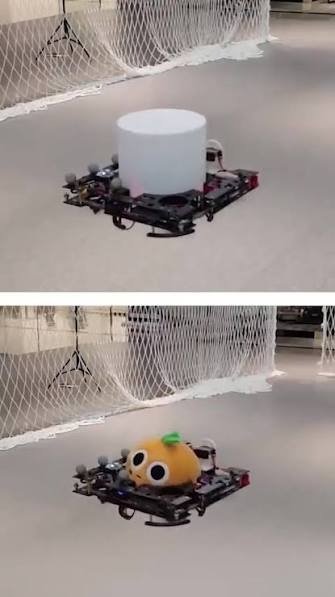
What makes the ring-shaped drone particularly interesting is not just how it shrinks, but what that shape frees up. On a normal quadrotor, the middle of the aircraft is packed with the flight controller, battery, and wiring, leaving no room to spare. By moving the rotors and structure out to the rim of a ring, the researchers opened up a hollow center that had never really existed on a drone before. Rather than leave that space empty, the team built it into a grasping and carrying system. The drone can lower itself around an object, close its ring slightly, and lift the item using its own body instead of a separate claw or robotic arm bolted underneath. In the experiments described in the paper, the aircraft was able to pick up and transport objects of different shapes this way, something that typically requires bulky add-on hardware and its own dedicated motors on other delivery-style drones.
Combining a shrinking frame with an aerial grasping function creates a control problem that does not exist on fixed-shape aircraft. Every time the ring contracts or expands, or grips an object, the drone’s mass, its center of gravity, and the way air moves around its frame all shift. A flight controller tuned for one configuration would struggle to keep the aircraft stable the moment its shape changes. To get around this, the researchers built a nonlinear model predictive control system that treats the drone’s physical parameters as variables rather than constants, continuously updating its model of the aircraft’s weight and balance as the ring moves. That let the team fly the drone through its full range of motion, from wide open to fully contracted and back, without it losing stability or requiring a human pilot to compensate.
The timing lines up with a broader shift happening across drone research. Government agencies and disaster relief organizations have been pushing hard for aircraft that can get into spaces search-and-rescue teams cannot reach on foot, and companies delivering packages in dense urban areas are running into the same wall: buildings, balconies, and loading docks are full of narrow openings that current delivery drones simply cannot pass through. A shape-shifting drone that can both shrink to fit a gap and carry a payload without extra hardware addresses two of the biggest limitations at once, rather than solving them with two separate systems bolted together.
There is still a gap between a working prototype published in a research paper and a drone that shows up on a construction site or in a delivery fleet. The Ring-Rotor design has been demonstrated indoors and in controlled real-world tests, but scaling the servo mechanism, hardening the frame for outdoor conditions, and proving it can operate reliably in wind and rain are the kind of steps that usually take years, not months. Battery life is another open question, since morphing structures and grasping mechanisms both draw additional power that a simpler airframe would not need.
Even so, the project is a useful signal of where drone hardware is heading. For most of the past decade, progress in consumer and commercial drones has come from smarter software, better cameras, and longer battery life bolted onto the same basic four-arm shape everyone recognizes. Ring-Rotor is part of a smaller but growing group of projects, including morphing-arm drones from labs in Europe and shape-changing aerial robots developed in Japan, that are instead rethinking the physical structure of the aircraft itself. Research groups at institutions such as Zhejiang University have increasingly focused on this kind of mechanical innovation alongside the artificial intelligence and control systems needed to make it fly safely.
Whether the ring-shaped approach becomes the next standard drone layout or stays a research curiosity will depend on how well it holds up outside a lab. For now, it stands out as one of the more inventive answers yet to a problem that has quietly limited drones since they first took to the air: getting through the gaps that matter most.